Tag Archives: Economic Reforms

Cuba closes once powerful sugar ministry

Marc Frank, Reuters
External Link: http://www.reuters.com/article/2011/09/29/food-cuba-sugar-idUSS1E78S0AG20110929

An Aerial View of What is Left of the Australia Sugar Mill, 2011

HAVANA, Sept 29 (Reuters) – Cuba is closing its once powerful Sugar Ministry in favor of a state holding company charged with pulling the sector out of a long decline, official media announced on Thursday.

A government communique said the decision was made at a  meeting of the Council of Ministers on Saturday. “The Council of Ministers, after an analysis of the sector, decided to close the Sugar Ministry as today it carries out no state functions,” it said.

President Raul Castro was quoted as stating the ministry would be replaced by holding company. Castro said 13 provincial companies   would belong to the new holding company with 61 mills, of which  five would close.

Plans to create the new sugar corporation and revitalize the industry by, among other things, allowing foreign investment and closing inefficient sugar mills were first reported by Reuters more than a year ago. The ministry’s demise is the last chapter in the dramatic decline of the sugar industry in a Caribbean island country where sugar was once king but now accounts for around 5 percent of foreign exchange earnings.

Cuba’s fall from once being the world’s biggest sugar exporter, producing 8 million tonnes of raw sugar annually, began with the  collapse of former benefactor the Soviet Union in 1991. Since then, the sector has declined relentlessly to 1.2 million tonnes. The country plans to produce 1.45 million tonnes during the harvest that gets underway in December.

Former Economy Minister Marino Murillo, recently promoted to lead economic reform efforts, said last year plans called for the industry to gradually increase production to around 2.5 million tonnes by 2015. Cuba itself consumes a minimum 600,000 tonnes of sugar annually and has a 400,000 tonne toll agreement with China.

In a painful 2002 downsizing of what was once the island’s flagship
sector, Cuba shut down and dismantled 71 of 156 mills, all 71 built well before the revolution, and relegated 60 percent of sugar plantation land to other uses.

More than 200,000 of the industry’s 400,000 workers were moved to other employment and many rural sugar towns were left stagnating, their closed mills marking the skyline. More mills have closed since then. Only 1.7 million acres (700,000 hectares) of the more than 5 million acres (2 million hectares) once controlled by Cuba’s sugar ministry are currently dedicated to sugar cane.

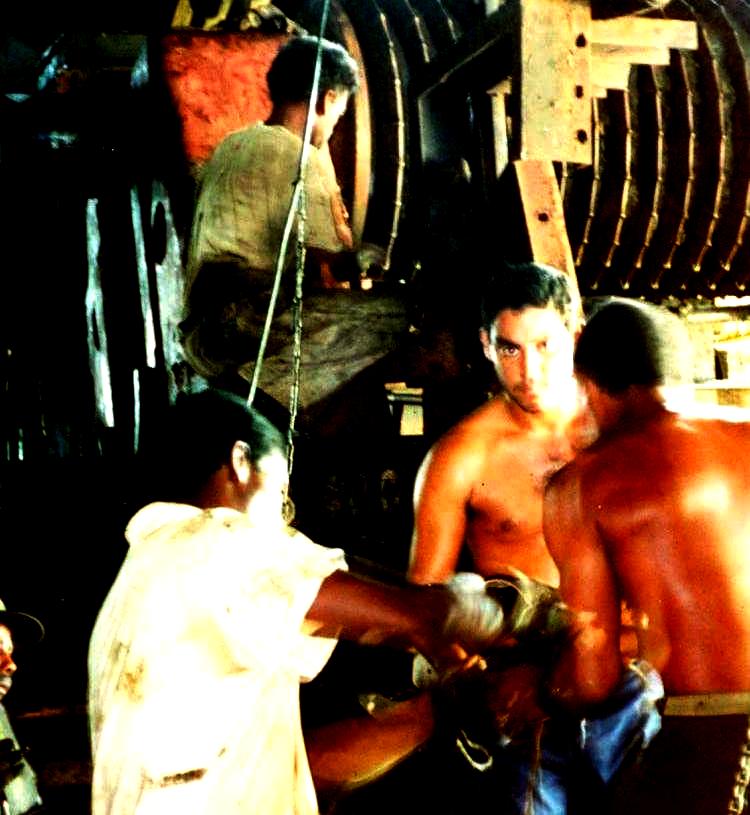
Repairs Inside the Australia Sugar Mill, November 1994

Posted in Blog | Tagged , , , | Leave a comment

POLITICAL ECONOMY OF CHANGE IN CUBA

A three-day international symposium held under the auspices of the Bildner Center at City University of New York. and spearheaded by its Director Mauricio Font, was held in March 2011. It was entitled Cuba Futures: Past and Present, and focused on the dynamics of change in contemporary Cuba—the politics, culture, economy.

A selection of the papers on the Cuban economy have been published on the web by the Bildner Centre.  The are all hyperlinked here: Political Economy of Change in Cuba, Bildner Center, CUNY New York. A Table of Contents is presented below. Of special interest are the essays by the analysts from the Centro de Estudios sobre la Economia Cubana, Armando Nova, Camila Piñeiro, Pavel Vidal Alejandro and Omar Everleny Pérez .

Table of Contents

Preface                                                                                                                                   xi

1 La actualización del modelo económico cubano, Omar Everleny Pérez Villanueva

2 Forecasting Cuba’s Economy: 2, 5, and 20 Years, Emily Morris*    10

3 Las restricciones de divisas en la economía cubana, 2010, Pavel Vidal Alejandro 19

4 New Forms of Enterprise in Cuba’s Changing Economy, Camila Piñeiro Harnecker    43

5 Valoración del impacto de las medidas más recientes en los resultados de la agricultura en Cuba, Armando Nova González     63

6 Las nuevas transformaciones en la agricultura cubana: éxitos y desafíos, Reynaldo Jiménez Guethón           81

7 Cuba y el turismo norteamericano. Analisis de potencialidades y de impactos en la región caribeña, Gerardo González Núñez and Roberto Orro Fernández         9

78 Tourism in Cuba: Barriers to Economic Growth and Development Hilary Becker     117

9 Cuba: A Services-Centered Survival and Development Pattern, Alberto Gabriele        133

10 Theoretical Foundations of a Future Privatization in Cuba: The Property and Ownership Paradigm, Frank-Christian Hansel   155

11 Globalization and the Socialist Multinational: Cuba and ALBA’s Grannacional Projects at the Intersection of Business and Human Rights, Larry Catá Backer         183

Posted in Blog | Tagged , , , , , , , , , | Leave a comment

“The Economist” on Taxes in Cuba: Get used to it

The Castros’ subjects get acquainted with that other sure thing

Sep 17th 2011 | HAVANA | from the print edition

Half your monies are belong to us

WHEN Raúl Castro, Cuba’s president, announced last year that the government would cut its payroll by up to 20% and promote self-employment, state media hailed the birth of a “tax culture”. As most Cubans had never paid income tax, the Communist newspaper published a guide to the concept. Government economists predicted a 400% increase in tax revenue from individuals.

The experiment has been bumpy. Last October Cuba published a tax code for workers in its 181 newly authorised occupations, ranging from furniture repairer to professional clown. As in the early 1990s, the last time Cuba tried economic liberalisation and taxation, the rates were punitive: 10% on turnover, 25% for social security and up to 50% on income. Such levies discouraged some people from risking self-employment. By May applications for job licences were tailing off.

Moreover, Mr Castro failed to beef up the National Tax Administration Office (ONAT), which was soon overwhelmed by filings. That has delayed revenue collection, and allowed both intentional and inadvertent tax cheats to go unpunished. “They seem even more confused about this than we are,” says Ernesto, an engineer who obtained a licence to set up a plumbing business in March. He admits that he simply guesses how much he has earned each month and declares a tenth as much.

But Mr Castro seems more flexible than his brother and predecessor Fidel, who blamed the self-employed for sowing inequality and happily taxed private firms out of existence. Eager to find jobs for up to 1m public workers he plans to fire, he has carved out exemptions from the social-security tax and twice increased the scope for deductions. He has also ordered ONAT to retrain its staff and hire new inspectors. “There certainly is an element of making up the rules as they go along,” says one European diplomat based in Havana. “But Raúl seems totally determined to make this work.”

Further reforms are on the way. By the end of 2011, Cubans will be allowed to buy and sell homes and cars. It remains to be seen how long they will accept taxation without representation. “They happily take our taxes,” says Michel, a barber who recently founded a business. “But they still keep their secrets.”

Posted in Blog | Tagged , , , , | Leave a comment

G. B. Hagelberg, Analyst and Friend of Cuba. His Last Work: ¨Cuban Agriculture: Limping Reforms, Lame Results”

By Arch Ritter

Cubans and friends of Cuba will lament the recent death of G.B. Hagelberg, a long time and highly respected analyst of Cuban agriculture, most notably the sugar sector. Hagelberg had a deep and long term knowledge of the sugar agro-industrial complex in the Caribbean generally including Cuba, having served as the resident sugar adviser of the government of Barbados from 1960 to 1968 and from 1980 to 1986. He was the author of numerous publications, including a book-length study entitled  The Caribbean Sugar Industries: Constraints and Opportunities (1974). More recently his work focused more on Cuban agriculture and he authored a variety of works in this area. His last analysis. referred to here, was originally entitled “Cuban Agriculture: Limping Reforms, Lame Results”. but was re-labelled “Agriculture: Policy and Performance”. It was presented at the  Association for the Study of the Cuban Economy (ASCE) Conference in August 2011.

Some central conclusions of this last work are presented below and the complete essay can be found here, courtesy of ASCE and especially Joaquin Pujol. It will be generally available on ASCE’s Website for the 2011 Conference soon.

The complete text can be found at this hyper-link:

Hagelberg ASCE 2011, AGRICULTURAL POLICY AND PERFORMANCE

Hagelberg’s Concluding Comments:

Analysts can thank Raúl Castro for a semblance of glasnost. Ironically, it reveals the limits of his perestroika. That enterprise is running the danger of unraveling under the weight of its internal contradictions. If this is not to happen, the realization has to gain ground that “concentration of ownership” (Article 3) is as undesirable in the public as in the private sector of the economy and that competition is the mother of efficiency. Non-functional state monopolies and monopsonies have to be dismantled. Also to be unpicked is the conflation of centralization and planning, a fantasy nowhere more counterproductive than in agriculture. To succeed, farm and agroindustrial policies must be informed by a thorough understanding of the conditions that make these sectors different from other economic activities. Regulation is obviously necessary in such areas as environmental protection, food safety and the prevention of market abuse. But to thrive, Cuba’s agriculture and agroindustry require the government to shift decisively from a controlling to an enabling mode, attending to rural infrastructure investment, research and extension, the reduction of risk from natural causes, financing, and the provision of timely and reliable information.

*********************

In a speech to the National Assembly in July 2008, Raúl Castro returned to his oft-quoted 1994 statement that “beans are more important than cannons.” Over 2007-10, the four calendar years in which he has led the government, bean production averaged 96,400 metric tons annually, against an average of 109,175 tons in the previous four years (ONE, 2011a, Table 1.6). Men who have spent a lifetime running the armed forces may believe that making farm policy is not rocket science. It is surely at least that. After all, a centrally managed economy was first to send a man into space; across the world, the track record of centrally managed economies in agriculture has been less glorious. The measures introduced to boost the home-grown food supply and reduce the need for imports have still to pass the beans test, and Cuba’s agricultural malaise rumbles on.

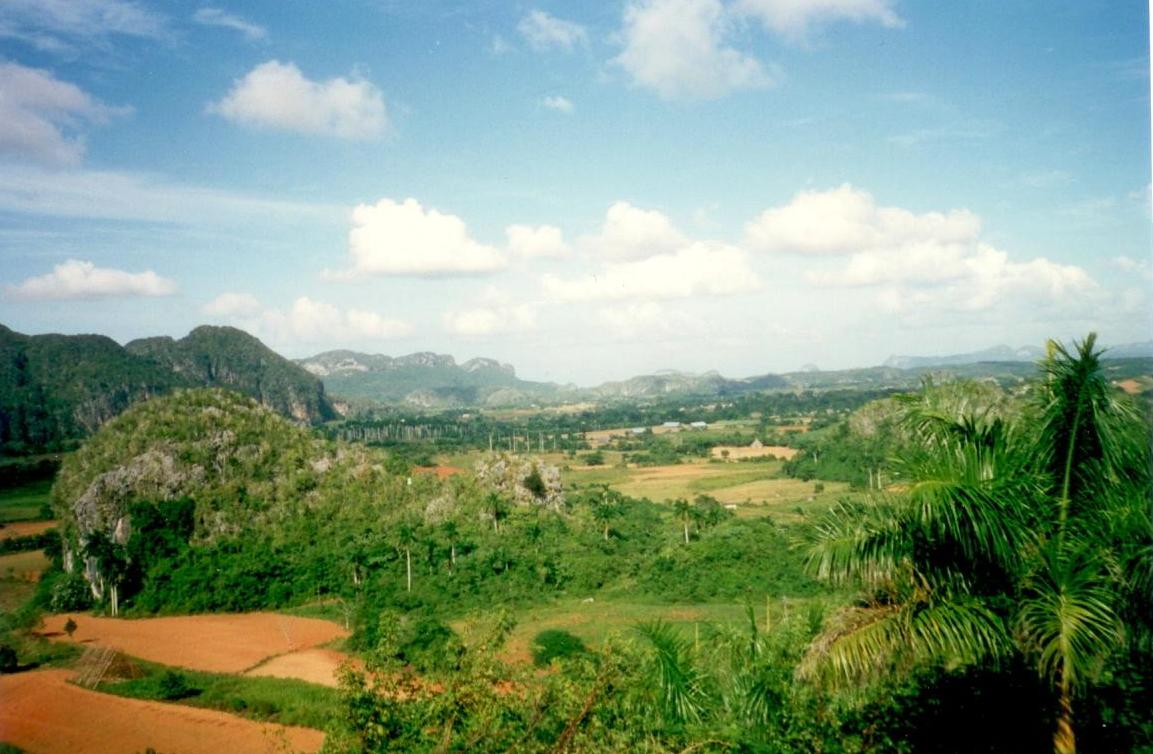
Agricultural Scene, Vinales, 1997

Posted in Blog | Tagged , , , | 1 Comment

NUEVA EDICIÓN DE LA REVISTA ESPACIO LAICAL

The July-September 2011 edition of La Revista Espacio Laical has just been published.  Its primary focus is on an evaluation of the results of the VI Congress of the Communist party of Cuba.Included also is an interview with Phil Peters, author of the Blog The Cuban Triangle and Carlos Saladrigas.Unfortunately it is available only in Spanish.

Here is a full Table of Contents together with Abstracts of some of the Economics Essays with hyper-links.

Table of Contents:

Índice General
Secciones y artículos:

EDITORIAL : El reto de ser audaces  – Del Magisterio.

RELIGIÓN
– Contemplarán al que traspasaron.  Por Sandro Magister

– La contemplación de la belleza.  Por Joseph Ratzinger

PÁGINAS RESCATADASA cargo de Jorge Domingo Cuadriello
– El patriotismo cubano. Por Eliseo Giberga

EL DOSSIER: Post VI Congreso PCC
– El VI Congreso del Partido y los Lineamientos: ¿un punto de vi raje para Cuba?  Por Archibald Ritter
– El VI Congreso: una evaluación preliminar.  Por Armando Chaguaceda.
– Cuba: ¿qué cambia tras el VI Congreso del Partido Comunista?  Por Carmelo Mesa-Lago.
– Cambios en marcha y consensos por lograr.  Por José Ramón Vidal
– Tratando de reinventar el socialismo. (Entrevista a Ricardo Alarcón). Por Manuel Alberto Ramy
– Reformas económic as y desarrollo en el Este de Asia: ¿una experiencia para Cuba? Por Arturo López-Levy

INTERNACIONALES

– La apuesta egipcia. Entrevista a Antonios Naguip. Por Gianni Valente
– Mi vida para la libertad de Chile. Entrevista a Sergio Bitar. Por Roberto Veiga González

BÚSQUEDA:

– Cuba y su diáspora: el desafío de facilitar un reencuentro.  Por Carlos Saladrigas

– Poder  e ineptitud en el exilio de Miami. Por Alejandro Armengol

CUBA
– Vivir como vecinos. Entrevista a Philip Peters. Por Roberto Veiga González

– Aportando para el diálogo y el consenso.  Entrevista a Roberto Veiga González.  Por Armando Chaguaceda

TEMA POLÉMICO

– Saladrigas, Arboleya y el debate sobre el futuro de Cuba.  Por Lenier González Mederos

CULTURA

– Re-señas de libros. Por Jorge Domingo Cuadriello

– Elogio y digresión.  Por David Mateo

– Aspera ad Astra o el itinerario espiritual de un líder político. Por Habey Hechavarría Prado

– José María Chacón y Calvo. Por Malena Balboa Pereira

– Cambiar o no cambiar: ¿es ese el dilema? Por Francisco Almagro Domínguez

– Harold Bloom y yo. Por Roberto González Echeverría

ESPIRITUALIDAD

– En busca de una transformación relevante. Por Raúl Fornet-Betancourt

DE LAS ENTRAÑAS DE LA ISLA

– Cuba en su diversidad cultural. Por Jesús Guanche

EN DIÁLOGO

– El lugar de la ciudadanía. Participación política  y República en Cuba.  Por Julio César Guanche

LA POLÉMICA

– Las propuestas de Carlos Saladrigas para Cuba. Por Jesús Arboleya Cervera

– Comentarios sobre la entrevista a Saladrigas y las opiniones de Arboleya. Por Ramón de la Cruz Ochoa

– Saladrigas y el debate con Ramón de la Cruz. Por Jesús Arboleya Cervera

– Soberanía nacional, emigrados e inversionistas Por Arturo López-Levy

Abstracts

El VI Congreso del Partido y los Lineamientos: ¿un punto de viraje para Cuba? Por Archibald Ritter

El VI Congreso del Partido Comunista de Cuba (PCC) probablemente será de gran importancia para el futuro de Cuba. La revisión que el Congreso hizo de los Lineamientos de la Política Económica y Social del Partido y la Revolución significa que ahora es políticamente correcto apoyar, promover e implementar esta ambiciosa agenda de reformas. Por deducción, es también políticamente correcto llegar a la conclusión de que medio siglo de experimentación económica estuvo en su mayor parte equivocada, y fue contraproducente e insostenible. A pesar de los intentos de crear una impresión de continuidad histórica con la referencia a una “actualización” del modelo económico, los viejos enfoques de gestión económica han quedado profundamente desacreditados. El Congreso ha certificado el clima creado por los cambios de opinión acerca de cómo puede funcionar mejor la economía cubana. Ahora parece que es altamente improbable un regreso a los viejos modos de operar.
(leer más…)


El VI Congreso: una evaluación preliminar. Por Armando Chaguaceda
Pocos eventos han generado tantas esperanzas, frustraciones y debates como el pasado VI Congreso del Partido Comunista de Cuba. La postergación del mismo por 14 años y el trasfondo político del país (continuación de la crisis estructural del modelo socialista de Estado, inicio de reformas económicas e institucionales, relevo de liderazgo) fueron caldo de cultivo para las más variadas especulaciones. Por ello, al cierre inmediato de sus cortinas, diferentes analistas compartieron sus plurales evaluaciones del foro, tributando al necesario balance de sus resultados en cuyo seno se inserta el presente texto. (leer más…)


Cuba: ¿qué cambia tras el VI Congreso del Partido Comunista? Por Carmelo Mesa-Lago
En abril de 2011 se realizó el VI Congreso del Partido Comunista de Cuba (pcc), después de 14 años sin celebrar ese tipo de reuniones. El Congreso estuvo marcado por las ambiciosas reformas que Raúl Castro se propuso como meta tras reemplazar a su hermano Fidel Castro en 2006. No obstante, las contradicciones, las indecisiones, las inercias y las resistencias del aparato burocrático siembran dudas acerca de la eficacia de los cambios aprobados por el Congreso para sacar al país de la profunda crisis económica que enfrenta y recuperar unas fuerzas agotadas. (leer más…)


Cambios en marcha y consensos por lograr. Por José Ramón Vidal
Las sesiones del VI Congreso del Partido Comunista de Cuba, celebradas en abril último, cerraron una etapa de formulación y consulta de propuestas dirigidas a producir transformaciones en el modelo económico y social, que como es lógico suponer tienen y tendrán en lo adelante inevitables repercusiones en la esfera política. (leer más…)


Tratando de reinventar el socialismo. (Entrevista a Ricardo Alarcón). Por Manuel Alberto Ramy
Hace apenas 48 horas concluyó el VI Congreso del Partido Comunista de Cuba, un congreso que, según lo que he leído y escuchado, prefigura un país cualitativamente distinto y una sociedad diferente. El presidente de la Asamblea Nacional y miembro del Buró Político del Partido Comunista, Ricardo Alarcón, me ha concedido esta entrevista. Sé que dispone de poco tiempo así que me gustaría hacerle tres preguntas muy concretas. La primera está referida al ámbito del Poder Popular.(leer más…)


– Reformas económicas y desarrollo en el Este de Asia: ¿una experiencia para Cuba? Por Arturo López-Levy
Al discutir los cambios planteados en los Lineamientos económicos y sociales del VI Congreso del Partido Comunista de Cuba, muchos observadores han evocado las reformas en el Este de Asia, particularmente los procesos ocurridos en China y Vietnam. El contexto cultural, económico y social cubano es diferente al de estas naciones; sin embargo, conviene plantearse si hay lecciones de aquellas experiencias que Cuba pueden adaptar. (leer más…)


Posted in Blog | Tagged , , , , , | Leave a comment

Centro de Estudios sobre la Economía Cubana, “Seminario Anual sobre la Economía Cubana” 21-24 de junio de 2011

 The Centro de Estudios sobre la Economia Cubana has just completed and publicized its 2011 Annual Report on the Cuban economy. Here are hyperlinks to the main economics articles. A number of essays focussing on enterprise management have not been included here.

Juan Triana Cordoví, “Cuba 2010-2011, del crecimiento posible al desarrollo necessario

Jorge Mario Sánchez Egozcue, “La Relación Crecimiento Económico y Sector Externo, una evaluación de la dinámica

Pavel Vidal Alejandro y Omar Everleny Pérez Villanueva, “Relanzamiento del cuentapropismo en medio del ajuste estructural1
 
Ileana Díaz Fernández y Ricardo Torres Pérez, “Los encadenamientos productivos, un análisis para Cuba


Posted in Blog | Tagged , , , , , , , | Leave a comment

Iglesia formará expertos en pequeñas empresas y cooperativas en Cuba (AFP)

Espacio Laical has just announced a new Masters’ Program in Business Management for micro, small and mediaum enterprises and cooperatives. It will be run bythe Centro Cultural Padre Félix Varela, of the Archdiocise of Havana and the Universidad Católica San Antonio,  Murcia, Spain.

The Convocatoria is presented below, together with a commentary from Agence France Presse.

Presumably Espacio Laical, the Centro Felix Varela and the Archdiocise of Havana have all the necessary permissions to proceed. if this is indeed the case, it represents a break of the state monopoly of higher education and the emergence of independent University level graduate programs. This could be of major significance for Cuba, representing a further loosening of state controls in professional education.

Convocatoria

Suplemento Digital No.134 / Junio  2011
Convocatoria, Maestria sobre Dirección de EmpresasEspacio Laical

El Centro Cultural Padre Félix Varela, de la Arquidiócesis de La Habana, y la Universidad Católica San Antonio, de Murcia, convocan a un Máster sobre Dirección de Empresas (MDE). La maestría, de modalidad semipresencial, tiene entre sus objetivos conseguir que el egresado adquiera habilidades y conocimientos avanzados en dirección de empresas; con un enfoque especial en pymes, micro-pymes y cooperativas. Contará con un claustro de profesores españoles y cubanos.
El MDE sesionará desde septiembre de 2011 hasta junio de 2012 y estará estructurado en siete materias:

  1. ENTORNO ECONÓMICO
  2. MARKETING
  3. ORGANIZACIÓN DE LA PRODUCCIÓN
  4. COMPORTAMIENTO ORGANIZACIONAL
  5. ECONOMÍA FINANCIERA Y CONTABILIDAD
  6. ESTRATEGIA Y EMPRESA
  7. SISTEMA TRIBUTARIO DE LA EMPRESA

Requisitos para los candidatos:

  • Podrán participar personas con título universitario.
  • Deberán entregar un currículum detallado, así como una fundamentación del por qué quieren cursar el MDE.
  • En la primera página del documento se colocará una ficha con nombre y apellidos del aspirante, lugar de residencia, dirección y teléfono, especialidad de la que es graduado y labor que desempeña actualmente.
  • Deberán adjuntar fotocopia del título.
  • Los documentos podrán ser entregados en la sede del Centro Cultural Padre Félix Varela (antiguo Seminario San Carlos y San Ambrosio), en La Habana Vieja , de lunes a viernes, de 9:00 AM a 12:00 M.
  • El plazo de admisión para los interesados vence el 20 de julio de 2011.
  • Del total de aspirantes los coordinadores del MDE escogerán a 40 personas.
  • El 28 de julio se hará pública la relación de personas seleccionadas.

..

Iglesia formará expertos en pequeñas empresas y cooperativas en Cuba, Agence France Presse, 23 June 2011.

La Iglesia Católica convocó este jueves a universitarios cubanos a una maestría sobre dirección de pequeñas y medianas empresas (Pymes) y cooperativas, contempladas en las reformas que impulsa el presidente Raúl Castro.

La maestría “tiene entre sus objetivos conseguir que el egresado adquiera habilidades y conocimientos avanzados en dirección de empresas; con un enfoque especial en Pymes, Micropymes y cooperativas”, dijo la convocatoria publicada en la versión digital de la revista Espacio Laical.

El curso, para el cual se escogerán 40 personas entre los candidatos, está convocado por el Centro Cultural Padre Félix Varela, de la Arquidiócesis de La Habana, y la Universidad Católica San Antonio, de Murcia, España. Contará con profesores españoles y cubanos y se extenderá desde septiembre de 2011 hasta junio de 2012.

Las más de 300 reformas de Raúl Castro, aprobadas por el VI Congreso del Partido Comunista en abril (PCC, único), ampliaron el trabajo privado y abrieron las puertas para la formación de Pymes y cooperativas urbanas de producción y servicios.

Ahora el Gobierno se concentra en la elaboración y aprobación del sustento legal de esas empresas no estatales, pues en 1968, cuando la denominada “Ofensiva Revolucionaria”, fueron eliminadas.

La Iglesia Católica, que sostiene un inédito diálogo con el Gobierno desde mayo de 2010, cuyo resultado más importante fue la excarcelación de 126 políticos, ocupa cada vez más espacio en la sociedad cubana.

Ese proceso de acercamiento, iniciado tras la visita papal en 1998, ha ido superando cuatro décadas de relaciones ondulantes, con tiempos de fuertes tensiones y cohabitaciones, sobre todo desde la llegada de Raúl Castro al poder en 2006, tras una crisis de salud de su hermano, Fidel Castro.


Posted in Blog | Tagged , , , , | Leave a comment

Similar Policies, Different Outcomes: Two Decades of Economic Reforms in North Korea and Cuba

An interesting comparison of Cuba and North Korea has just been published by Dr. José Luis León-Manríquez, a professor of international studies at the Department of Politics and Culture of the Metropolitan Autonomous University-Xochimilco, in Mexico City. It is available here:

Similar Policies, Different Outcomes, Two Decades of Economic Reforms in North Korea and Cuba

Introduction: “This article is aimed at analyzing, in a comparative perspective, the economic reforms undertaken by Democratic People’s Republic of Korea (DPRK, or North Korea) and Cuba since the demise of the Soviet bloc in the late 1980s and the early 1990s.1 The comparison seems pertinent inasmuch as both the DPRK and Cuba are relatively small countries that managed to survive the collapse of real socialism. Although the geographic areas of both countries are roughly the same, the North Korean population is more than double Cuba’s; by contrast, the Cuban GDP per capita is four times bigger than the DPRK’s individual income (Figure 1). Both countries have been ruled by single parties and have undertaken successful dynastic successions, and both countries have tried to maintain, with increasing tribulations, economic systems that advocate central planning and state property.”

Posted in Blog | Tagged , , | 1 Comment

Espacio Laical, “The Sixth Party Congress and “Lineamientos”: A Turning Point for Cuba?”

Just Published on Espacio Laical, Suplemento Digital No.132 / 16 de Junio 2011
Tomado de la sección Búsqueda (revista 3-2011) Hyperlink here:

The Sixth Congress of the Cuba’s Communist Party will likely be of immense importance for Cuba’s future. The ratification of the revised Lineamientos de la Política Económica y Social del Partido y la Revolución “by the National Assembly means that it is now politically correct to support, advocate and implement an ambitious reform agenda.  By implication, it also is politically correct to draw the conclusion that a half century of economic experimentation with the lives of Cuban citizens was for the most part misguided, counterproductive, and unsustainable.  Despite attempts to create an impression of historical continuity by referring to the “updating” of the economic model, the old approaches to economic management have been deeply discredited. The shifting climate of opinion regarding how the Cuban economy can best function has been certified as reasonable by the National Assembly.  It now appears that a regression to old modes of economic operation is now highly improbable..

The economic future for Cuba clearly lies in a newly-rebalanced albeit vaguely-envisaged mixed market economy that will be the outcome of the various reforms that are slated to be implemented.  This is a surprising reversal of fortunes. It also constitutes a vindication of the some of the views of the critics of past economic policies.

The “Lineamientos” represent an attempt by President Raul Castro to forge his own “legacy” and to emerge from the long shadow of his brother, as well as to set the Cuban economy on a new course. The ratification of the reform agenda represents a successful launch of the “legacy” project.  President Raul Castro would indeed make a unique and valuable contribution to Cuba and its citizens were he to move Cuba definitively through dialogue and agreement among all Cubans towards a model that guarantees both economic and social rights as well as civil liberties and authentic democracy.

Are moves in these directions likely to happen? Not under current political circumstances. However, there are bottom-up pressures building and some official suggestions that movement towards political liberalization is not impossible. In the meantime, Raul’s de-centralizing, de-bureaucratizing and “market-liberalizing” reforms been launched. This is a good start for the construction of a positive independent “legacy.”

I. Cuba’s Economic Situation

In various speeches since 2006, Raul Castro has indicated that he recognizes the problems that Cuba confronts in terms of the production of agricultural and industrial goods and improvement of Cuba’s infrastructure (despite the ostensibly solid GDP performance from 2005 to 2009 before Cuba was hit by the international recession.) He is well aware of the central causal forces underlying weak Cuba’s economic vulnerabilities and weaknesses such as the unbalanced structure of the economy, the overburden of deadening rules and regulations and a sclerotic bureaucracy and the monetary and exchange rate pathologies and dysfunctional incentive environment that deform the energies and lives of Cuban citizens.

Cuba’s economic plight can be summarized quickly with a couple of illustrations. First, Cuba’s underwent  serious de-industrialization after 1989 from which it has not recovered, reaching only about 51% of the 1989 level by 2009 (Chart 1)
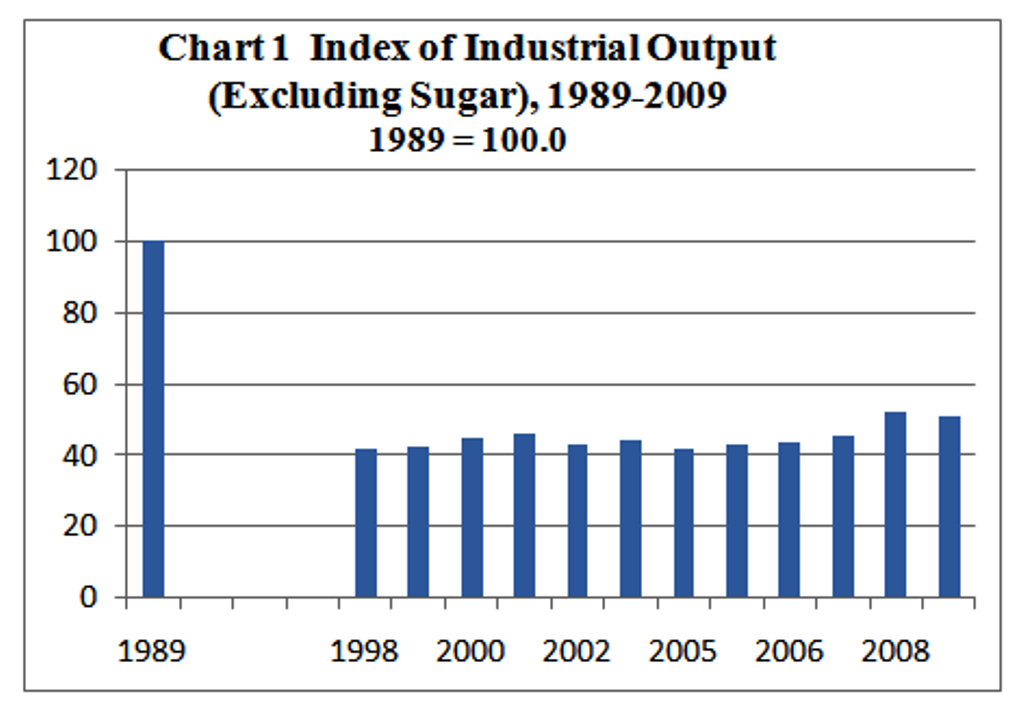
Source: ONE AEC, 2004, Table 11.1 and 2IX.1

Note: Data for 1990-1997 are not available

There are a variety of reasons for the collapse of the industrial sctor:

(a)    The antiquated technological inheritance from the Soviet era as of 1989;

(b)   Insufficient maintenance over a number of decades before and after 1989;

(c)    The 1989-1993economic melt-down;

(d)   Insufficient levels of investment; (The overall level of investment in Cuba in 2008 was 10.5% of GDP compared to 20.6% for all of Latin America  according to UN ECLA, 2011, Table A-4.)

(e)    The dual monetary and exchange rate system that penalizes potential exporters that would receive one old (Moneda Nacional) peso for each US dollar earned from exports;

(f)    Competition in Cuba’s domestic market with China which has had a grossly undervalued exchange rate, coexisting with Cuba’s grossly overvalued exchange rate.

Second, the collapse of the sugar agro-industrial complex is well known and is illustrated in Chart 2. The sugar sector essentially was a “cash cow” milked to death for its foreign exchange earnings, by insufficient maintenance, by insufficient re-investment preventing productivity improvement, and by the exchange rate regime under which it labored.
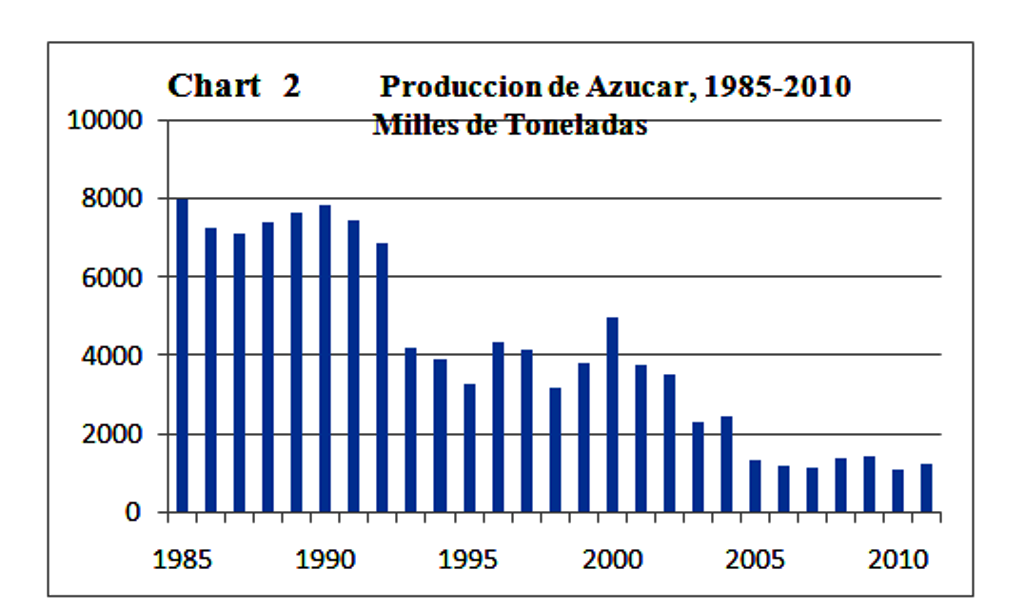
Source: NU CEPAL, 2000 Cuadro A.86; ONE, 2010 Table 11.4

The consequences of the collapse of the sugar sector include the loss of about US$ 3.5 billion in foreign exchange earnings foregone (generated largely with domestic value added); reductions in co-produced electricity; a large increase in idled farm land; a destruction of the capacity to produce ethanol; damaging regional and local development impacts, and a destruction of much of the “cluster” of input-providing, output-processing and marketing activities related to sugar.

Third, the production of food for domestic consumption has been weak since 1989, despite some successes in urban agriculture.  Food imports have increased steadily and in recent years account for an estimated 75 to 80% of domestic food consumption despite large amounts of unused farm land. Meanwhile agricultural exports have languished,


Chart 3  Cuban Exports and Imports of Foodstuffs, 1989-2009
(excluding Tobacco and Alcoholic Beverages) (Millions CUP)
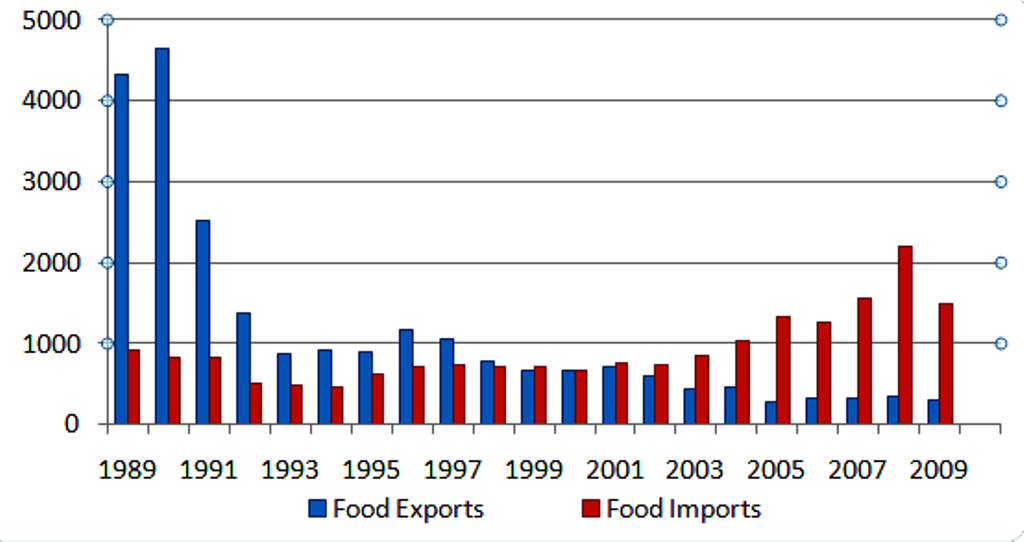
Source: NU CEPAL, 2000 Tables A.36 and A.37, and ONE, AEC, Various Years.

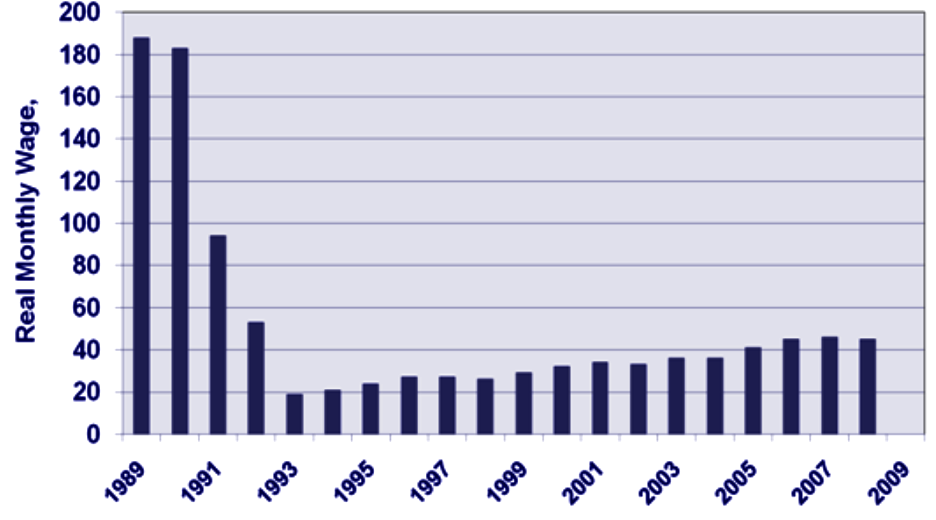
Fourthly, “inflation-adjusted “ or “real” wages in the official economy collapsed and have not recovered significantly according to estimates from the Centro de Estudios sobre la Economia Cubana (Chart 4.)  This is indeed a major calamity for the official state economy. But though the official 2008 wage rate remained around 25% of its level of 1989, most people had other sources of income, such as remittances, legal self-employment, home produced goods and services, economic activities in the underground economy, income supplements in joint ventures, goods in kind from the state and widespread pilferage.  Those without other sources of income are in poverty.

Chart 4   Cuba: Real Inflation-Adjusted Wages, 1989-2009
(
Pesos, Moneda Nacional)

Vidal  Alejandro, Pavel, “Politica Monetaria y Doble Moneda”, in Omar Everleny Perez et. al., Miradas a la Economia Cubana, La Habana: Editorial Caminos, 2009
Furthermore, despite the exceedingly low official rates of unemployment – around 1.6 to 1.7%, (far below the “natural rate” of unemployment which represents normal new entrants, job-changers and structural changes in any economy) – underemployment is obviously very high. Presumably the 1.8 million workers considered by the Government to be redundant and subject to probable lay-off and transfer to small enterprise, are “underemployed”, accounting for around 35 per cent of the labor force.

A further dimension of the fragility of Cuba’s economic situation is the dependence on the special relationship with Venezuela that relies upon high oil prices and the presence and munificence of President Chavez.

It is to the credit of President Raul Castro that he has faced these problems directly, diagnosed their sources, and produced the “Lineamientos” to deal with them. The central sources of the difficulties are the general structure of incentives that orients the economic activities of Cuban citizens, this including the dual monetary and exchange rate system, the tight containment of individual economic initiatives, the detailed rules and regulations of the omnipresent bureaucracy. Paradoxically, in attempting to control everything in the past, the government has ended up controlling very little. The effectiveness of stricter state controls actually leads to weaker genuine control due to their promotion of illegalities, corruption and the ubiquitous violation of unrealistic regulations.

II. The Lineamientos

The objective of the “Lineamientos” is “to guarantee the continuity and irreversibility of Socialism” as well as economic development (p.10). This is to be achieved through an “up-dating” of the economic model that should result in utilization of idle lands, reversal of decapitalization of infrastructure and industry, a restructuring of employment, increased labor productivity, increased and diversified exports, decentralized decision-making and elimination of monetary and exchange rate dualism (p. 8.)

But the term “Socialism” remains somewhat ambiguous in the document.  Reference is made to “socialist property” and “preserving the conquests of the Revolution.”  Especially interesting is the statement that

“…socialism signifies equality of rights and equality of opportunities for all the citizens, not egalitarianism” (p.9)

This assertion could be of game-changing significance, as it articulates a fundamental principle of “Social Democracy” more so that a traditional principle of  “Socialism.”  This leaves questions unanswered and doors unclosed.

The “Lineamientos” are in effect an ambitions and comprehensive “wish-list” or statement of aspirations. Many of the 313 recommendations are fairly obvious, trite and general statements of reasonable economic management. Some statements have been made repeatedly over a number of decades, including those relating to the expansion and diversification of exports, science and technology policy, the sugar agro-industrial complex, or the development of by-products and derivatives from the sugar industry (an objective at least since 1950.) Restating many of these as guidelines can’t do much harm, but certainly does not guarantee their implementation.

There are also opaque elements among the guidelines and seeming contradictions as some of them stress continuity of state planning and control while others emphasize greater autonomy for enterprises.  For example, Guideline 7 emphasizes how “planning” will include non-state forms of enterprise and “new methods…. of state control of the economy” while No. 62 states “The centralized character …of the degree of planning of the prices of products and services, which the state has an interest in regulating will be maintained.” But numerous other guidelines spell out the greater powers that state and non-state enterprises will have over a wide range of their activities including pricing (Guidelines 8 to 22 and 63.)

While there are a few gaps and shortcomings in the “Lineamientos” as well as the references to planning and state control, they include some deep-cutting proposals on various aspects of economic organization and policy that represent the inauguration of a movement towards a “market-friendly” economic policy environment. Among these are:

  • Greater autonomy of the enterprise in numerous dimensions, hiring and firing, wage structures, financing, price setting, investing, and also in facing bankruptcy;
  • A phase-out of rationing and the ration book and the more careful targeting of social assistance to those who need it, thereby also strengthening incentives to work (No. 162);
  • The establishment of wholesale markets for inputs for all types of enterprise. (No. 9);
  • Continuing distribution of unused state lands to small farmers (No. 187);
  • Reduction of state controls regarding small farmers and cooperatives regarding producer decision-making, marketing of crops, provision of inputs, and (No. 178-184)

A central policy thrust is the expansion of the self-employment and cooperative sector in order to absorb ultimately some 1,800.000 state workers considered redundant. The legislation already implemented in October 2010 liberalized policy somewhat so as to encourage the establishment of additional microenterprises – especially by the liberalization of licensing, the establishment of wholesale markets for inputs and the recent relaxation of hiring restrictions. However, the limitations of the policy changes are highlighted by the modest increase in the number of “Paladar” chairs – from 12 to 20.

Unfortunately current restrictions will prevent the expected expansion of the sector. These include the heavy taxation that can exceed 100% of net earnings (after costs are deducted from revenues)  for enterprises with high costs of production; the prohibition of the use of intermediaries and advertising, and continued petty restrictions. Perhaps most serious restriction is that all types of enterprises that are not specifically permitted are prohibited including virtually all professional activities.  The 176 permitted activities, some defined very narrowly, contrast with the  “Yellow Pages” of the telephone directory for Ottawa (half the size of Havana) that includes 883 varieties of activities, with 192 varieties for “Business Services”, 176 for “Home and Garden, 64 for “Automotive”  and 29 for “Computer and Internet Services.” Presumably policies towards micro-and small enterprise will be further liberalized in the months ahead if laid-off workers are to be absorbed productively.

One short-coming of the “Lineamientos” is the lack a time dimension and a depiction of how the various changes will be implemented. There are no clear priorities among the innumerable guidelines, no sequences of actions, and no apparent coordination of the guidelines from the standpoint of their implementation. It remains a “check-list” of good intentions, though none-the-less valuable.

The absence of a vision of how change was to occur and the slow pace of the adoption of the reforms so far is also worrisome. However, the Administration of Raul Castro has been deliberative and systematic though also cautious. It is probable that somewhere in the government of Raul Castro there is a continually evolving time-line and master-plan for the implementation of the reform measures.

A careful and well-researched approach to economic reform is obviously desirable. The difficulties encountered in laying off 500,000 state sector workers and re-absorbing them in the small-enterprise sector by March 31, 2011 has probably encouraged an even more cautious  “go-slow” approach.  Perhaps “slow and steady wins the race!”

A process of economic —but not political— reform seems to have already begun following the Congress. Where it will lead is hard to predict. Presumably Raúl Castro’s regime would like the process to end with the political status quo plus a healthy economy. The latter would require a new balance between public and private sectors, with a controlled movement toward the market mechanism in price determination and the shaping of economic structures, and with the construction of a rational configuration of incentives shaping citizens’ daily economic actions so that their private endeavors become compatible with Cuba’s broader economic well-being.

In such a reform process many things would be changing simultaneously with symbiotic impacts and consequences that will likely be painful and are difficult to foresee. Will President Raul Castro have the courage to take the risks inherent in an ambitious process of economic change? This remains to be seen. But the economic and political consequences of inaction are so bleak and the attractiveness of a positive historical “legacy” are so enticing that President Raul Castro will continue.

The economic reform process has been launched. It is in its early stages. It will likely continue under the leadership of Raul Castro. It will proceed far beyond the “Lineamientos” under new generations of Cuban citizens in economic as well as political spheres.

Bibliography

Naciones Unidas, CEPAL, La Economia Cubana: Reformas estructurales y desempeňo en los noventa, Santiago, Chile, 2000, Second Edition.

Oficina Nacional de Estadisticas (ONE), Anuario Estadistico de Cuba (AEC), various years. Website: http://www.one.cu/

Partido Comunista de Cuba,  Lineamientos de la Política Económica y Social del Partido y la Revolución, Aprobado el 18 de abril de 2011, VI Congreso del PCC

United nations, Economic Commission for Latin America and the Caribbean, Preliminary Overview of the Economies of Latin America and the Caribbean, 2010, Santiago, Chile January, 2011

Vidal Alejandro, Pavel, “Politica Monetaria y Doble Moneda”, in Omar Everleny Perez et. al., Miradas a la Economia Cubana, La Habana: Editorial Caminos, 2009

Posted in Blog | Tagged , , , , , , , , , | 3 Comments

Mark Frank: “Higher prices luring more farmers in Cuba”

*Sugar ministry providing free services to new farmers

*Land lease program prioritizes sector

HAVANA, June 2 (Reuters) – More Cuban farmers are opting to grow sugar cane due to higher prices and other incentives being offered by the Sugar Ministry as part of plans to revive the depressed crop, industry sources said this week.

Sugar may no longer be king on the Caribbean island where it once accounted for 90 percent of export earnings with 7 to 8 million tonne harvests, and today brings in only 5 percent of foreign currency.

But with international prices expected to remain high, the cash-strapped government is showing a new interest in the sector.

“The ministry is clearing and plowing land, providing seed and some other services to individuals who lease fallow state acreage under a government program begun in 2008,” a local sugar expert said, asking his name not be used due to a prohibition on talking with foreign journalists.

“Mills have more than doubled what they pay for cane to 100 pesos per tonne (US$4.00),” he added.

The expert said the price remained too low, but free start-up services put sugar at an advantage over other crops where new farmers were expected to clear and bring land into production with little, if any, government support.

To date, the agriculture ministry has granted 128,000 leases covering 1.2 million hectares (2.9 million acres), with another 700,000 hectares (1.7 million acres) being offered.

The government is expected to liberalize the program this month by expanding the acreage an individual can farm, significantly extending the 10 year lease, and allowing homes and other structures to be built on the land, among other measures.

Output was around 1.2 million tonnes of raw sugar this year, slightly higher than the 1.1 million tonne 2010 season, but still one of the poorest performances on record.

The state owned industry hopes to increase production to 2.4 million tonnes by 2015.

“The agriculture ministry is prioritizing cane and pointing out its advantages when people come in seeking land,” one industry insider said, adding thousands of new farmers were opting to grow sugar and existing ones to switch over or add it, without being more specific.

“Acreage earmarked for sugar cane is 974,000 hectares (2.4 million acres), of which 450,000 hectares (1.1 million acres) were in production this season,” he said.

Cuba consumes an average 700,000 tonnes of sugar annually; however last year consumption was around 600,000 tonnes due to a reduction in the domestic ration and other measures.

Assuming similar local consumption this year, the industry would be offering around 200,000 tonnes on the market after meeting its 400,000 tonne toll agreement with China.

Ministry officials have said this year’s output was 7 percent above plan, with industry sources reporting at least two extra shipments, totaling 80,000 tonnes, contracted. (Editing by John Picinich)

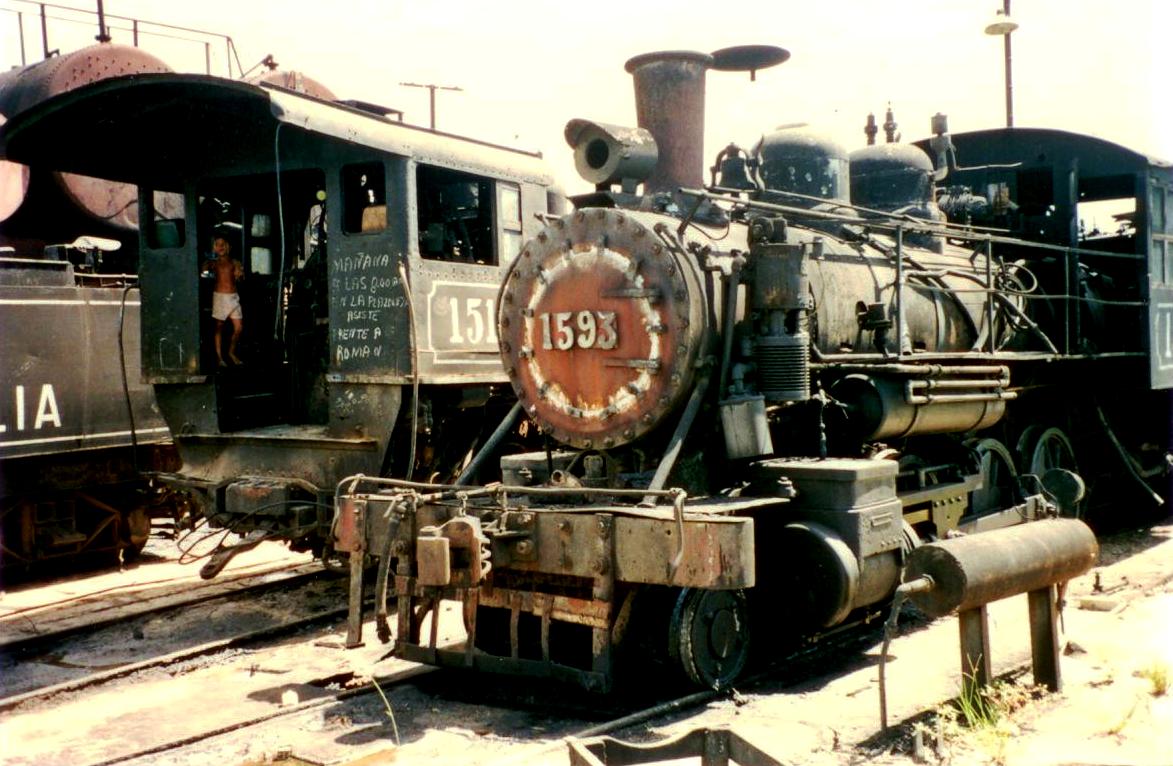
Transportation  at the Australia Sugar Mill, November 1994, Photo by A. Ritter

Posted in Blog | Tagged , , | Leave a comment