Tag Archives: Special Period

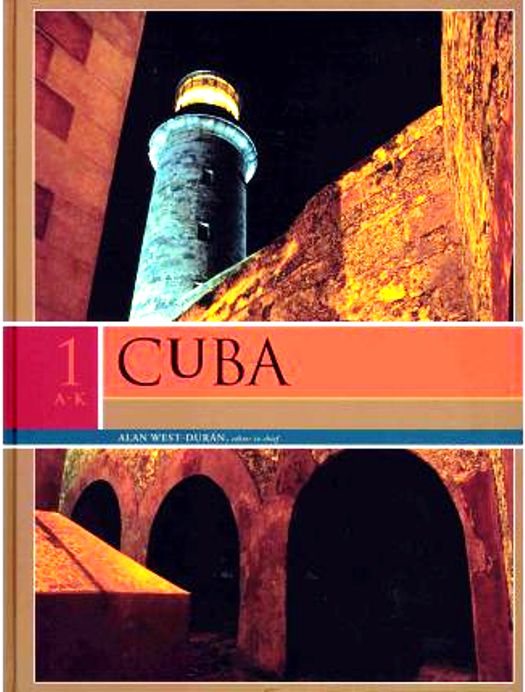
New Publication, CUBA: PEOPLE, CULTURE, HISTORY

A near-encyclopedic volume on Cuba was recently published by Charles Scribner’s Sons but has received surprisingly limited publicity- at least from my perspective up here in winter-time in the True North. I have not yet seen the volume myself nor have I even seen the Table of Contents. However, the description of the substance of the volume below looks interesting.

If my finances were infinite, I would certainly buy a copy, even though the price ranges from $284.44 to $454.95, depending on the seller.

I contributed two essays on the Cuban economy. These are available here:

Archibald Ritter  “The Cuban Economy, Revolution, 1959-1990″

Archibald Ritter, “Cuba’s Economy During the Special Period, 1990-2010″

Here is a brief description of the volume:

Editor in Chief: Alan West-Durán, Northeastern University

 Associate Editors: Victor Fowler Calzada, Unión de Escritores y Artistas de Cuba (UNEAC); Gladys E. García Pérez, Unión de Escritores y Artistas de Cuba (UNEAC); Louis A Pérez, Jr., University of North Carolina; César Salgado, University of Texas; Maria de los Angeles Torres, University of Illinois, Chicago

Charles Scribner’s Sons,  An Imprint of Gale, Cengage Learning 2011

 INTRODUCTION

In an exceedingly complex and changing global situation,  understanding Cuba is an important and challenging task. The Scribner CUBA: People, Culture, History is a reference work that goes beyond a mere presentation of facts, biographies, and “ready reference” information, which is widely available on the Internet, to offer deep interpretation. The book will offer on the one hand, twenty-one interpretative essays on major topics in Cuban history, culture and society, as well as over one hundred twenty-five shorter essays on artistic, literary, and nonfiction works; major events and places of cultural significance.

The major essays will not only cover Economics, Sugar, Tobacco, Religion, and Food, but also Cuba and its Diasporas, Ecology and Environment, Sexuality, Gender, Race and Ethnicity, the Arts, Language, Sports and Cuban Ways of Knowing and Being, among others.

The short essays will focus on specific literary works, photographs, paintings, political documents, speeches, testimonies, historical dates, key places and cities on the island and abroad. For example:  literary works include “Los Versos sencillos”; “Paradiso”; and “The Mambo Kings Play Songs of Love”; works of nonfiction include: “Cuba: Azúcar y Población”; “Indagación del choteo”; and La historia me absolverá”; works of visual art: “La Jungla”; and “Los Hijos del agua conversando con un pez”; works of music: “Guantanamera”; “Misa cubana”; and “Mambo #5”; cinema: “Lucía”; and “Fresa y chocolate”; events: “Violence and Insurrection in 1912: A Racial Conflict”; and “January 1, 1959”; and places of cultural significance: “Baracoa”; “Holguín”; “Isla de Pinos”; “Spain”; and “New York,” to name a few examples.

By combining longer overview pieces with short and focused descriptive and analytical ones, CUBA  aims to give the curious and interested reader a way to comprehend the country by presenting the major forces that have shaped the island historically and culturally. Rather than overwhelm the reader with thousands of entries and biographies, CUBA offers a close look at major themes that are emblematic to the country’s unique history. CUBA is a reference guide for readers undertaking a journey of comprehension; it is not a work that presumes to have all of the answers.

Posted in Blog | Tagged , , , , , , , , | Leave a comment

Can Cuba Recover from its De-Industrialization? I. Characteristics and Causes

By Arch Ritter

[Note: a subsequent Blog Entry will analyze “Consequences and Courses of Action” ]

Since 1989, Cuba has experienced a disastrous de-industrialization from which it has not recovered. The causes of the collapse are complex and multi-dimensional. Is it likely that the policy proposals of the Lineamientos approved at the VI Congress of the Communist Party of Cuba will lead to a recovery from this collapse? What can be done to reverse this situation?

One of the last Cane-Harvesting Machines Fabricated in Cuba, en route to its Destination, November 1994

Perhaps it should be noted to begin with that the  manufacturing sector of many if not most high income countries have shrunk as a proportion of GDP and especially in terms employment. This has been due to the migration of  labor-intense manufacturing to lower wage countries, most notably China and India, as well as technological change and rising labor productivity in many areas of manufacturing. However, given Cuba’s income levels and its historical record, it could and should be expanding its manufacturing base and perhaps even increasing employment in the sector rather than remaining in melt-down phase

I. Characteristics of Cuba’s De-Industrialization, 1989-2010

The accompanying Charts and Tables, all using data from Cuba’s Oficina Nacional de Estadisticas, indicate the severity of Cuba’s manufacturing situation.

Chart 1 illustrates the almost 60% decline in the physical volume of industrial output – excluding sugar – from 1989 to 1998. By the year 2010, the level of output was at 49.9% of the 1989 level. This does not constitute a recovery.

The physical volume of output by destination is presented in Appendix Table 11.2 below. This Table indicates industrial output including sugar in 2010 was at 43% of its 1989 volume. Products for Consumption were at 81.8% of their 1989 value in 2010. Some product areas had improved, namely manufactures for consumption and “other manufactures” but food drink and tobacco production were at 71.5% of their 1989 volume. Footwear and clothing were at 21.8% of their 1989 volume.  Equipment production had almost totally disappeared and was at 6.6% of their 1989 volume in 2010. Intermediate products were at 34.7% of their 1989 volume, despite a near 50% increase in volumes of mineral extraction. .

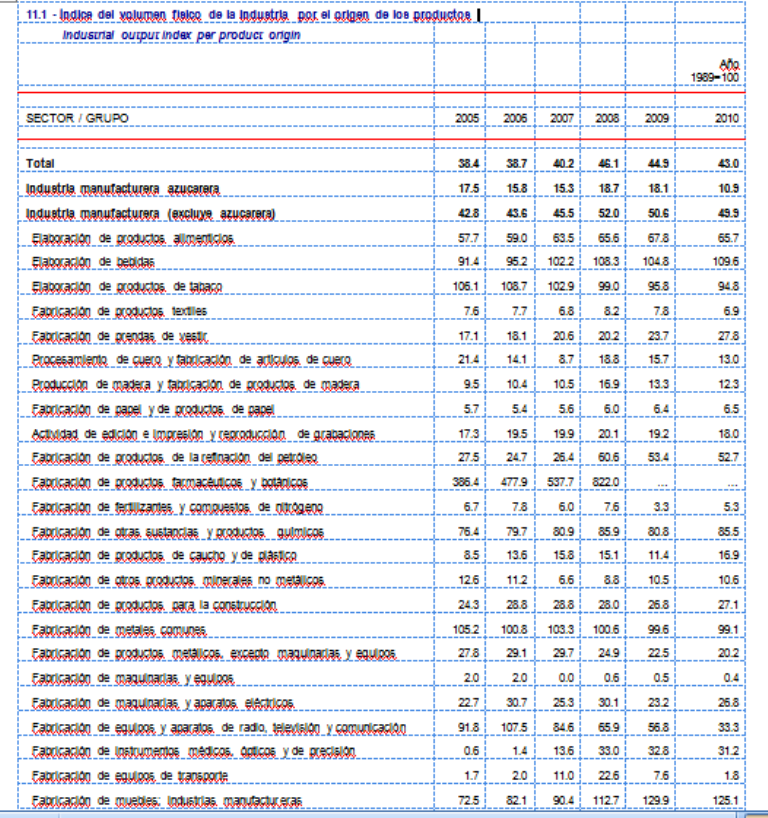
Volumes of industrial output by origin or industrial sub-sector are presented in Appendix in Table 11.1 Some manufacturing sub-sectors have virtually disappeared with production at very low levels as a percentage of 1989 levels. For example, for the following sectors, 2010 levels as a percentage of 1989 levels were as follows:

  • Textiles:                                     6.9%
  • Clothing:                                      27.8%
  • Paper and paper products:        6.5%
  • Publications and recordings:   18.0%
  • Wood products:                         12.3%
  • Construction Materials:           27.1%
  • Machinery and Equipment:      0.4%

On the other hand, pharmaceutical production increased dramatically, with 2008 production at 822% of the 1989 level. Tobacco, drinks (presumably alcoholic) and metal products were approximately at the 1989 levels. But almost everything else was around 25% of the levels of 1989 or less.

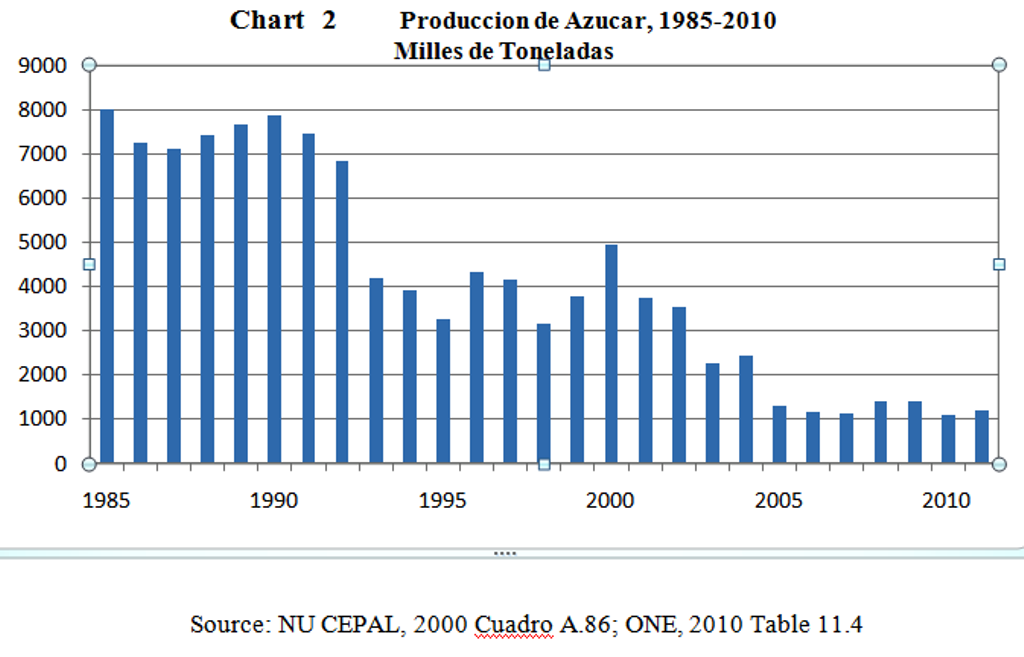
The collapse of the sugar agro-industrial complex is well known and is illustrated in Chart 2.

II. Causal factors

There are a variety of reasons for the collapse of the industrial sector.

1.      The initial factor was the ending of the special relationship with the Soviet Union that subsidized the Cuban economy generously for the previous 25 years or so. This resulted from the shifting of the Soviet Union to world prices in its trade relations with Cuba rather than the high prices for Cuba’s sugar exports as well as an end to the provision of credits to cover Cuba’s continuing trade deficits with the USSR. The break-up of the Soviet Union and recession in Eastern Europe also damaged Cuba’s exports. These factors reduced Cuba’s imports of all sorts, especially of imported inputs, replacement parts, and new machinery and equipment of all sorts.  The resulting economic melt-down of 1989-1993 reduced investment to disastrous levels and resulted in cannibalization of some plant and equipment for replacement parts. The end result was a severe incapacitation of the manufacturing sector.

2.      The technological inheritance from the Soviet era as of 1989 was also antiquated and uncompetitive, as Became painfully apparent after the opening up of the Soviet economy following Perestroika.

3.      Since 1989, levels of investment have been continuously insufficient. For example, the overall level of investment in Cuba in 2008 was 10.5% of GDP in comparison with 20.6% for all of Latin America, according to UN ECLA, (2011, Table A-4.)

4.      Maintenance and re-investment was also de-emphasized even before 1989. After 1989, maintenance and re-investment were a category of economic activity that could be postponed during the economic melt-down – for a little while. But over a longer period of time, lack of adequate maintenance of the capital stock has resulted in its serious deterioration or near destruction. This can be seen graphically by the casual observer with the dilapidated state of housing in Havana and indeed the frequent “derrumbes” or collapse of houses and abandoned urban areas.

5.      The dual monetary and exchange rate system penalizes traditional and potential new exporters that receive one old (Moneda Nacional) peso for each US dollar earned from exports – while the relevant rate for Cuban citizens is 26 old pesos to US$1.00. This makes it difficult if not impossible for some exporters and was a key contributor to the collapse of the sugar sector.

6.      The blockage of small enterprise for the last 50 years has also prevented entrepreneurial trial and error and the emergence of new manufacturing activities.

7.      Finally, China has played a major role in Cuba’s de-industrialization as it has done with other countries as well. China has major advantages in its manufacturing sector that have permitted its meteoric ascent as a manufacturing power house. These include

  • Low cost labor;
  • An industrious labor force;
  • Past and current emphases on human development and higher education;
  • A relatively new industrial capital stock;
  • Massive economies of scale;
  • Massive “agglomeration economies”;

But of particular significance has been its grossly undervalued exchange rate that has permitted it to incur continuing trade and current account surpluses and amass foreign assets now amounting to around US$ 3 trillion. Indeed, in my view, China has cheated  in the globalization process and captured the lion’s share of its benefits through manipulation of the exchange rate, and has contributed to the generation of major imbalances for the rest of the world, including both the United States and Cuba among other countries. .

China’s undervalued exchange rate has co-existed with Cuba’s grossly overvalued exchange rate that has been partly responsible for pricing potential Cuban exports of manufactures out of the international market. The result is that Cuba is awash with cheap Chinese products that have replaced consumer products that Cuba formerly – in the 1950s as well as the 1970s – produced for itself.

With respect to the sugar sector, there are a number of factors have been responsible for its decline.

1.      Most serious, the sector essentially was a “cash cow” milked to death for its foreign exchange earnings, by insufficient maintenance and by insufficient re-investment preventing productivity improvement.

2.      The monetary and exchange rate regimes under which it labored have also damaged it badly. Earning one “old peso” for each dollar of sugar exports has deprived the sugar sector of the revenues needed to sust4ain its operations.

3.      Finally the decision by former President Fidel Castro to shut down close to half the industrial capacity of the sector and try to convert former sugar lands to other uses sealed its fate.  In view of Cuba’s natural advantages in sugar cultivation, the sophistication and diversity of the whole sugar agro-industrial cluster of activities, the high sugar prices of  recent years and the competitiveness of ethanol derived from sugar cane, this decision was foolish in the extreme.

Next: Part II, The Consequences of Deindustrialization and Possible Future Courses of Action. will be published in the next Blog Entry

Posted in Blog, Featured | Tagged , , , , , , , | Leave a comment

(Español) Similar Policies, Different Outcomes: Two Decades of Economic Reforms in North Korea and Cuba

An interesting comparison of Cuba and North Korea has just been published by Dr. José Luis León-Manríquez, a professor of international studies at the Department of Politics and Culture of the Metropolitan Autonomous University-Xochimilco, in Mexico City. It is available here:

Similar Policies, Different Outcomes, Two Decades of Economic Reforms in North Korea and Cuba

Introduction: “This article is aimed at analyzing, in a comparative perspective, the economic reforms undertaken by Democratic People’s Republic of Korea (DPRK, or North Korea) and Cuba since the demise of the Soviet bloc in the late 1980s and the early 1990s.1 The comparison seems pertinent inasmuch as both the DPRK and Cuba are relatively small countries that managed to survive the collapse of real socialism. Although the geographic areas of both countries are roughly the same, the North Korean population is more than double Cuba’s; by contrast, the Cuban GDP per capita is four times bigger than the DPRK’s individual income (Figure 1). Both countries have been ruled by single parties and have undertaken successful dynastic successions, and both countries have tried to maintain, with increasing tribulations, economic systems that advocate central planning and state property.”

Posted in Blog | Tagged , , | 1 Comment

Special Revista TEMAS Panel on the “Special Period”

TEMAS, Ei Periodo Especial veinte anos despues

TEMAS: no. 65: 59-75, enero-marzo de 2011

http://www.temas.cult.cu/revistas/65/059%20Mesa.pdf

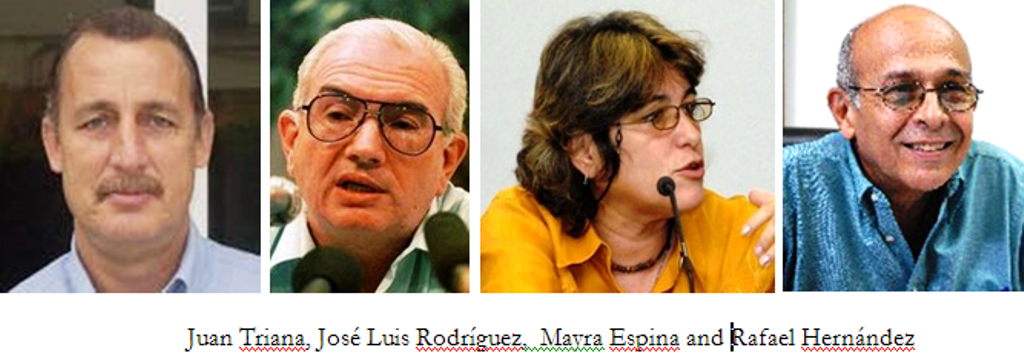
A special section of the TEMAS issue of January-March 2011 includes a Panel discussion on the causes, character and consequences of the “Special Period.” This still seems to be the epoch that Cuba is in officially, as there has been no official termination of the epoch nor a declaration of a new label for a new era. The panelists include Mayra Espina, sociologist ath the Centro de Investigaciones Psicológicas y Sociológicas (CIPS). José Luis Rodríguez, once again at the. Centro de Investigaciones de la Economía Mundial (CIEM) but formerly Minister of Finance and Planning,  Juan Triana, an economist at the. Centro de Estudios sobre la Economía Cubana (CEEC) and Rafael Hernández the Director de TEMAS

The questions addressed to the panel by Rafael Hernández include (in paraphrase):

1.      What was the character of the “Special Period” (SP)?

Were its causes essentially external?

Was it predominantly economic in character?

For how long has it continued?

2.      How effective were the policies implemented to deal with ot”

Were the policies based on scientific research?

Were the policies coherent and effective?

Were there unintended consequences?

To what extent did the policies succeed?

3.      Has the SP generated positive or progressive advances?

4.      Questions from the floor.


Posted in Blog | Tagged , | Leave a comment

English Version of Partido Comunista de Cuba, “Proyecto de Lineamientos de la Politica Economica y Social”: Viable Strategic Economic Re-Orientation and / or Wish List ?

A complete English translation of the “Lineamientos” has just been published by Walter Lippmann, the Editor-in-Chief of CubaNews , the free Yahoo news group on Cuba.

The “Draft Guide for Economic and Social Policy” for the Fifth Congress of the Communist Party is available here: http://www.walterlippmann.com/pcc-draft-economic-and-social-policy-guidelines-2010.html

What follows here is the Blog entry for November 11, 2010 on the “Guidelines”.

I. “Structural Adjustment” on a Major Scale

On Tuesday, November 9, a major document appeared for sale in Cuba entitled “Proyecto de Lineamientos de La Political Economica y Social” or “Draft Guide for Economic and Social Policy.”  The purpose of the “Guide’ presumably is to spark and to shape public discussion and education on the economic matters that will be the focus of the long-postponed Sixth Congress of the Cuban Communist Party to take place in April, 2011. It also provides the essentials of the new approach that will likely be adopted at the Sixth Congress.

It can be found in its entirety, courtesy of the Blog Caf Fuerte. (http://cafefuerte.com/, here: Projecto de Lineamientos de la Politica Economica y Social,

The “Guide” is a broad-reaching and comprehensive document that puts forward 291 propositions for the improvement of the functioning of the Cuban economy. It signals a break in the four years of near inaction that the Cuban economy endured since Raul Castro took over as acting and then actual President – and the ten years of paralysis from about 1995 to 2006 under President Fidel.  It amounts to a major process of “structural adjustment” of the sort that was begun in 1992-1994, but was then stalled when the Cuban economy appeared to rebound after 1994.  The document is also a contradiction and maybe a “slap-in-the-face” for Fidel Castro, as it indeed indicates that the Fidelista-style Cuban model – his life’s work – is not working. (See “Fidel’s No-Good Very Bad Day” and The “FIDEL” Models Never Worked; Soviet and Venezuelan Subsidization Did.)

II. General Character of the Proposals

The Table of Contents provides a quick idea of the scope of the document:

Introduction

Contours of Economic and Social Policy

I           Economic Management Model

II          Macroeconomic Policies

III        External Economic Policies

IV        Investment Policy

V         Science, Technology and Innovation Policy

VI        Social Policy

VII       Agroindustrial Policy

VIII     Industrial and Energy Policy ix

IX        Tourism Policy

X           Transport Policy

XI         Construction, Housing, and Hydraulic Resource Policy

xii        Commercial Policy.

The Introduction summarizes the basic objectives required to overcome the principal problems of the economy. These include putting into productive use the unused lands constituting almost 50% of total, raising agricultural yields, developing new mechanisms to reverse the process of industrial and infrastructural de-capitalization, eliminating excess and redundant employment, raising labor productivity, recovery of export capacity in traditional exports, undertake studies in order to eliminate monetary dualism, and provide improved capacities for more decentralized regional development.

The “Contour” section then states that “…only socialism is capable of overcoming the difficulties and preserving the conquests of the Revolution, and the implementation of the economic model prioritizes planification and not the market”. However, the next paragraph states “…socialism is equality of rights and equality of opportunity for all citizens, not egalitarianism.” The latter sounds less like “socialism” and more like “social democrat” if not the common approach of most Western countries. The latter quotation makes the former somewhat hard to interpret if not meaningless.

The document then goes on to list the 291 propositions under the 12 different headings. A few of the more interesting propositions are summarized below:

  • Wholesale markets for supplying state, cooperative and self-employment enterprises will be established. (9)
  • State enterprises will decide themselves how to allocate their investment funds, and normally will not receive budgetary support for this. (13)
  • Insolvent enterprises will face liquidation. (16)
  • Workers incomes in state enterprises will be linked to enterprise performance (# 19)
  • Monetary and exchange rate unification will be “advanced” (54)
  • The taxation system will be advanced in terms of progressivity and coverage, and will be based on generality and equity of its structure. (56 and 57)
  • The centralized character of the determination of the planned level and structure of prices will be maintained. (62)
  • Recover the place of work as the fundamental means of contributing to the development of society and the satisfaction of personal and family needs. (130)
  • Modify the structure of employment, reducing inflated staffing and increasing employment in the non-state sector (158-159)
  • Eliminate the ration book as a means of distributing products. (162)
  • Improve agriculture so that Cuba is no longer a net importer of food, prioritizing import substituting activities, reviving citrus fruit production, augmenting sugar production. (166, 174, 179, 194.)
  • Promote export-oriented industry (197)
  • Develop a range of new industries such as tires, construction materials and metallurgy (213, 215, 216)
  • Restructuring of domestic retailing and wholesaling. (283-291)

III. Preliminary Evaluation

This document will receive a great deal of attention inside and outside Cuba. It provides fodder – along with the recent legislation on self-employment – for analysts and observers of Cuba, who have had little of hard substance on which to base their analyses of Cuban policy under the “Raulista” Presidency for some time.

In some senses, this document is remarkable. It sets out an ambitious reform program for much of the Cuban economy. It may indeed constitute a “Wish List” of all the types of policy improvements and changes that would be nice to have. The question is “can and will they be implemented?”

This document also is a major risk for the Raul Castro Administration. It provides a check-list of tasks that will be difficult to achieve. If future implementation and economic performance is far below the expectations that are now being raised to high levels, there could well be a serious fall-out for the Government and the Party.

The document is also broad and ambitious but does not set any clear priorities and does not propose a sequence of actions. Everything can’t be done at once. How should the policy changes be phased or sequenced?

Some observers are skeptical and perhaps cynical regarding the “Guide” – for good historical reasons. In her Blog Entry entitled The Art of Speaking Without Speaking (http://www.desdecuba.com/generationy/?p=2088) Yoani Sanchez states:

When you grow up decoding each line that appears in the newspapers, you manage to find, among the rhetoric, the nugget of information that motivates, the hidden shreds of the news. We Cubans have become detectives of the unexpressed, experts in discarding the chatter and discovering — deep down — what is really driving things. The Draft Guidelines for the Communist Party’s VI Congress is a good exercise to sharpen our senses, a model example to evaluate the practice of speaking without speaking, which is what state discourse is here.

The Guide undoubtedly could be seen as an economic rescue program designed to rescue also the Communist party of Cuba, which faces steady de-legitimation as the economy deteriorates – even as the official GDP statistics appear to rise steadily.

What is missing from the “Guide”? Here is a first brief listing. Further analysis will be incorporated here later.

1.      Nothing is said regarding labor rights. A vital part of the reform approach if labor is to be used effectively would be freedom of association, collective bargaining and the right to strike. In the absence of these, pressures and insights from the grass roots to improve economic policy and its effectiveness are suppressed.

2.      Nothing is said regarding freedom of expression and the right to criticize the policies and institutions openly, honestly and continuously. The absence of this right leads to economic inefficiency and corruption as argued elsewhere. ( Freedom of Expression, Economic Self-Correction and Self-Renewal)

3.      No further elaboration of how the self-employment or micro-enterprise sector is presented, suggesting that the recent reforms are the end of the journey not a first step.

4.      The dedication to centralized determination of prices is problematic. If maintained strictly, it would make the decentralized decision-making allotted to enterprises for investment, the hiring of resource inputs, etc. meaningless, and the problems of trying to run the economy from a few office towers in Havana would continue.

Posted in Blog | Tagged , , , , , , , , , , | Leave a comment

CARMELO MESA-LAGO and PAVEL VIDAL-ALEJANDRO, “The Impact of the Global Crisis on Cuba’s Economy and Social Welfare”

Journal of Latin American Studies. 42, 689–717,  Cambridge University Press, 2010

Carmelo Mesa-Lago and Pavel Vidal have teamed up to produce a fine analysis of the impacts of the world recession of 2009-201o on Cuba,  its macro-economy and its social sectors.  It is certainly encouraging to see such cooperation in the economics discipline! The article can be found here: Pavel Vidal and Carmelo Mesa-Lago, Cuba economic social impact crisis-JLAS-11 (2)

Abstract.The mechanisms by which the world economic crisis has been transmitted from developed to developing economies are conditioned by domestic factors that may attenuate or accentuate external economic shocks and their adverse social effects. Cuba is a special case : it is an open economy and hence vulnerable to trade growth transmission mechanisms, but at the same time, it is a socialist economy with universal social services. This article reviews the literature, summarises Cuba’s domestic socio-economic strengths and weaknesses prior to the crisis, evaluates the effects of the crisis on the macro-economic and social services indicators, assesses the government response and suggests alternative socio-economic policies.

Carmelo Mesa-Lago


Pavel Vidal

Posted in Blog | Tagged , , , , , , , , , , , | Leave a comment

Carmelo Mesa-Lago: “Cincuenta años de servicios sociales en Cuba”

Carmelo Mesa-Lago. Professor Emeritus, University of Pittsburgh

Hyperlink: Revista TEMAS, no. 64: 45-56, octubre-diciembre de 2010

Revista Temas has published a valuable work by Carmelo Mesa-Lago analysing Cuba’s major social issues, namely health, education, pensions, and housing, and drawing on the work of various analysts from the Centro de Estudios sobre la Economia Cubana. Inclusion of Mesa-Lago’s work in Revista TEMAS is indeed encouraging in my view and contrasts with the situation some 25 years ago when he and other Cuban-American analysts were villified as “Cubanologos.”

Here is the Table of Contents for  followed by its concluding session. Unfortunately an English translation is not available right now.

Introducción

Evolución de los servicios sociales (1959-2000

Costo actual de los servicios sociales en Cuba

Un caso de estudio: el costo creciente de las pensiones

Capacidad económica para sostener los servicios sociales a largo plazo

Cambios necesarios para mejorar y hacer sustentables los servicios sociales

No es posible resolver los problemas que los costosos servicios sociales enfrentan sin un aumento de la producción, la productividad y las exportaciones que permitan, a su vez, reducir las importaciones. Pero para lograrlo, se necesita implementar las reformas estructurales anunciadas por el presidente Raúl Castro y recomendadas por numerosos economistas cubanos.

El tema de la sostenibilidad de los servicios sociales ha sido planteado por varios economistas cubanos. Viviana Togores y Anicia García consideran que

la crisis económica y el proceso de ajuste han mostrado que la preservación de los beneficios sociales debe transitar hacia una nueva etapa donde su sustentabilidad financiera quede asociada al desarrollo de la economía y los cambios estructurales y organizativos [necesarios] […] las decisiones de política social deben tomarse no solo teniendo en cuenta las funciones sociales, sino que debenrespetar los principios de equilibrio económico.34

Por ejemplo, la seguridad y asistencia socials agravan seriamente el déficit fiscal y su carga, hoy solo asumida por el Estado; debe ser compartida por otros contribuyentes (los trabajadores). Mayra Espina agrega:

El primer reto [de la renovación social] es el de la sustentabilidad económica de la política de desarrollo social [...] es necesario encontrar fórmulas de reinserción  de la economía cubana en los mercados internacionales que reactiven la producción interna y doten a los programas sociales de los recursos suficientes, sin los cuales siempre estarán enfrentados al déficit.35

Las decisiones cruciales sobre la economía y los servicios sociales competen a los cubanos. Pero a  diferencia de la crisis de los años 90, en que hubo una estrategia para hacerles frente, en la presente esta no se ha definido. El VI Congreso del PCC, anunciado inicialmente para fines de 2008, debe decidir los lineamientos económicos para el próximo quinquenio y también dictar las directrices en materia de servicios sociales. Habiendo dedicado cincuenta años de mi vida al estudio de este tema en toda América Latina, incluida  Cuba, hago unas sugerencias —parte de estas coinciden con las de economistas y académicos cubanos— como aporte para el debate. A mi juicio, sería posible aumentar el ingreso fiscal y reducir el gasto social, mediante mejoras en la asignación y uso de los recursos, con las medidas siguientes:

Educación: En la enseñanza elemental habría que transferir fondos hacia el pago de mejores sueldos a los maestros (en vista de la caída en la fecundidad y de la población en edad primaria) y, en la secundaria,  riorizar la educación vocacional. Respecto a la superior, Juan  Triana propone invertir más en las carreras técnicas y las que contribuyen al conocimiento, aunque son más costosas que las humanidades, la pedagogía y las ciencias sociales.36 Las carreras científicas son esenciales para el desarrollo, incluyendo la administración de negocios y la economía moderna, por lo que habría que transferor recursos de carreras no tan esenciales, imponiéndoles cuotas y estándares de ingreso más estrictos. Ya en 2008-2009 se estaba reduciendo la matrícula en medicina, humanidades y ciencias sociales, pero también en agronomía y ciencias técnicas.37 Además, habría que continuar y expandir las medidas recién iniciadas que  establecen exámenes de ingreso para la educación superior y requisitos más estrictos de admisión, lo cual ayudaría a aumentar la relación de graduados por matriculados; considerar el establecimiento de pago de matrículas en las universidades a los grupos de altos ingresos, y legalizar el trabajo por cuenta propia de los maestros y profesores.

Salud: Sería aconsejable priorizar la infraestructura de agua potable y alcantarillado,38 reasignar los recursos destinados a la continuada reducción de la mortalidad infantil (un problema resuelto hace años) hacia la reparación de la infraestructura deteriorada, la importación de medicinas, la disminución de la mortalidad materna y otras áreas de mayor necesidad; subordinar el número de profesionales de la salud que  trabajan en el extranjero a las necesidades internas, e invertir parte de los ingresos en divisas que generan sus servicios en la mejora de las instalaciones y equipos  internos y el suministro de medicinas; convertir  hospitales de  aternidad y pediatría que tienen bajas tasas de ocupación en hospitales geriátricos y asilos para ancianos; terminar las becas a estudiantes extranjeros y cobrar el costo básico de los servicios que hoy se regalan  a otros países; cargar el costo de cuartos privados al grupo de altos ingresos de la población cubana; autorizar el trabajo por cuenta propia del personal de salud y permitir la organización de cooperativas médicas.

Pensiones de seguridad social: Habría que realizar un studio que determine cuál es la cotización de  quilibrio del sistema; establecer cotizaciones a todos los trabajadores de empresas no estatales con un mínimo de empleados, incorporándolos al sistema; cargar a los trabajadores por cuenta propia y empleados en el sector  rivado el mismo 5% que paga parte de los asalariados (en lugar de 10% y 15%) para promover su afiliación; ajustar las pensiones al costo de la vida, lo que requiere, primero, aumentar la producción y la productividad y, a su vez, avanzar en las reformas estructurales. Medidas más complejas serían cerrar el actual sistema de pensiones, que el Estado se haga responsable de las pensiones en curso de pago, y crear un nuevo sistema público para los asegurados jóvenes y los nuevos trabajadores, con una reserva que se invierta para generar un retorno del capital y ayudar en el financiamiento a largo plazo y mejorar las pensiones.

Vivienda: Rafael Hernández argumenta que la ley originalmente estipuló que la vivienda es propiedad de los ciudadanos, y es lógico que ellos puedan hacer con ella lo que quieran, venderla y también comprarla; además, hay que facilitar que la gente pueda reparar y construir viviendas por medios propios.39 Habría que proporcionar a la población el acceso a materiales de construcción, y otorgar pequeños créditos estatales rembolsables con interés para la construcción y reparación de viviendas; permitir el uso de la casa propia como colateral para obtener  réstamos destinados a su reparación; posibilitar la inversión de remesas externas en esas actividades; eliminar el actual sistema de permutas y autorizar la compraventa con regulaciones adecuadas.

Asistencia social. Para reducir la pobreza, Lía Añé recomienda eliminar la dualidad monetaria,

disminuir la segmentación del mercado, mejorar los salaries más bajos, y consolidar y evaluar la efectividad de los nuevos programas sociales.40 Pedro Campos propone eliminar la libreta de racionamiento, previa concesión de subsidios directos focalizados en las personas de bajos ingresos, y un reajuste salarial para compensar el incremento de precios que ocurriría.41 Alexis Codina agrega que los cuantiosos recursos fiscales asignados a subsidios de precios por la libreta, recibidos por todos, independientemente de sus ingresos, deberían quedar solo para la población más vulnerable y el resto utilizaría el mercado.

En mi opinión, el sistema de racionamiento no debería aliminarse de golpe, pues o bien sería muy  costoso o dejaría parte de los necesitados sin protección. Lo ideal sería hacerlo gradualmente, de manera paralela a los incrementos en la producción y la productividad  que resulten de reformas estructurales, a la par que se focaliza la asistencia social en toda la población pobre y vulnerable, a fin de crear una amplia red mínima de protección. Ello requeriría mecanismos eficientes para determinar el grado de necesidad de la población y una estimación confiable de la incidencia de pobreza. También habría que permitir a iglesias y ONG que establezcan y expandan asilos gratuitos para ancianos pobres con ayuda externa directa.

La Revolución transformó los servicios socials —salvo la vivienda—,  universalizó su cobertura, eliminó desigualdades entre grupos de ingreso y zonas urbanas y rurales, y otorgó servicios gratuitos de calidad. Las crisis de los años 90 y la actual, unidas a deficiencias de las políticas económicas, han afectado severamente esos servicios y agravado su falta de sustentabilidad a largo plazo. Resulta crucial, por tanto, implementar  las reformas estructurales necesarias y los cambios en dichos servicios para restaurar su calidad y garantizarlos a las generaciones futuras.

.

Posted in Blog | Tagged , , , , , , , | Leave a comment

“Shifting Realities in ‘Special Period. Cuba”, LATIN AMERICAN RESEARCH REVIEW, volume 45 number 3, 2010

By Arch Ritter

Just Published: “Shifting Realities in ‘Special Period’ Cuba”

Archibald R. M. Ritter, Carleton University, Ottawa, Canada

Che’s Afterlife: The Legacy of an Image. By Michael Casey. New York: Vintage Books, 2009. Pp. 388. $15.95 paper. ISBN: 9780307279309.

The Cuba Wars: Fidel Castro, the United States, and the Next Revolution. By Daniel P. Erikson. New York: Bloomsbury Press, 2008. Pp. xiii + 352. $28.00 cloth. ISBN: 9781596914346.

Political Disaffection in Cuba’s Revolution and Exodus. By Sylvia Pedraza. Cambridge: Cambridge University Press, 2007. Pp. xix + 359. paper. ISBN: 9780521687294.

Looking Forward: Comparative Perspectives on Cuba’s Transition. Edited by Marifeli Pérez-Stable. Notre Dame, IN: University of Notre Dame Press, 2007. Pp. xx + 332. $27.00 paper. ISBN: 9780268038915.

Cuba in the Shadow of Change: Daily Life in the Twilight of the Revolution. By Amelia Rosenberg Weinreb. Gainesville: University Press of Florida, 2009. Pp. 272. $69.95 cloth. ISBN: 9780813033693.

Cuban Currency: The Dollar and Special Period Fiction. By Esther Whitfield. Minneapolis: University of Minnesota Press, 2008. Pp. 217. $22.50 paper. ISBN: 9780816650378.

Revolutionary Cuba’s Golden Age ended in 1988-1990 when the former Soviet Union adopted world prices in its trade with Cuba, ceased new lending, and discontinued its subsidization of the Cuban economy. The result was the economic meltdown of 1989-1994. In1992, President Fidel Castro labeled the new époque the “Special Period in Time of Peace,” a title that has lasted almost two decades as of 2010. Many outside observers have imagined that Cuba would in time follow the countries of Eastern Europe and the former Soviet Union in making a transition toward a more market-oriented economic system and perhaps a Western style of pluralistic democracy. This has not happened. The modest economic changes of the early1990s have not led to sustained reform. Political reform has been almost undetectable. At times, rapid change has seemed inevitable and imminent. But at others, it has appeared that gerontocratic paralysis might endure well into the 2010s. Change will undoubtedly occur, but its trajectory, timing, and character are difficult if not impossible to predict. When a process of transition does arrive, it will likely be unexpected, confused, and erratic, and will probably not fit the patterns of Eastern Europe, China, or Vietnam.

The books included in this review focus mainly on changing realities during the Special Period and the nature of prospective change. They constitute a valuable contribution to our understanding of a range of dimensions of Cuba’s existence in this era which in fact is not “special” but is instead the “real world”.

The collection edited by Marifeli Pérez-Stable assumes that a transition will occur and asks what useful insights may be gleaned from the experiences of other Latin, Eastern European, Asian, and Western European countries. The analyses included in the collection constitute the best exploration of the key aspects of Cuba’s possible alternative futures yet available. Then Daniel P. Erikson examines the U.S.-Cuban relationship together with domestic U.S. policies toward Cuba during the Special Period, concluding with a chapter on “The Next Revolution.” His popular historical analysis also is probably the best available as well as most readable review of this tragically dysfunctional relationship.

The culture of the silent majority or “shadow public” is the focus of Amelia Weinreb. This sociological-anthropological analysis of Cuba’s silent majority fills a major vacuum in works on Cuba over the last 20 years, focusing as it does on the character, aspirations and behavior of a group that has been almost ignored even though it probably constitutes a majority of the population of Cuba. Sylvia Pedraza examines Cuba’s evolving domestic political situation and the consequences for emigration over the last half century, including the two decades of the Special Period. Her work is probably the seminal analysis of the motivations underlying and patterns of Cuba’s continuing emigration hemorrhage.

Michael Casey examines how the Cuban government has capitalized on Che Guevara’s “brand”—epitomized by the iconic photograph by Alberto Korda—and how Che’s image has been commercialized for both political and financial motivations, using property and trademark law, and the marketing mechanisms of the international capitalist system. While perhaps outside the common purview of mainstream social science research on Cuba, Casey’s examination of the Korda-Che image provides a novel and convincing examination of how the Cuban political regime has sought to commercialize the central martyr of the Revolution. Finally, Esther Whitfield explores cultural and literary changes in Cuba’s world of fiction during the Special Period. Her work is also ground-breaking in examining the impacts of the economic realities of the two-currency pathology on the incentive structure and orientation of Cuban writers of fiction.

Marifeli Pérez-Stable has assembled an all-star cast of authors to produce yet another fine contribution to our understanding of Cuba and its current situation.[1] Looking Forward aims to investigate the alternatives facing Cuba after a possible regime change or “poof moment”—as Jorge Domínguez puts it (7 and 61) —when such change might occur, as if by magic. The authors were asked to examine their particular areas of expertise for insights from other democratizing processes, the particular relevance of the conditions of the Special Period, and the “plausible and/or desirable alternatives . . . for a Cuba in transition” (7). Given the concision and richness of the twelve essays in this book, it is difficult if not impossible to outline and critique them in the detail that each of them merits in a brief review. All are substantively first-rate.

In opening, Pérez-Stable assumes that “a medium-term democratic transition is likely in Cuba though not certain” (19). She explores first the transitions of Eastern and Central Europe and Latin America for insights into the Cuban case, and second, the possible roles in a post-Fidel Castro Cuba of the Communist Party, the National Assembly, and the Association of Combatants of the Cuban Revolution, Cuba’s veterans’ organization. Her central conclusion is that a hybrid regime is most probable, in which elements of marketization and some liberalization combine with continued authoritarianism.

In his examination of military-civil relations, Jorge Domínguez is reasonably optimistic that further downsizing of the Cuban military will occur with the normalization of U.S.-Cuban relations. He also argues that the military will be compatible with democratization under the last three of the four scenarios that he explores: 1. a dynastic succession with continued Communist Party monopoly and a market economy opening; 2. with removal of the external threat, the military could focus on internal security only; 3. the previous scenario, but with a stronger military to maintain public order in the face of serious domestic security threats; and 4. the second scenario again but with a major continuing role for professional armed forces for international peace-keeping. (61-70).

Gustavo Arnavat analyzes the legal and constitutional dimensions of moving toward representative democracy and a market economy, and argues that major constitutional amendments or a new constitution approved by referendum will be necessary.

Damián Fernández presents a thought-provoking and sobering analysis of the role of civil society, emphasizing the difficulty of political reengagement and the development of attitudes supporting participatory citizenship. Mala Htun puts forward a well-balanced discussion of Cuba’s achievements and lingering problems in the same area of transition politics, and of the impacts of the Special Period on women and gender equality. She concludes that “[a]chieving gender justice . . . requires greater economic growth and political reforms” (137). Alejandro de la Fuente also outlines the achievements of Cuba since 1959 and some of the setbacks for Afro-Cubans since 1990; these include a smaller share of remittances and relatively less employment in tourism and high-end self-employment. His main conclusion is that special antidiscrimination policies will be necessary in the transition to a market economy. Jorge Pérez-Lopez contributes a fine analysis of the economic policy reforms needed for transition. In his first-rate essay, Carmelo Mesa-Lago carefully reviews the impacts of the Special Period on social welfare—education, health, social services, poverty, and income equality—and outlines the range of policy approaches needed if Cuba is to maintain social justice while providing incentives to economic improvement.

Corruption has been a curse for Cuba since Independence. It has evolved in unique ways there since 1990, and has tended to escalate seriously in Eastern European transitions, as Dan Erikson shows in his contribution to Looking Forward. The politically complex and difficult role of Cuban émigrés in any future transition is addressed by Lisandro Pérez, though perhaps not with due emphasis on how Cuban-Americans are likely to contribute to institutional development, trade linkages, investment projects, return migration, and tourism. Rafael Rojas provides an insightful exploration of the psychological and political transformations that must occur in this same area, in which polarized and implacable enemies— each claiming ownership of historical interpretation—must become loyal adversaries, competing yet cooperating within democratic rules. Finally, William LeoGrande provides a superb survey of U.S.-Cuban relations during the Special Period and of U.S. relations with former adversaries, so as to address the future dealings of the two neighbors.

In its entirety, this fine volume sets a high standard that will be difficult to surpass. What one would also like to see, however, is another chapter on how Cuba might get to and through a transition to achieve genuine democracy and a mixed-market economy. One might also question the editor’s decision against the citation of sources so as to reach a broader, less academic audience. This book should indeed reach a wide public, but the absence of the citations hardly seems necessary for that purpose.

In a market well supplied with books and reports on U.S.-Cuba relations, Erikson’s The Cuba Wars is perceptive, objective, and engaging. His work is based on general political analysis from his vantage point at the Inter-American Dialogue in Washington; on interviews with many key players on Cuban issues in Miami, the U.S. Congress, the policy community, and academics; and on his own knowledge of Cuba, attained in many visits to the island in the past decade. For those who have lived through the U.S.-Cuba relationship over the last decade or the last 50 years, Erikson’s discussion will be enjoyable as well as insightful. His narrative style is captivating and brings again to life various events at the center of U.S.-Cuban interaction: events such as the Elián González affair, the tenure of James Cason as chief of the U.S. Interests Section, Cuba’s shooting down of an aircraft operated by Brothers to the Rescue, the conviction of Cuban spy Ana Belén Montes, the “Five Cuban Heroes,” and the eviction of Cubans from a hotel in Mexico City by the U.S. Treasury Department’s Office of Foreign Asset Control. Erikson’s discussions of the Chávez/Venezuela-Castro/Cuba relationship, the Cuban-American Community in Miami, and the pressures promoting and obstructing a greater role for market mechanisms in Cuba are all captivating and substantive. His vignettes of congressmen and women with important roles in policymaking with respect to Cuba are fascinating. If I have any quibbles with the book, it is with the title which seems over-amplified, as there has not been a war between the two countries. The “Next Revolution” referred to in the title is not impossible, but I would think that a difficult but orderly evolution toward Western-style participatory democracy, and a more centrist form of economic organization, are more probable.[2]

In Cuba in the Shadows, Amelia Rosenberg Weinreb (Anthropology, University of Texas at Austin) explores and analyzes the lives, behavior, and views of “ordinary Cubans.”[3] These Cubans are familiar to those who have come to know Cuba during the Special Period. They probably constitute a large majority of the population. These “unsatisfied citizen-consumers,” as Weinreb calls them (2 and 168.), strive to survive with some access to basic “modern” goods, above and beyond what the ration book provides in an amount insufficient for life maintenance since 1990. These modern goods perhaps include some luxuries, but they also include basics such as toilet paper and women’s hygiene products that are available only in the “dollar stores” or tiendas de recaudación de divisas (stores for the collection of foreign exchange). This “silent majority” has remained under-analyzed and largely ignored by scholars, perhaps—as Weinreb suggests—because they do not seem to merit special attention relative to indigenous peoples, the poor, or labor unions, or perhaps because they do not fit the orientations of New Social Movement and Structuralist Marxist approaches.

Weinreb’s ethnographic participant observation succeeds in producing an analysis from about as deep within Cuban realities as it is possible for an outsider to get. Her success can be attributed in part to her research assistants and neighborhood ambassadors, namely her three young children, Maya, Max, and Boaz, who helped to establish rapport, friendship, and shared parenting bonds with Cubans who empathized and wanted to help a young mother. This “family fieldwork” provides a unique window into Cuban society and the lives of Cubans.

Weinreb’s focus is a “shadow public,” somewhat analogous to the shadow economy, as the following explains:

[U]nsatisfied citizen-consumers . . . share interests, characteristics, a social imagery and practice, but their political silence, underground economic activity, and secret identity as prospective migrants casts a shadow over them. They are therefore a shadow public, an un-coalesced but powerful group that engages in resistance to state domination but without a public sphere, and only in ways that will allow them to remain invisible while maintaining or improving their families’ economic welfare. (168)

The roots of the shadow economy of course predate the Revolution, indeed going back to the colonial period and its unofficial economy of smuggling and contraband, as reflected in the expression obedezco pero no cumplo (I obey but do not comply). However, the expansion and pervasiveness of today’s shadow economy were generated by the character of central planning itself, and by the circumstances of the Special Period, as analyzed in chapter 1. Chapters 2 and 3 examine how citizens strive to maintain private space and personal control within the context of the state’s domination of personal life and economic activity. Chapters 4-6 explore a range of survival strategies. Chapter 4 focuses on the concepts and practices encapsulated by the terms resolver, luchar, conseguir, and inventar, each with unique connotations in the context of the Special Period. The significance of material things—and the lack thereof—are investigated in chapter 5. Chapter 6 treats the importance of access to foreign exchange or “convertible pesos.” Weinreb here presents a Cuban class system that puts the “red bourgeoisie” at the top, followed by artists with privileged access to travel and foreign exchange earnings, “dollar dogs” or cuenta propistas (own-account workers) with access to tourist expenditures or remittances from relatives or friends abroad, “unsatisfied citizen consumers,” and finally, at the bottom, the “peso poor” who lack access to foreign exchange and additional earnings. The final chapters examine the broad-based phenomenon of feeling trapped and the dream of escape via emigration. Chapter 8 explores “off-stage” expressions of dissatisfaction, criticism, and resistance, which remain purposely hidden, unorganized, and outside public space. This state of affairs may be changing, however, with the Damas en Blanco and bloggers courageously breaking into the public arena, spearheaded by Yoani Sánchez. Finally, chapter 9 draws together the strands of Weinreb’s analysis and explores the relevance of the concepts of shadow public and unsatisfied citizen-consumer in the broader context of Latin America.

Weinreb succeeds admirably in describing and analyzing Cuba’s silent majority, those “ordinary outlaws” who are decent, hard-working, entrepreneurial, and ethical, yet must defend themselves and their survival through a myriad of economic illegalities within the framework of a dysfunctional economic system. These people live within the doble moral, effectively cowed into acquiescence by a political system whose main escape valve is criticism, innocuous at first, but then increasingly bitter, followed by emigration. The shadow public perhaps constitutes a potential “shadow opposition,” but seems to be easily contained and controlled by the governments of the Castro brothers. One might conclude from Weinreb’s work that this population—currently disengaged and thinking incessantly about emigration—is ripe for public reengagement and that in time there may occur a surprisingly rapid mobilization for change.

Weinreb’s analysis raises some additional questions. Under what circumstances might a shadow opposition become organized, finding a strong voice to become a real opposition? Will the new citizen-journalists of Cuba’s blogging community—plus critics such as Vladimiro Roca, Oscar Espinosa Chepe, Marta Beatriz Roque, Elizardo Sánchez, the Damas en Blanco, and some Catholic organizations—be able to break the control of the Communist Party and the current leadership? Will normalization of relations with the United States and the ending of the “external threat”—a siege mentality long used as a pretext for denying basic political liberties—further erode control of the Party and create new political alignments within Cuba?

Like the flag raised by Máximo Gómez in Cuba’s struggle for independence but sewn by Victoria Pedraza, her grandaunt, Sylvia Pedraza (Sociology, University of Michigan) intends her book to be a contribution to Cuban history. Political Disaffection in Cuba’s Revolution and Exodus,  Pedraza’s magnum opus so far,  is indeed a splendid contribution. It examines the political, social, and economic history of Revolutionary Cuba, exploring its impact on citizens and on emigration decisions and patterns from 1959 to midway through the first decade of the present century. The scope of the work of course goes beyond the Special Period, whose emigrants are the most recent product of a series of four waves from Revolutionary Cuba, following those of 1959-1962, 1962-1979, and 1979-1989.[4] These emigrations serve as organizing periods for Pedraza, who offers a careful reading of the history of the Revolution, using participation and observation from within the Cuban-American community and among Cubans on the island, 120 in-depth structured interviews with a representative selection of émigrés from 1959 to 2004, personal documents of émigrés, and census and polling information. Of special interest in this engaging and moving mix (which few academics manage to achieve) are Pedraza’s personal odyssey and insights as a child of the Revolution, quasi-Peter Pan émigré, and returnee with the Antonio Maceo Brigade in 1979. The account of her reunification with an extended family that she had not seen since leaving Cuba is particularly poignant.

In Che’s Afterlife, Michael Casey follows Korda’s famous photograph of a Christ-like Ernesto “Che” Guevara into the consciousness of people around the world. This image is a well-defended and trademarked icon (copyright VA-1-276-975) owned by Korda’s daughter, Diana Díaz, and used in collaboration with the government of Cuba. For some, it is a quasi-spiritual symbol of hope for a better future; for others, a symbol of undefined but earnest youthful rebellion; and for still others, an abhorrent symbol of authoritarianism. Casey, a Dow Jones Newswire bureau chief in Buenos Aires, has written an intriguing history of the image’s trajectory over the last half century. He brings together research into the lives of both Korda and Guevara, a command of the history of Revolutionary Cuba, knowledge of countries where the Guevara mythology is important, an understanding of copyright law, and original investigative interviewing and reporting.

Casey begins with the instant when the photo was taken on 5 March 1960. He sketches Che’s role in the new government—notably as chief of La Cabaña prison and overseer of the swift executions of prisoners—his secretive and disastrous Congo operation, and his guerrilla campaign in Bolivia, putting the launch of Che as icon and of the “Heroic Revolutionary” brand at the 18 October 1967 memorial ceremony at the Plaza de la Revolución. Casey also presents an account of Korda’s activities in Havana, the first publications of his photograph, and the cultural ferment of the early years of the Revolution, followed by the disillusionment of many in the mid-1960s. He traces the peregrinations of Korda’s Che through Argentina, Bolivia, Venezuela, and Miami, as well as in the student ferment of 1968 from Paris to Berkeley. His later chapters focus on the use of Che’s image as a brand by the government of Cuba; here, it no longer signifies a heroic guerrilla promoting revolution, but has instead become an advertisement, selling Cuba in the international tourist marketplace. The essence of the image ia now “the idea of revolutionary nostalgia” (306). After some thirty-seven years during which the photograph was freely available for use by anyone, copyright ownership now applies and control is exercised through legal means when necessary.

Casey takes us on a fascinating journey through the life and afterlife of Che and through a half century of international social and political history, using Che’s image as a prism. His book should find a wide readership, of all political stripes, who have an interest in Cuba or in major political and social movements. Those with interests in marketing, branding, and copyright law will also find this volume illuminating.

I must confess that when I agreed to include Cuban Currency: the Dollar and Special Period Fiction in this review, I thought it was an analysis of Cuba’s monetary system, not having read the title carefully. To my initial trepidation, Esther Whitfield focuses instead on literature, but in the context of Cuba’s dual-currency pathology. Her survey of recent fiction has turned out to be a delight, even for an economist with little direct knowledge of Cuban literature.

Whitfield’s central argument is that the Special Period generated a boom in cultural exports, including literature, due to the opening of Cuba’s economy and society, the subsequent expansion of international tourism and the popularity of all things Cuban, the decriminalization of the use of the dollar, its adoption as a legal currency, and its quick ascent to supremacy over the “old peso.” Special Period literature then became market-driven—like many other activities in Cuba—with authors’ incomes dependent on foreign sales and hard-currency contracts, rather than on Cuba’s literary bureaucracy and membership in the writers’ union. The dominance of the foreign market was further strengthened by the shrinkage of the domestic peso market for books because of declining incomes. This new foreign-market orientation was formalized by legislation in 1993 that permitted authors to negotiate their own contracts with foreign publishing houses and to repatriate their royalties under a relatively generous tax regime. Like other Cuban citizens, authors responded quickly to these new incentives. Special Period fiction is set in a “real Cuba” of interest to foreigners, namely in the Cuba of a behavior-warping dual-currency system, urban decay, dysfunctional Soviet-style economy, and political gerontocracy, together with a vibrant Afro-Latin culture and time-immemorial tropical eroticism. Ironically, the international boom in Cuban fiction during the sunset of the Revolution was a sequel to the literary boom of the 1960s, which was set in the confidence and vigor of the youthful Revolution.

Whitfield begins with an analysis of the circumstances of the Special Period that pushed authors into an external orientation. She then focuses on the works of Zoé Valdés, especially her award-winning I Gave You All I Had (1966), published in exile in Paris, which allows Whitfield to trace the central role played by a U.S. one dollar bill and its symbolic relevance for the culture of the Special Period. Short stories are the subject of the next chapter, with particular attention to the work of Ronáldo Menéndez. His story, entitled “Money,” is also set in the world of the doble moneda and doble moral, but criticizes the reliance on foreign markets and worries about the jineterización (translated imperfectly as “prostituting”) of the writer-publisher relationship and possible debasement of “true” Cuban literature. Whitfield goes on to examine the work of Pedro Juan Gutiérrez, notably the five books of his Ciclo Centro Habana. Gutiérrez writes for a foreign readership, but also critiques it, placing the reader in the position of voyeur into the “lives of sexual disorder, moral depravity and economic despair” of Havana (98). In her final chapter Whitfield meditates on artists’ depictions of Cuba’s urban decay and on critical analyses of such depictions.

Whitfield has produced a fine analysis of how economic circumstances generated new problems and new possibilities for Cuban authors, who have risen to the challenge and produced a literature of broad international appeal. Whitfield’s writing is engaging, her knowledge seems profound, and her subject is enchanting. However, I am not a competent critic of Cuban literature or literary criticism, and cannot tender a confident evaluation of its value for scholars in these fields. Her book, linking socio-politico-economic circumstances of the Special Period to Cuban literature, will nevertheless interest a broad range of social scientists, as well as the more literary-minded.

Is the international market for Cuban fiction as transitory as one might expect or hope that the Special Period itself may be? Perhaps. It may be that when Cuba escapes the Special Period and becomes a “normal country” with a normal monetary system, the special interest in its literary portrayal may diminish. However, the difficulties of economic and political reform are likely to continue for some time, and are likely to take various twists and turns that will hold our interest for some time to come. I hope that Cuba’s fiction writers are there to illuminate the process for a world readership.


[1] Full disclosure: I served as an evaluator for Marifeli Perez-Stable’s edited collection Looking Forward for the University of Notre Dame Press.
[2] One minor detail: Fidel Castro’s hometown was not Bayamo but Birán, not far from Cueto and Mayarí, both immortalized in the song “Chan Chan” by the Buena Vista Social Club.
[3] I also served as a reader for the Universities Press of Florida for the original manuscript of this volume. I was as impressed with it then as I am now.
[4] The emigrations of 1979-1989 were sparked in part by the return visits of Cuban Americans, who turned out not to be gusanos (worms)—the dehumanizing  label given to them by the Cuban government—but instead mariposas (butterflies), as they were relabeled with typical Cuban humor.


Posted in Blog, Featured | Tagged , , , , , , , , , | Leave a comment

Cuban Demography and Development: the “Conception Seasonality Puzzle”, the “Dissipating Demographic Dividend” and Emigration.

By Arch Ritter

Cuba’s Oficina Nacional de Estadisticas (O.N.E.) recently published the 2010 Edition of the Anuario Demográfico de Cuba 2009, available on line here: http://www.one.cu/anuariodemografico2009.htm. A wide-ranging listing of the web publications on demography and population is located at this address: Oficina Nacional de Estadisticas, LA POBLACION CUBANA . Comprehensive statistical information for Cuba is available quickly, comprehensively. ONE’s coverage and presentation of demographic statistics has been improving steadily in terms of quality and timeliness. (In contrast, basic information on the economy such as unemployment, the consumer price index, and GDP is opaque, minimalist, and not clearly defined.)

Numerous useful and interesting insights into Cuba’s development, past and prospective, are apparent in the ONE data – and other demographic sources. A few are mentioned here.

1. Cuba’s Seasonal Conception Puzzle

An interesting phenomenon. of which I have been unaware. is the seasonal character of the numbers of births in Cuba – and of course the causal seasonality of conception rates. As Chart 1 illustrates, births peak from August to December but decline sharply during the months of February to June. This means that Cuba’s amorous months of high conception levels are from about December to April.

One can venture a number of guesses as to why this might be the case. For example, perhaps the cooler weather of Cuba’s winter months is more conducive to activities related to conception. Or maybe there is greater optimism and dynamism during the more prosperous times of the tourist high season. If anyone has clearer insights into this phenomenon, please let me know!

Chart 1 also shows increasing numbers of births from 2007 to 2009.

2. From Baby Boom to Baby Bust and Beyond?

From 1960 to 1970 Cuba experienced a major “baby boom” with fertility rates rising to around 4.5 children per woman on average Chart 2. This may reflect the improvement in living conditions for many families, improved medical facilities and perhaps greater optimism about the future, leading women and families to choose to have more children during the first decade of the Revolution.  As is well known, however, the fertility rate began a long descent to levels a good deal below the minimum necessary for long-term population stability which is considered to be around 2.2 children per woman.  This baby “bust” commenced in 1970 and has continued to 2009, bottoming out at 1.39 children per woman in 2006 but rising somewhat to 1.70 in 2009. Cuba’s demographic experience is similar to that of numerous higher income countries such as Spain, with a fertility rate of 1.6 in 2005-2010: Italy, 1.4 ; Portugal, 1.4; Russia, 1.5; Canada, 1.6 and Germany 1.3.)

The causes of the declining fertility rates in Cuba undoubtedly included similar factors to the experience of other countries: higher female labor force participation rates (so that the income sacrifice for additional children was higher), better pension systems (so that one’s children were no longer necessary for income-support during old age), reduced opportunities for employing children as income earning assets due to urbanization and increased schooling, different career aspirations for women, easy availability of contraception including abortion etc.

The impact of the changing fertility rates can then be observed in the 2010 population pyramid (Chart 3.) The 1960-1975 “Baby Boomers” reached age 40 to 50 during the 2000s leading to the large cohorts in the 2010 pyramid. But since 1970, the declining fertility rate has led to ever-narrowing cohorts of younger age groups. Even the demographic “echo” of the 1960-1970 cohort was muted.

Chart 3  Cuba’s Population Pyramid, 2010

The consequences for Cuba of an aging population also are similar to those for other countries, though some other high income countries, large scale immigration changes the picture. The main consequences are:

  • The Old Age Dependency rate increased by almost 40% over the 1990-2010 period. Child Dependency rates declined by about 30% in the same period, reflecting the declining fertility rate.  (Table 1.).
  • The aging population will cause the Total Dependency Ratio (the sum of Child and Old Age Dependency as a proportion of the total population) to increase in future, burdening the economically active population for the support of pensioners and their health care.
  • The “aging population” in time will become a “dying population.” The population, previously increasing or stable, will decline sharply when the “baby boom” cohorts hit age 65 or so in 10 to 15 years. This could be modified by compensating changes in fertility or international migration, but not in life expectancy which is unlikely to rise much further in future..
  • The “Total Dependency Ratio” has been particularly low during the years when Child Dependency declined but the large “Baby Boom” age cohorts were still of working age. It is now at 42.2% (Table 1). Consequently the economically active population between age 20 and 60 as a proportion of the total population has been large.This so-called “demographic dividend” or “demographic window of opportunity” normally provides a stimulus to growth and development as in China. However, in Cuba’s case, it is passing quickly and so far has been partly wasted as it has been underemployed in low productivity activities.

Emigration

The Anuario Demográfico de Cuba 2009 also provides comprehensive information on internal migration and some general figures for external migration. Emigration numbers are illustrated in Figure 4. The “Special Period” since 1994 has been characterized by a steady hemorrhage of emigration. While ONE does not present information on the sociological character of the emigrants, casual observation suggests that they are well educated, entrepreneurial and perhaps disproportionately in the early adult 18 to 35 age grouping.

Posted in Blog, Featured | Tagged , , , | Leave a comment

The New Analysis of Cuba’s Monetary Situation by Pavel Vidal Alejandro: “Cuban Monetary and Financial Jigsaw Puzzle”

An insightful new analysis of Cuba’s monetary, exchange rate, banking and balance of payments imbroglio by Pavel Vidal Alehjandro has just been published by the Real Instituto Elcano, Madrid. A bruef extract is included below.

The full document is available here: The Cuban Monetary and Financial Jigsaw Puzzle

Theme: The 2008-09 balance of payments crisis and a succession of errors in economic policies have resulted in new monetary and financial complications in the Cuban economy, to be added to the costs and distortions of currency duality.

Summary: The Cuban economy currently operates with two local currencies –the Cuban peso and the convertible peso, both with convertibility problems and multiple and overvalued exchange rates– and has been subject to a banking crisis since 2009. It is a veritable monetary and financial jigsaw puzzle. In order to do away with the dual currency and overcome financial imbalances, monetary policy must devalue the two domestic currencies. Cuba’s banks are facing a systemic liquidity crisis with no lender of last resort to help them out of it. The country cannot access a last-resort loan from the IMF, the World Bank or the IDB since it is not a member of these institutions. The government has been applying a tough adjustment policy which has led to the reduction in the fiscal deficit and to a surplus in the balance of payments, which has served to pay off debt and gradually unfreeze bank accounts, although the matter is far from being fully settled

Posted in Blog | Tagged , , , , , , | Leave a comment