Tag Archives: President Raul Castro

Melissa Lockhart, “After dramatic 2011 in Cuba, will US-Cuban policy shift in 2012?”

Melissa Lockhart reviews a year of what she calls big change in Cuba, little change in US policy. From the Christian Science Monitor. http://www.csmonitor.com/World/Americas/ December 29, 2011

This year in Cuban history will be viewed as a significant one, having seen more economic change and reform on the island than some entire decades. Yet Washington’s response has been minimal.

Let’s start with a brief summary of the past year. In January 2011, the executive branch of the US government announced and published new travel and remittance rules with respect to Cuba, which increased possibilities for people-to-people travel. The effect has been gradual (OFAC in the Treasury is under-staffed and really quite slow), but greater numbers of cultural travel groups have received the necessary licenses and are leading trips to the island because of the new rules.

February and March saw the trial of the infamous violent Cuban exile Luis Posada Carriles, and a historic step in the US to prosecute him for terrorist acts in Cuba (he was later acquitted, to the chagrin of many Cuba-watchers). Alan Gross, the USAID contractor who remains in jail in Cuba, was ultimately sentenced in March to 15 years in prison — a relationship-damaging development that has continued to be a point of great contention between Washington and Havana.

In April, the Cuban Communist Party held their Sixth Party Congress and reviewed the terms of a great number of economic reforms whose implementation has proceeded during the course of the year. Yet in the fall, the US stood nearly solo at the United Nations as the world voted against the US embargo on Cuba. Washington put Cuba again on its list of “State Sponsors of Terrorism,” though the evidence to support the designation has withered.

This week, President Castro pardoned 2,900 prisoners in advance of the Pope’s visit to the island in 2012, noting that many of the pardoned were first-time offenders, youths, or inmates over 60 or suffering from illness. Yet here we are at the close of the year, and the Obama administration is still apparently convinced that the release of political prisoners in Cuba and the drastic economic changes underway are not enough to qualify as the “change” that would merit a significant bilateral discussion.

Asi es la vida for Cuba-watchers. The most unexpected event of this year was not a “happening” at all: it is the lack of movement forward in Washington on Cuba issues, and the continuing age-old tendency to cater to the conservative Miami Cuban-American base — a demographic that is changing and adapting its views to new developments in Cuba more so than Congress and the current administration, it seems. We expected more this year, despite the myriad of other global challenges faced by the US. Washington has found time recently to take a fresh look at Myanmar, but still not at our close neighbor Cuba.

With all of the events of the last year, here in the US the individual whose name has received the most airtime – and who therefore receives our designation of person of the year – is Alan Gross. Mr. Gross has been held in Cuba since December 2009 for distributing communications equipment illegally on the island. His sentence of 15 years in prison for crimes against the Cuban state was upheld by the Cuban Supreme Court in August. US officials have tried unsuccessfully to argue for his unilateral release; many experts have unsuccessfully argued for a prisoner swap (modeled off of the Israel-Hamas prisoner exchange of Gilad Shalit for hundreds of Palestinians — but in this case just one for five). Mr. Gross remains imprisoned, and as he was not one of the recently pardoned 2,900, Washington has continued to ignore other signs of significant change within the Cuban state. As long as Gross remains imprisoned, it appears there can be no progress.

Are you up on Latin American news? Try our quiz. Christmas In Havana: President Obama prevails on Cuban family travel rules For Cubans, new property rights – and the return of an old anxiety Topics

The forecast for 2012 is unfortunately only a tick higher than bleak in terms of the US-Cuba relationship. 2012 is a US election year, and Cuba policy remains a contentious political issue. Even just in the last few weeks, Cuba-watchers cringed (and spoke out) as a small faction of House representatives sought to fold an amendment into the 2012 spending bill that would change US regulations on Cuban-American family visits to Cuba, rolling this policy back to the Bush era. Fortunately, the White House took a stand and threatened a veto if the amendment was not removed. But many had feared that the administration would not spend the political capital to step in, and this was on an issue that simply maintained the status quo. There is very little reason for an administration seeking re-election to take the kind of political risk that more significant (necessary) Cuba policy changes entail.

However, the island’s future looks positive, at least for the moment. The population is testing out new economic reforms, the reforms are pressing ahead to the long-run benefit of a troubled economy, and foreign businesses and investors remain interested in Cuba (despite recent crackdowns on corruption that have affected foreigners as well as Cubans). Pope Benedict XVI will visit Cuba in March, and the state appears to be taking a look at its prison system in advance of that visit and making the largest number of pardons and releases of prisoners in recent history. These are positive developments that likely will not receive much acknowledgement from Washington, but for now, Havana does not appear to need our stamp of approval.

Melissa Lockhart Fortner is Senior Programs Officer at the Pacific Council on International Policy and Cuba blogger at the Foreign Policy Association. You can read her blog here.


Posted in Blog | Tagged , , , | Leave a comment

“Reflections” … on Vaclav Havel, Kim Jong Il, Fidel Castro and Raul Castro

By Arch Ritter

On December 18 and 19 2011, the world witnessed the passing of Vaclav Havel of Czechoslovakia and Kim Jong Il of North Korea.


Vaclav Havel

Kim Jong Il

Vaclav Havel will be remembered as the courageous dissident who stood up against a monolithic totalitarian regime, backed by the armed forces of the Soviet Union which had suppressed the “Prague Spring” of 1968, as well as uprisings in East Germany and Poland. Havel’s audacity in the face of overwhelming odds is an inspiration to all of us. But let us remember also Lech Walesa as well as the innumerable citizens who early on led the uprisings in most of the Eastern European states. Despite numerous incarcerations and suppressions, Havel persisted, providing ethical insight and guidance to the Czechoslovak democracy movement. In Havel’s words, from Living in Truth (1986):

It is, however, becoming evident—and I think that is an experience of an essential and universal importance—that a single, seemingly powerless person who dares to cry out the word of truth and to stand behind it with all his person and all his life, ready to pay a high price, has, surprisingly, greater power, though formally disfranchised, than do thousands of anonymous voters. …..…. It is becoming evident that politics by no means need remain the affair of professionals and that one simple electrician with his heart in the right place, honoring something that transcends him and free of fear, can influence the history of his nation.

How will Kim Jong Il be remembered?

Unfortunately Fidel Castro and his government threw their lot in with the totalitarian dictators of this world such as Kim Il Sung and his just-departed son Kim Jong Il, Gustaf Husak, Wojciech Jaruzelski etc. Even in 2008, Fidel was pronouncing his admiration for the Kims and their despicable, dysfunctional, dynastic despotism. (See Fidel Castro’s Reflections of Fidel Castro about Korea, from Cuba News Agency, August 22 and 24 2008.)

Who can forget and forgive Fidel Castro’s justification of and support for the Soviet invasion of Czechoslovakia in August 1968 – that took four tightly packed pages of Granma (August 24, 1968)?

Who in Cuba today rules with similar institutions to and in the style of Gustáv Husák, (Czechoslovakia), Leonid Brezhnev (USSR), Erich Honecker (East Germany), Wojciech Jaruzelski (Poland), Janis Kadar (Hungary),  Nicolae Ceausescu (Rumania) or Todor Zhivkov (Bulgaria) ?

Who in Cuba today wields the moral authority and insight of Vaclav Havel?

Perhaps Raul Castro is or should be thinking of the significance and legacies of Vaclav Havel and Kim Jong Il. Could Raul redeem himself at this late date and generate a legacy that will not be reviled in future? He could conceivably, if he were to phase out the old political regime and phase in a pluralistic democratic political system that fully respected political and civil liberties and labor rights as these are articulated in the various United Nations Declarations and Covenants. Perhaps there is still time. But the chances of this occurring are possibly 1 in 1,000. We most likely await the beginnings of an inevitable resolution that will be provided soon by Mother Nature and Father Time.

Granma, 24 de agosto de 1968, Front page

Yet Another Medal, this one from Kim Il Sung

With Jarulzelski

Holding hands with Quaddafi


Posted in Blog | Tagged , , , , , , | 1 Comment

Paul Hare: “Cuba: What Might Happen Now?”

Paul Hare has just published a valuable analysis on Cuba’s current overall economic and political situation. It is certainly worth some careful attention. Especially interesting is the Appendix which presents a detailed and comprehensive comparison of the positions of the Government with those of dissident groups on a broad range of issues.

Paul Hare was the British Ambassador to Cuba from 2001-2004. He is  currently a Lecturer in International Relations at Boston University.

Paul Webster Hare, Cuba, What Might Happen Now in Cuban Affairs: Quarterly Electronic Journal, Volume 6 Issue 2, 2011

Summary

It didn’t happen 20 years ago. It hasn’t happened so far in 2011. Despite massive popular uprisings against totalitarian governments elsewhere in the world, Cuba continues to buck the trend. If there are no mass protests and sit-ins at the Plaza de la Revolución, what might happen now in Cuba? What changes are taking place in Cuba, and what are the implications for its economic and political future?

This paper analyzes the new political and economic space that is opening up in Cuba. The space is developing because the government has recognized that it needs to salvage the economy if it is to salvage the Revolution. This paper argues that Cuba is unlikely in the near-term to see a grass roots movement that demands the wholesale replacement of its leadership. But the surge of interest in the economy, perhaps unwittingly stimulated by the government, is shifting activity to territory that favors the opposition. Raul Castro is promoting a language of reform, even though his own definitions require some linguistic contortions. His speeches are still more of the parade ground, rather than of a CEO growing a business in the world market. And there is no new product; instead a striving to perfect the old one – socialism – through greater efficiency, reducing state spending and cutting imports. But so far there is no acceptance by Raul Castro that by allowing individuals to get rich, the Cuban economy will grow.

None of this means that democracy with features such as freedom of expression, freedom of movement, and an end to communist party monopoly is around the corner in Cuba. Indeed there have been many times in the 52 year revolution when signals of greater openness were withdrawn. But in 2011 the scenario is moving away irreversibly from the communist comfort zone. The debate is not yet in the political center but it is hard to see how it can be contained, given the principles that are being discussed.

The government is seeking to implement limited reform, change economic calculations, revise revolutionary definitions, and deal with a potential explosion in cell phone use (now 25% of all Cubans) plus demands that internet access be unrestricted for economic and political reasons. The goalposts of 52 years of government are moving slightly. The objective remains a state-controlled economy where the ilitary/government dominates the strategic sectors and not one where a private sector will be given free license. This suggests that those who want an increase in fundamental freedoms in Cuba, and greater political and economic openness, need to engage and show by example in politics, economics and above all in business what works and what offers Cubans a better future. This paper examines how such actions might develop and how a new cadre of “civic entrepreneur” might have a significant influence. The annex provides a summary of what Cubans on the island are saying about current issues of debate.

Annex: How Far Apart are Cubans?

It is difficult if not impossible to gauge opinions on key issues of Cubans on the island. As an attempt to measure the scope of the debate, I have compared below what the government has been saying on a variety of issues with public comments of Cubans not in government positions who live on the island. Some are from members of the “opposition,” some from semi-official centers of studies, and some from popular cultural figures. All are producing the critical comments and new ideas which Raul Castro professes to value. These issues are some of those on which Cubans must join in a debate and where the civic entrepreneurs will have a key contribution.

Ambassador Paul Hare

Posted in Blog | Tagged , , , , , | 4 Comments

Eusebio Mujal-León: “Survival, Adaptation and Uncertainty, The Case of Cuba”

Professor Eusebio Mujal-Leon, of Geogetown University, has just published a valuable analysis of Cuba’s current economic reforms and the changing political configuration under President Raul Castro.

The article was published in the Journal of International Affairs, Fall/Winter 2011, and can be found here: Mujal-Leon_JIA “Survival, Adaptation and Uncertainty, The Case of Cuba”

ABSTRACT

The Cuban Revolution recently experienced a major transition of leadership as power shifted hands from Fidel Castro to his younger brother, Raúl. Eschewing the role of caretaker, Raúl embarked on an ambitious program aiming to streamline a cumbersome and inefficient state while reforming the economy in ways that will increase agricultural production, encourage self-employment and lead to sustainable economic growth. At the same time, Raúl Castro refashioned the ruling coalition and proposed major changes to the ruling Communist Party, including term limits, leadership rotation and the separation of party and state functions. This article analyzes the emergence of a new Cuban political elite, explores how power is distributed between its military and party wings and examines the major challenges this coalition must overcome if it is to successfully manage the transition from the Castro era and  stabilize Cuban autocracy.

Below are two of Professor Mujal-Leon’s tables that summarize the changes in the membership of Cuba’s central political institutions.

ProfessorEusebio Mujal-Leon


Posted in Blog | Tagged , , , | Leave a comment

Juan Tamayo: Espacio Laical Urges Communist Party to Embrace Significant Reforms

From Juan Tamayo, Miami Herald, Wednesday, 11.16.11

Espacio Laical Article Here: Espacio Laical, November 2011 Rectificar el Rumbo

A Catholic magazine in Havana has  complained that a plan for an upcoming Communist Party conference shows the party is tied to “failed dogmas” and called for profound changes in Cuba’s economy, its tightly controlled news media and its rubberstamp legislature.

The editorial in the magazine, Espacio Laical, used unusually direct wording to argue that the published agenda for the National Conference of Cuba’s ruling and only legal political party on Jan. 28 falls far short of what is so desperately needed. While any changes must be well-considered, it noted, “we do not have the luxury of confusing gradualism with a lack of clarity or speed” because “it would be painful if the current generations of Cubans must suffer the pain of seeing their aspirations truncated.”

Yet, the agenda for the conference shows the party remains “attached to failed dogmas and obstinately holding on to a very vertical relationship with society,” added Espacio Laical, published by and for lay Catholics in the archdiocese of Havana.

The most important reform needed would be to give common Cubans more opportunities to run their own lives and truly influence government decisions, the magazine argued, calling it a “re-founding of citizenship.”

For its part, the magazine added, it favors allowing small and medium private enterprises as well as all types of cooperatives, and freedom for professionals such as doctors and lawyers, who can now exercise their professions only in government jobs. Cuba also must promote the growth of civil society — that part of a country’s life not controlled by the government — by allowing independent social organizations and opening the heavily censured mass media “to the diversity of criteria in the nation,” it argued.

Reforms also are needed within the Communist Party, the magazine added, as well as “the mechanisms of people’s power, so that the institutions of public power can have the authority they need.” Cuba’s rubberstamp legislature is the National Assembly of People’s Power.

Espacio Laical’s arguments coincided on many points with recent columns by Pedro Campos, a well-known Havana historian and former diplomat sometimes described as the voice of Cuba’s democratic communists. Campos has argued that the party must end its “neo-Stalinist” ways and develop a version of socialism that includes more direct citizen participation in government decisions as well as the productive sector, through workers’ cooperatives.

The Raúl Castro government has launched a string of reforms designed to improve the economy, by slashing public spending and allowing an increase in private enterprise. It also has legalized the sale of dwellings and expanded the legal sale of cars and trucks. But some of the reforms remain in the planning stages, and there’s been no sign that the government would agree to any political changes that could endanger the Communist Party’s hold on power.

The Espacio Laical editorial acknowledged the Castro reforms so far and noted that others no doubt will follow, but added that Cubans “feel that there’s nothing big, capable of renovating life and driving away the hopelessness.”
The announcement that the party would hold a conference in January sparked “great expectations” for change, added the editorial. But the recent publication of the agenda “worried many who had hoped for renovation.”

With most of Cuba’s revolutionary rulers in their 80s, the editorial called the conference “the last moment for the so-called historical generation” and urged it to “propose substantial changes and convene the people to carry them out. Don’t lose this opportunity.”


Posted in Blog | Tagged , , | Leave a comment

Michelle Chase: Cuba Rethinks the Revolution

An interesting and perceptive overview analysis of Cuba’s reform process was published recently in The Nation by Michelle Chase,who teaches Latin American history at Bloomfield College is writing a book on the role of women and gender during the Cuban Revolution.

The full essay is available here: Michelle Chase, Cuba Rethinks the Revolution.

The original may be found at: http://www.agenceglobal.com/Article.asp?Id=2666

Here is an excerpt:

The Cuban economy has been struggling for years. Actually, with some ups and downs, for decades. So why is the transformation happening now? There are external reasons, such as the global economic crisis and the costly hurricane damage of 2008. But mostly the reforms are the result of Raúl Castro’s gradual consolidation of power. The political shift may seem subtle, but it is important. Raúl’s style of governance is more procedural and institutional, less charismatic and spontaneous than Fidel’s. He’s less of a crusader, more of a planner and negotiator. And it’s clear that he wants to implement the reforms with the widest possible consensus.

That search for consensus may be one reason behind the slow pace of the rollout. Within government circles alone, there are different camps. Some fully embrace the reforms, seeing China and Vietnam as positive models. The economist Everleny, for one, was struck by the vibrancy of the Vietnamese economy when he visited, and was hopeful that Cuba could learn from the successful reforms implemented there. It’s a view that is probably shared by many powerful stakeholders in the government and the armed forces. Others want Cuba’s reforms to be tailored in a way that would give priority to small, worker-owned cooperatives, resulting in a new, sui generis model of decentralized socialism. One young economist I spoke to was inspired by cooperatives and worker-generated enterprise in other Latin American countries, where the “pink tide” has rejuvenated the left. “This is an opportunity to improve our system,” she said of the reforms. “But there’s a risk that the prevailing paradigm here will be privatization and the market socialism of Vietnam and China.”

Beyond government circles, some see the political moment as an opportunity to make Cuban socialism more democratic, representative and plural — proof that the old dream of a more democratic socialism has not been extinguished. Within Cuba’s small but growing circle of independent organizations, some warn that with major economic transformations on the horizon, open debates about Cuba’s future are more urgent than ever. For example, members of Observatorio Crítico, a network of small working groups dedicated to issues like racial justice, labor and the environment, have warned of the costs of Cuba’s economic transformation for the country’s most vulnerable. Others have called for a re-elaboration of the fraying social pact. As Veiga has argued in Espacio Laical, Cuban society needs to collectively redefine concepts like sovereignty, democracy, social justice and human solidarity: in essence, to rethink the revolution from the ground up.

Posted in Blog | Tagged , , | 1 Comment

Yoani Sanchez on Cuba’s Current Predicament: “ Country for Old Men”

BY YOANI SÁNCHEZ

This essay was originally published in Foreign Policy, October 12, 2011. It can be found here:  “ Country for Old Men” or here: http://www.foreignpolicy.com/articles/2011/10/11/country_for_old_men

At the end of his July 31, 2006, broadcast, the visibly nervous anchor on Cuban Television News announced that there would be a proclamation from Fidel Castro. This was hardly uncommon, and many Cubans no doubt turned off their TVs in anticipation of yet another diatribe from thecomandante en jefe accusing the United States of committing some fresh evil against the island. But those of us who stayed tuned that evening saw, instead, a red-faced Carlos Valenciaga, Fidel’s personal secretary, appear before the cameras and read, voice trembling, from a document as remarkable as it was brief. In a few short sentences, the invincible guerrilla of old confessed that he was very ill and doled out government responsibilities to his nearest associates. Most notably, his brother Raúl was charged with assuming Fidel’s duties as first secretary of the Communist Party’s Central Committee, commander in chief of the Revolutionary Armed Forces, and president of the Council of State. The dynastic succession had begun.

It was a miracle that the old telephone exchanges, with their 1930s-vintage equipment, didn’t collapse that night as callers rushed to share the news, in a code that was secret to no one: “He kicked the bucket.” “El Caballo” — the Horse — “is gone.” “The One is terminal.” I picked up the receiver and called my mother, who was born in 1957, on the eve of Castro’s revolution; neither of us had known any other president. “He’s not here anymore, Mom,” I said, almost whispering. “He’s not here anymore.” On the other end of the line she began to cry.

It was the little things that changed at first. Rum sales increased. The streets of central Havana were oddly empty. In the absence of the prolific orator who was fond of cutting into TV shows to address his public, homemakers were surprised to see their Brazilian soap operas air at their scheduled times. Public events began to dwindle, among them the so-called “anti-imperialism” rallies held regularly throughout the country to rail against the northern enemy. But the fundamental change happened within people, within the three generations of Cubans who had known only a single prime minister, a single first secretary of the Communist Party, a single commander in chief. With the sudden prospect of abandonment by the papá estado — “daddy state” — that Fidel had built, Cubans faced a kind of orphanhood, though one that brought more hope than pain.

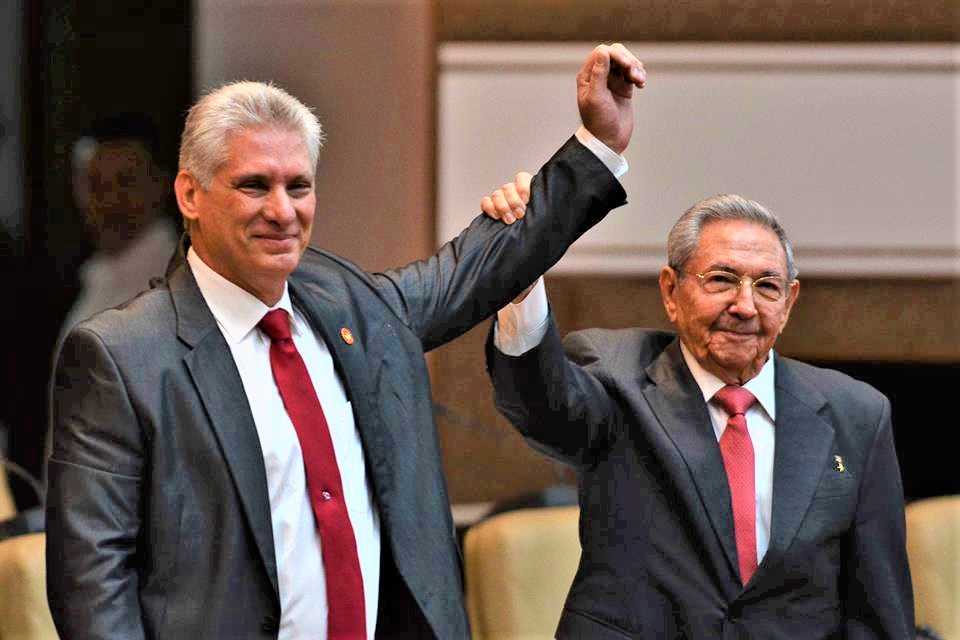
Five years later, we have entered a new phase in our relationship with our government, one that is less personal but still deeply worshipful of a man some people now call the “patient in chief.” Fidel lives on, and Raúl — whose power, as everyone knows, comes from his genes rather than his political gifts — has ruled since his ultimate accession in February 2008 without even the formality of the ballot box, prompting a dark joke often told in the streets of Havana: This is not a bloody dictatorship, but a dictatorship by blood. Pepito, the mischievous boy who stars in our popular jokes, calls Raúl “Castro Version 1.5″ because he is no longer No. 2, but still isn’t allowed to be the One. When the comandante — now barely a shadow of his former self — appeared at the final session of the Communist Party’s sixth congress this April, he grabbed his brother’s arm and raised it, to a standing ovation. The gesture was intended to consecrate the transfer of power, but to many of us the two old men seemed to be joining hands in search of mutual support, not in celebration of victory.

Raúl’s much-discussed reforms followed the supposed handover of power, but in reality, they have been less steps forward than attempts to redress the legal absurdities of the past. One of these was the lifting of the tourist apartheid that prevented Cubans from enjoying their own country’s hotel facilities. For years, to connect to the Internet, I had to disguise myself as a foreigner and mumble a few brief sentences in English or German to buy a web-access card in the lobby of some hotel. The sale of computers was finally authorized in March 2008, though by that time many younger Cubans had assembled their own computers with pieces bought on the black market. The prohibition on Cubans having cell-phone contracts was also repealed, ending the sad spectacle of people begging foreigners to help them establish accounts for prepaid phones. Restrictions on agriculture were loosened, allowing farmers to lease government land on 10-year terms. The liberalization brought to light the sad fact that the state had allowed much of the country’s land (70 percent of it was in state hands) to become overgrown with invasive weeds.

While officially still socialist, the government has also pushed for an expansion of so-called self-employment, masked with the euphemism of “nonstate forms of production.” It is, in reality, a private sector emerging in fits and starts. In less than a year, the number of self-employed grew from 148,000 to 330,000, and there is now a flowering of textile production, food kiosks, and the sale of CDs and DVDs. But heavy taxes, the lack of a wholesale market, and the inability to import raw materials independent of the state act as a brake on the inventiveness of these entrepreneurs, as does memory: The late 1990s, when the return to centralization and nationalization swept away the private endeavors that had surged in the Cuban economy after the fall of the Berlin Wall, were not so long ago.

So for now, the effects of the highly publicized reforms are barely noticeable on our plates or in our pockets. The country continues to import 80 percent of what we consume, at a cost of more than $1.5 billion. In the hard-currency stores, the cans of corn say “Made in the USA”; the sugar provided through the ration book travels from Brazil; and in the Varadero tourist hotels, a good part of the fruit comes from the Dominican Republic, while the flowers and coffee travel from Colombia. In 2010, 38,165 Cubans left the island for good. My impatient friends declare they are not going to stay “to turn off the light in El Morro” — the lighthouse at the entrance to Havana Bay — “after everyone else leaves.”

The new president understands all too well that transformations that are too deep could cause him to lose control. Cubans jokingly compare their political system to one of the dilapidated houses in Old Havana: The hurricanes don’t bring it down and the rains don’t bring it down, but one day someone tries to change the lock on the front door and the whole edifice collapses. And so the government’s most practiced ploy is the purchase of time with proclamations of supposed reforms that, once implemented, fail to achieve the promised effects.

But this can only continue for so long. Before the end of December, Raúl Castro will have to fulfill his promise to legalize home sales, which have been illegal since 1959, a move that will inevitably result in the redistribution of people in cities according to their purchasing power. One of the most enduring bastions of revolutionary imagery — working-class Cubans living in the palatial homes of the bygone elite — could collapse with the establishment of such marked economic differences between neighborhoods.

And yet the old Cuba persists in subtle, sinister forms. Raúl works more quietly than Fidel, and from the shadows. He has increased the number of political police and equipped them with advanced technology to monitor the lives of his critics, myself among them. I learned long ago that the best way to fool the “security” is to make public everything I think, to hide nothing, and in so doing perhaps I can reduce the national resources spent on undercover agents, the pricey gas for the cars in which they move, and the long shifts searching the Internet for our divergent opinions. Still, we hear of brief detentions that include heavy doses of physical and verbal violence while leaving no legal trail. Cuba’s major cities are now filled with surveillance cameras that capture both those who smuggle cigars and those of us who carry only our rebellious thoughts.

But over the last five years the government has undeniably and irreversibly lost control of the dissemination of information. Hidden in water tanks and behind sheets hanging on clotheslines, illegal satellite dishes bring people the news that is banned or censored in the national media. The emergence of bloggers who are critical of the system, the maturation of independent journalism, and the rise of autonomous spaces for the arts have all eroded the state’s monopoly on power.

Fidel, meanwhile, has faded away. He appears rarely and only in photos, always dressed in the tracksuit of an aging mafioso, and we begin to forget the fatigues-clad fighting man who intruded on nearly every minute of our existence for half a century. Just a year ago, my 8-year-old niece was watching television and, seeing the desiccated face of the old commander in chief, shouted to her father, “Daddy, who is this gentleman?”

Posted in Blog | Tagged , , | Leave a comment

G. B. Hagelberg, Analyst and Friend of Cuba. His Last Work: ¨Cuban Agriculture: Limping Reforms, Lame Results”

By Arch Ritter

Cubans and friends of Cuba will lament the recent death of G.B. Hagelberg, a long time and highly respected analyst of Cuban agriculture, most notably the sugar sector. Hagelberg had a deep and long term knowledge of the sugar agro-industrial complex in the Caribbean generally including Cuba, having served as the resident sugar adviser of the government of Barbados from 1960 to 1968 and from 1980 to 1986. He was the author of numerous publications, including a book-length study entitled  The Caribbean Sugar Industries: Constraints and Opportunities (1974). More recently his work focused more on Cuban agriculture and he authored a variety of works in this area. His last analysis. referred to here, was originally entitled “Cuban Agriculture: Limping Reforms, Lame Results”. but was re-labelled “Agriculture: Policy and Performance”. It was presented at the  Association for the Study of the Cuban Economy (ASCE) Conference in August 2011.

Some central conclusions of this last work are presented below and the complete essay can be found here, courtesy of ASCE and especially Joaquin Pujol. It will be generally available on ASCE’s Website for the 2011 Conference soon.

The complete text can be found at this hyper-link:

Hagelberg ASCE 2011, AGRICULTURAL POLICY AND PERFORMANCE

Hagelberg’s Concluding Comments:

Analysts can thank Raúl Castro for a semblance of glasnost. Ironically, it reveals the limits of his perestroika. That enterprise is running the danger of unraveling under the weight of its internal contradictions. If this is not to happen, the realization has to gain ground that “concentration of ownership” (Article 3) is as undesirable in the public as in the private sector of the economy and that competition is the mother of efficiency. Non-functional state monopolies and monopsonies have to be dismantled. Also to be unpicked is the conflation of centralization and planning, a fantasy nowhere more counterproductive than in agriculture. To succeed, farm and agroindustrial policies must be informed by a thorough understanding of the conditions that make these sectors different from other economic activities. Regulation is obviously necessary in such areas as environmental protection, food safety and the prevention of market abuse. But to thrive, Cuba’s agriculture and agroindustry require the government to shift decisively from a controlling to an enabling mode, attending to rural infrastructure investment, research and extension, the reduction of risk from natural causes, financing, and the provision of timely and reliable information.

*********************

In a speech to the National Assembly in July 2008, Raúl Castro returned to his oft-quoted 1994 statement that “beans are more important than cannons.” Over 2007-10, the four calendar years in which he has led the government, bean production averaged 96,400 metric tons annually, against an average of 109,175 tons in the previous four years (ONE, 2011a, Table 1.6). Men who have spent a lifetime running the armed forces may believe that making farm policy is not rocket science. It is surely at least that. After all, a centrally managed economy was first to send a man into space; across the world, the track record of centrally managed economies in agriculture has been less glorious. The measures introduced to boost the home-grown food supply and reduce the need for imports have still to pass the beans test, and Cuba’s agricultural malaise rumbles on.

Agricultural Scene, Vinales, 1997

Posted in Blog | Tagged , , , | Leave a comment

NUEVA EDICIÓN DE LA REVISTA ESPACIO LAICAL

The July-September 2011 edition of La Revista Espacio Laical has just been published.  Its primary focus is on an evaluation of the results of the VI Congress of the Communist party of Cuba.Included also is an interview with Phil Peters, author of the Blog The Cuban Triangle and Carlos Saladrigas.Unfortunately it is available only in Spanish.

Here is a full Table of Contents together with Abstracts of some of the Economics Essays with hyper-links.

Table of Contents:

Índice General
Secciones y artículos:

EDITORIAL : El reto de ser audaces  – Del Magisterio.

RELIGIÓN
- Contemplarán al que traspasaron.  Por Sandro Magister

- La contemplación de la belleza.  Por Joseph Ratzinger

PÁGINAS RESCATADASA cargo de Jorge Domingo Cuadriello
- El patriotismo cubano. Por Eliseo Giberga

EL DOSSIER: Post VI Congreso PCC
- El VI Congreso del Partido y los Lineamientos: ¿un punto de vi raje para Cuba?  Por Archibald Ritter
- El VI Congreso: una evaluación preliminar.  Por Armando Chaguaceda.
- Cuba: ¿qué cambia tras el VI Congreso del Partido Comunista?  Por Carmelo Mesa-Lago.
- Cambios en marcha y consensos por lograr.  Por José Ramón Vidal
- Tratando de reinventar el socialismo. (Entrevista a Ricardo Alarcón). Por Manuel Alberto Ramy
- Reformas económic as y desarrollo en el Este de Asia: ¿una experiencia para Cuba? Por Arturo López-Levy

INTERNACIONALES

- La apuesta egipcia. Entrevista a Antonios Naguip. Por Gianni Valente
- Mi vida para la libertad de Chile. Entrevista a Sergio Bitar. Por Roberto Veiga González

BÚSQUEDA:

- Cuba y su diáspora: el desafío de facilitar un reencuentro.  Por Carlos Saladrigas

- Poder  e ineptitud en el exilio de Miami. Por Alejandro Armengol

CUBA
- Vivir como vecinos. Entrevista a Philip Peters. Por Roberto Veiga González

- Aportando para el diálogo y el consenso.  Entrevista a Roberto Veiga González.  Por Armando Chaguaceda

TEMA POLÉMICO

- Saladrigas, Arboleya y el debate sobre el futuro de Cuba.  Por Lenier González Mederos

CULTURA

- Re-señas de libros. Por Jorge Domingo Cuadriello

- Elogio y digresión.  Por David Mateo

- Aspera ad Astra o el itinerario espiritual de un líder político. Por Habey Hechavarría Prado

- José María Chacón y Calvo. Por Malena Balboa Pereira

- Cambiar o no cambiar: ¿es ese el dilema? Por Francisco Almagro Domínguez

- Harold Bloom y yo. Por Roberto González Echeverría

ESPIRITUALIDAD

- En busca de una transformación relevante. Por Raúl Fornet-Betancourt

DE LAS ENTRAÑAS DE LA ISLA

- Cuba en su diversidad cultural. Por Jesús Guanche

EN DIÁLOGO

- El lugar de la ciudadanía. Participación política  y República en Cuba.  Por Julio César Guanche

LA POLÉMICA

- Las propuestas de Carlos Saladrigas para Cuba. Por Jesús Arboleya Cervera

- Comentarios sobre la entrevista a Saladrigas y las opiniones de Arboleya. Por Ramón de la Cruz Ochoa

- Saladrigas y el debate con Ramón de la Cruz. Por Jesús Arboleya Cervera

- Soberanía nacional, emigrados e inversionistas Por Arturo López-Levy

Abstracts

El VI Congreso del Partido y los Lineamientos: ¿un punto de viraje para Cuba? Por Archibald Ritter

El VI Congreso del Partido Comunista de Cuba (PCC) probablemente será de gran importancia para el futuro de Cuba. La revisión que el Congreso hizo de los Lineamientos de la Política Económica y Social del Partido y la Revolución significa que ahora es políticamente correcto apoyar, promover e implementar esta ambiciosa agenda de reformas. Por deducción, es también políticamente correcto llegar a la conclusión de que medio siglo de experimentación económica estuvo en su mayor parte equivocada, y fue contraproducente e insostenible. A pesar de los intentos de crear una impresión de continuidad histórica con la referencia a una “actualización” del modelo económico, los viejos enfoques de gestión económica han quedado profundamente desacreditados. El Congreso ha certificado el clima creado por los cambios de opinión acerca de cómo puede funcionar mejor la economía cubana. Ahora parece que es altamente improbable un regreso a los viejos modos de operar.
(leer más…)


El VI Congreso: una evaluación preliminar. Por Armando Chaguaceda
Pocos eventos han generado tantas esperanzas, frustraciones y debates como el pasado VI Congreso del Partido Comunista de Cuba. La postergación del mismo por 14 años y el trasfondo político del país (continuación de la crisis estructural del modelo socialista de Estado, inicio de reformas económicas e institucionales, relevo de liderazgo) fueron caldo de cultivo para las más variadas especulaciones. Por ello, al cierre inmediato de sus cortinas, diferentes analistas compartieron sus plurales evaluaciones del foro, tributando al necesario balance de sus resultados en cuyo seno se inserta el presente texto. (leer más…)


Cuba: ¿qué cambia tras el VI Congreso del Partido Comunista? Por Carmelo Mesa-Lago
En abril de 2011 se realizó el VI Congreso del Partido Comunista de Cuba (pcc), después de 14 años sin celebrar ese tipo de reuniones. El Congreso estuvo marcado por las ambiciosas reformas que Raúl Castro se propuso como meta tras reemplazar a su hermano Fidel Castro en 2006. No obstante, las contradicciones, las indecisiones, las inercias y las resistencias del aparato burocrático siembran dudas acerca de la eficacia de los cambios aprobados por el Congreso para sacar al país de la profunda crisis económica que enfrenta y recuperar unas fuerzas agotadas. (leer más…)


- Cambios en marcha y consensos por lograr. Por José Ramón Vidal
Las sesiones del VI Congreso del Partido Comunista de Cuba, celebradas en abril último, cerraron una etapa de formulación y consulta de propuestas dirigidas a producir transformaciones en el modelo económico y social, que como es lógico suponer tienen y tendrán en lo adelante inevitables repercusiones en la esfera política. (leer más…)


- Tratando de reinventar el socialismo. (Entrevista a Ricardo Alarcón). Por Manuel Alberto Ramy
Hace apenas 48 horas concluyó el VI Congreso del Partido Comunista de Cuba, un congreso que, según lo que he leído y escuchado, prefigura un país cualitativamente distinto y una sociedad diferente. El presidente de la Asamblea Nacional y miembro del Buró Político del Partido Comunista, Ricardo Alarcón, me ha concedido esta entrevista. Sé que dispone de poco tiempo así que me gustaría hacerle tres preguntas muy concretas. La primera está referida al ámbito del Poder Popular.(leer más…)


- Reformas económicas y desarrollo en el Este de Asia: ¿una experiencia para Cuba? Por Arturo López-Levy
Al discutir los cambios planteados en los Lineamientos económicos y sociales del VI Congreso del Partido Comunista de Cuba, muchos observadores han evocado las reformas en el Este de Asia, particularmente los procesos ocurridos en China y Vietnam. El contexto cultural, económico y social cubano es diferente al de estas naciones; sin embargo, conviene plantearse si hay lecciones de aquellas experiencias que Cuba pueden adaptar. (leer más…)


Posted in Blog | Tagged , , , , , | Leave a comment

Espacio Laical, “The Sixth Party Congress and “Lineamientos”: A Turning Point for Cuba?”

Just Published on Espacio Laical, Suplemento Digital No.132 / 16 de Junio 2011
Tomado de la sección Búsqueda (revista 3-2011) Hyperlink here:

The Sixth Congress of the Cuba’s Communist Party will likely be of immense importance for Cuba’s future. The ratification of the revised Lineamientos de la Política Económica y Social del Partido y la Revolución “by the National Assembly means that it is now politically correct to support, advocate and implement an ambitious reform agenda.  By implication, it also is politically correct to draw the conclusion that a half century of economic experimentation with the lives of Cuban citizens was for the most part misguided, counterproductive, and unsustainable.  Despite attempts to create an impression of historical continuity by referring to the “updating” of the economic model, the old approaches to economic management have been deeply discredited. The shifting climate of opinion regarding how the Cuban economy can best function has been certified as reasonable by the National Assembly.  It now appears that a regression to old modes of economic operation is now highly improbable..

The economic future for Cuba clearly lies in a newly-rebalanced albeit vaguely-envisaged mixed market economy that will be the outcome of the various reforms that are slated to be implemented.  This is a surprising reversal of fortunes. It also constitutes a vindication of the some of the views of the critics of past economic policies.

The “Lineamientos” represent an attempt by President Raul Castro to forge his own “legacy” and to emerge from the long shadow of his brother, as well as to set the Cuban economy on a new course. The ratification of the reform agenda represents a successful launch of the “legacy” project.  President Raul Castro would indeed make a unique and valuable contribution to Cuba and its citizens were he to move Cuba definitively through dialogue and agreement among all Cubans towards a model that guarantees both economic and social rights as well as civil liberties and authentic democracy.

Are moves in these directions likely to happen? Not under current political circumstances. However, there are bottom-up pressures building and some official suggestions that movement towards political liberalization is not impossible. In the meantime, Raul’s de-centralizing, de-bureaucratizing and “market-liberalizing” reforms been launched. This is a good start for the construction of a positive independent “legacy.”

I. Cuba’s Economic Situation

In various speeches since 2006, Raul Castro has indicated that he recognizes the problems that Cuba confronts in terms of the production of agricultural and industrial goods and improvement of Cuba’s infrastructure (despite the ostensibly solid GDP performance from 2005 to 2009 before Cuba was hit by the international recession.) He is well aware of the central causal forces underlying weak Cuba’s economic vulnerabilities and weaknesses such as the unbalanced structure of the economy, the overburden of deadening rules and regulations and a sclerotic bureaucracy and the monetary and exchange rate pathologies and dysfunctional incentive environment that deform the energies and lives of Cuban citizens.

Cuba’s economic plight can be summarized quickly with a couple of illustrations. First, Cuba’s underwent  serious de-industrialization after 1989 from which it has not recovered, reaching only about 51% of the 1989 level by 2009 (Chart 1)

Source: ONE AEC, 2004, Table 11.1 and 2IX.1

Note: Data for 1990-1997 are not available

There are a variety of reasons for the collapse of the industrial sctor:

(a)    The antiquated technological inheritance from the Soviet era as of 1989;

(b)   Insufficient maintenance over a number of decades before and after 1989;

(c)    The 1989-1993economic melt-down;

(d)   Insufficient levels of investment; (The overall level of investment in Cuba in 2008 was 10.5% of GDP compared to 20.6% for all of Latin America  according to UN ECLA, 2011, Table A-4.)

(e)    The dual monetary and exchange rate system that penalizes potential exporters that would receive one old (Moneda Nacional) peso for each US dollar earned from exports;

(f)    Competition in Cuba’s domestic market with China which has had a grossly undervalued exchange rate, coexisting with Cuba’s grossly overvalued exchange rate.

Second, the collapse of the sugar agro-industrial complex is well known and is illustrated in Chart 2. The sugar sector essentially was a “cash cow” milked to death for its foreign exchange earnings, by insufficient maintenance, by insufficient re-investment preventing productivity improvement, and by the exchange rate regime under which it labored.
Source: NU CEPAL, 2000 Cuadro A.86; ONE, 2010 Table 11.4

The consequences of the collapse of the sugar sector include the loss of about US$ 3.5 billion in foreign exchange earnings foregone (generated largely with domestic value added); reductions in co-produced electricity; a large increase in idled farm land; a destruction of the capacity to produce ethanol; damaging regional and local development impacts, and a destruction of much of the “cluster” of input-providing, output-processing and marketing activities related to sugar.

Third, the production of food for domestic consumption has been weak since 1989, despite some successes in urban agriculture.  Food imports have increased steadily and in recent years account for an estimated 75 to 80% of domestic food consumption despite large amounts of unused farm land. Meanwhile agricultural exports have languished,


Chart 3  Cuban Exports and Imports of Foodstuffs, 1989-2009
(excluding Tobacco and Alcoholic Beverages) (Millions CUP)

Source: NU CEPAL, 2000 Tables A.36 and A.37, and ONE, AEC, Various Years.

Fourthly, “inflation-adjusted “ or “real” wages in the official economy collapsed and have not recovered significantly according to estimates from the Centro de Estudios sobre la Economia Cubana (Chart 4.)  This is indeed a major calamity for the official state economy. But though the official 2008 wage rate remained around 25% of its level of 1989, most people had other sources of income, such as remittances, legal self-employment, home produced goods and services, economic activities in the underground economy, income supplements in joint ventures, goods in kind from the state and widespread pilferage.  Those without other sources of income are in poverty.

Chart 4   Cuba: Real Inflation-Adjusted Wages, 1989-2009
(
Pesos, Moneda Nacional)

Vidal  Alejandro, Pavel, “Politica Monetaria y Doble Moneda”, in Omar Everleny Perez et. al., Miradas a la Economia Cubana, La Habana: Editorial Caminos, 2009

Furthermore, despite the exceedingly low official rates of unemployment – around 1.6 to 1.7%, (far below the “natural rate” of unemployment which represents normal new entrants, job-changers and structural changes in any economy) – underemployment is obviously very high. Presumably the 1.8 million workers considered by the Government to be redundant and subject to probable lay-off and transfer to small enterprise, are “underemployed”, accounting for around 35 per cent of the labor force.

A further dimension of the fragility of Cuba’s economic situation is the dependence on the special relationship with Venezuela that relies upon high oil prices and the presence and munificence of President Chavez.

It is to the credit of President Raul Castro that he has faced these problems directly, diagnosed their sources, and produced the “Lineamientos” to deal with them. The central sources of the difficulties are the general structure of incentives that orients the economic activities of Cuban citizens, this including the dual monetary and exchange rate system, the tight containment of individual economic initiatives, the detailed rules and regulations of the omnipresent bureaucracy. Paradoxically, in attempting to control everything in the past, the government has ended up controlling very little. The effectiveness of stricter state controls actually leads to weaker genuine control due to their promotion of illegalities, corruption and the ubiquitous violation of unrealistic regulations.

II. The Lineamientos

The objective of the “Lineamientos” is “to guarantee the continuity and irreversibility of Socialism” as well as economic development (p.10). This is to be achieved through an “up-dating” of the economic model that should result in utilization of idle lands, reversal of decapitalization of infrastructure and industry, a restructuring of employment, increased labor productivity, increased and diversified exports, decentralized decision-making and elimination of monetary and exchange rate dualism (p. 8.)

But the term “Socialism” remains somewhat ambiguous in the document.  Reference is made to “socialist property” and “preserving the conquests of the Revolution.”  Especially interesting is the statement that

“…socialism signifies equality of rights and equality of opportunities for all the citizens, not egalitarianism” (p.9)

This assertion could be of game-changing significance, as it articulates a fundamental principle of “Social Democracy” more so that a traditional principle of  “Socialism.”  This leaves questions unanswered and doors unclosed.

The “Lineamientos” are in effect an ambitions and comprehensive “wish-list” or statement of aspirations. Many of the 313 recommendations are fairly obvious, trite and general statements of reasonable economic management. Some statements have been made repeatedly over a number of decades, including those relating to the expansion and diversification of exports, science and technology policy, the sugar agro-industrial complex, or the development of by-products and derivatives from the sugar industry (an objective at least since 1950.) Restating many of these as guidelines can’t do much harm, but certainly does not guarantee their implementation.

There are also opaque elements among the guidelines and seeming contradictions as some of them stress continuity of state planning and control while others emphasize greater autonomy for enterprises.  For example, Guideline 7 emphasizes how “planning” will include non-state forms of enterprise and “new methods…. of state control of the economy” while No. 62 states “The centralized character …of the degree of planning of the prices of products and services, which the state has an interest in regulating will be maintained.” But numerous other guidelines spell out the greater powers that state and non-state enterprises will have over a wide range of their activities including pricing (Guidelines 8 to 22 and 63.)

While there are a few gaps and shortcomings in the “Lineamientos” as well as the references to planning and state control, they include some deep-cutting proposals on various aspects of economic organization and policy that represent the inauguration of a movement towards a “market-friendly” economic policy environment. Among these are:

  • Greater autonomy of the enterprise in numerous dimensions, hiring and firing, wage structures, financing, price setting, investing, and also in facing bankruptcy;
  • A phase-out of rationing and the ration book and the more careful targeting of social assistance to those who need it, thereby also strengthening incentives to work (No. 162);
  • The establishment of wholesale markets for inputs for all types of enterprise. (No. 9);
  • Continuing distribution of unused state lands to small farmers (No. 187);
  • Reduction of state controls regarding small farmers and cooperatives regarding producer decision-making, marketing of crops, provision of inputs, and (No. 178-184)

A central policy thrust is the expansion of the self-employment and cooperative sector in order to absorb ultimately some 1,800.000 state workers considered redundant. The legislation already implemented in October 2010 liberalized policy somewhat so as to encourage the establishment of additional microenterprises – especially by the liberalization of licensing, the establishment of wholesale markets for inputs and the recent relaxation of hiring restrictions. However, the limitations of the policy changes are highlighted by the modest increase in the number of “Paladar” chairs – from 12 to 20.

Unfortunately current restrictions will prevent the expected expansion of the sector. These include the heavy taxation that can exceed 100% of net earnings (after costs are deducted from revenues)  for enterprises with high costs of production; the prohibition of the use of intermediaries and advertising, and continued petty restrictions. Perhaps most serious restriction is that all types of enterprises that are not specifically permitted are prohibited including virtually all professional activities.  The 176 permitted activities, some defined very narrowly, contrast with the  “Yellow Pages” of the telephone directory for Ottawa (half the size of Havana) that includes 883 varieties of activities, with 192 varieties for “Business Services”, 176 for “Home and Garden, 64 for “Automotive”  and 29 for “Computer and Internet Services.” Presumably policies towards micro-and small enterprise will be further liberalized in the months ahead if laid-off workers are to be absorbed productively.

One short-coming of the “Lineamientos” is the lack a time dimension and a depiction of how the various changes will be implemented. There are no clear priorities among the innumerable guidelines, no sequences of actions, and no apparent coordination of the guidelines from the standpoint of their implementation. It remains a “check-list” of good intentions, though none-the-less valuable.

The absence of a vision of how change was to occur and the slow pace of the adoption of the reforms so far is also worrisome. However, the Administration of Raul Castro has been deliberative and systematic though also cautious. It is probable that somewhere in the government of Raul Castro there is a continually evolving time-line and master-plan for the implementation of the reform measures.

A careful and well-researched approach to economic reform is obviously desirable. The difficulties encountered in laying off 500,000 state sector workers and re-absorbing them in the small-enterprise sector by March 31, 2011 has probably encouraged an even more cautious  “go-slow” approach.  Perhaps “slow and steady wins the race!”

A process of economic —but not political— reform seems to have already begun following the Congress. Where it will lead is hard to predict. Presumably Raúl Castro’s regime would like the process to end with the political status quo plus a healthy economy. The latter would require a new balance between public and private sectors, with a controlled movement toward the market mechanism in price determination and the shaping of economic structures, and with the construction of a rational configuration of incentives shaping citizens’ daily economic actions so that their private endeavors become compatible with Cuba’s broader economic well-being.

In such a reform process many things would be changing simultaneously with symbiotic impacts and consequences that will likely be painful and are difficult to foresee. Will President Raul Castro have the courage to take the risks inherent in an ambitious process of economic change? This remains to be seen. But the economic and political consequences of inaction are so bleak and the attractiveness of a positive historical “legacy” are so enticing that President Raul Castro will continue.

The economic reform process has been launched. It is in its early stages. It will likely continue under the leadership of Raul Castro. It will proceed far beyond the “Lineamientos” under new generations of Cuban citizens in economic as well as political spheres.

Bibliography

Naciones Unidas, CEPAL, La Economia Cubana: Reformas estructurales y desempeňo en los noventa, Santiago, Chile, 2000, Second Edition.

Oficina Nacional de Estadisticas (ONE), Anuario Estadistico de Cuba (AEC), various years. Website: http://www.one.cu/

Partido Comunista de Cuba,  Lineamientos de la Política Económica y Social del Partido y la Revolución, Aprobado el 18 de abril de 2011, VI Congreso del PCC

United nations, Economic Commission for Latin America and the Caribbean, Preliminary Overview of the Economies of Latin America and the Caribbean, 2010, Santiago, Chile January, 2011

Vidal Alejandro, Pavel, “Politica Monetaria y Doble Moneda”, in Omar Everleny Perez et. al., Miradas a la Economia Cubana, La Habana: Editorial Caminos, 2009

Posted in Blog | Tagged , , , , , , , , , | 2 Comments