Tag Archives: Economic Recovery

Cuba’s Economic Problems and Prospects in a Changing Geo-Economic Environment

By Arch Ritter

Below is a Power Point Presentation made at the “Seminar on Prospects for Cuba’s Economy” at the Bildner Center, City University of New York, on May 21, 2012.

The full presentation can be found here: CUNY Bildner Presention, Arch Ritter on Cuba’s Economic Problems and Prospects….”, May 21 2012

Posted in Blog, Featured | Tagged , , , , , , , , , , , , , , , , , | Leave a comment

The Economist, Special Report on Cuba, March 24, 2012


The Castros, Cuba and America; On the road towards capitalism

Change is coming to Cuba at last. The United States could do far more to encourage it.

The Economist has produced one of its excellent surveys, this time focusing on Cuba.

Below are a set of hyperlinks to the various chapters of the Cuba Report. The chapter on the economy is presented following the Table of Contents.

Hyperlinked Table of Contents

  Revolution in retreat; Revolution in retreat

Under Raúl Castro, Cuba has begun the journey towards capitalism. But it will take a decade and a big political battle to complete, writes Michael Reid

  Inequality; The deal’s off

Inequalities are growing as the paternalistic state is becoming ever less affordable

Population; Hasta la vista, baby

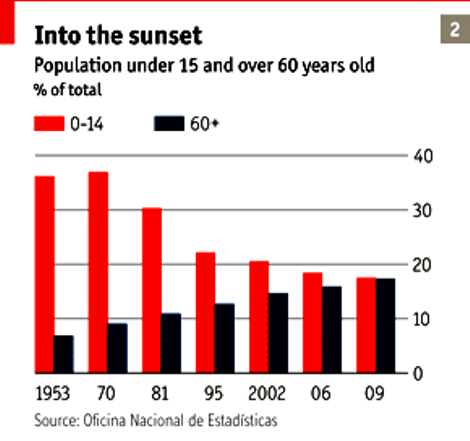
The population is shrinking, ageing—and emigrating
The economy: Edging towards capitalism

Why reforms are slow and difficult

Politics; Grandmother’s footsteps

With no sign of a Cuban spring, change will have to come from within the party

Cuban-Americans; The Miami mirror

Cubans on the other side of the water are slowly changing too

After the Castros; The biological factor

Who and what will follow Raúl?
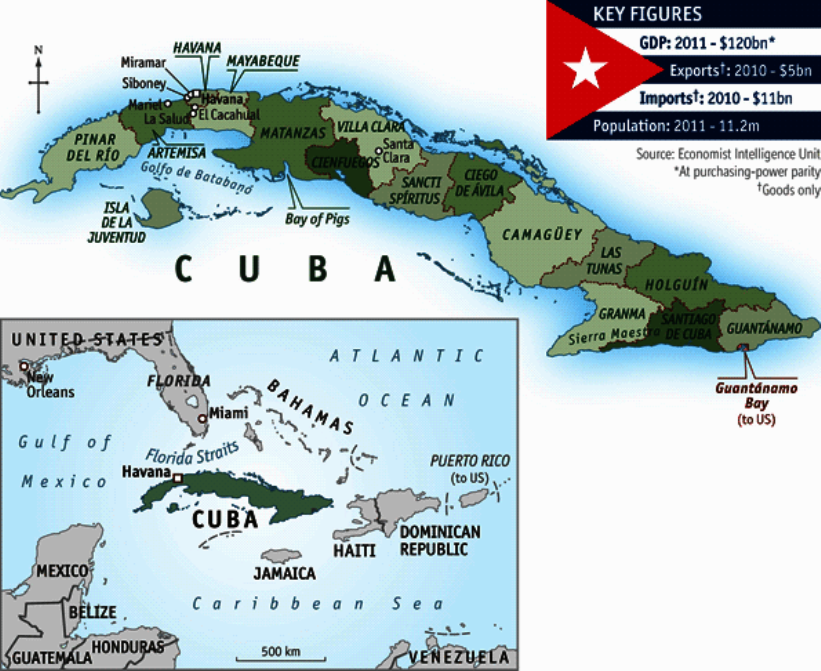
The Economy: Edging towards capitalism

Why reforms are slow and difficult

GISELA NICOLAS AND two of her friends wanted to set up an events-catering company, but that is not one of the 181 activities on the approved list for those who work por cuenta propia (“on their own account”), so in May 2011 they opened a restaurant called La Galeria. With 50 covers, it is a fairly ambitious business by Havana standards. They have rented a large house in Vedado and hired a top chef and 13 other staff who are paid two to three times the average wage, plus tips. The customers are mainly foreign businesspeople and diplomats, Cuban artists and musicians and visiting Cuban-Americans.

“This opportunity means a lot to us,” says Ms Nicolas, who used to work for a Mexican marketing company. “But they haven’t created the conditions for a profitable business.” There are no wholesalers in Cuba, so all supplies come from state-owned supermarkets or from trips abroad. Reservations are taken on Ms Nicolas’s mobile phone. Advertising is banned, though classified ads in the phone book will soon be allowed.

Across Cuba small businesses are proliferating. Most are on a more modest scale than La Galeria. Fernando and Orlandis Suri, who are smallholders at El Cacahual, a hamlet south of Havana, can now legally sell their fat pineapples and papaya from a roadside stall, along with other produce. Orlandis plans to rent space on Havana’s seafront to sell fruit cocktails and juice. In Santa Clara, Mr Pérez’s wife, Yolanda, sells ice-cream from their home. Having paid 200 pesos for a licence and 87 pesos in social-security contributions, she earns enough “to buy salad”. The streets around Havana’s Parque Central heave with vendors hawking snacks and tourist trinkets. Many of them are teachers, accountants and doctors who have left their jobs for a more lucrative, if precarious, life in the private sector.

No reason to work

This cuentapropismo is only the most visible part of Raúl Castro’s reform plan. “The fundamental issue in Cuba is production,” says Omar Everleny, a reformist economist. “Prices are high and wages are low because we don’t produce enough.”

Cuban statistics are incomplete, inconsistent and often questionable. But in a lifetime’s detective work, Carmelo Mesa Lago at the University of Pittsburgh has calculated that output per head of 15 out of 22 main agricultural and industrial products was dramatically lower in 2007 than it had been in 1958. The biggest growth has come in oil and gas and in nickel mining, largely thanks to investment since the 1990s by Sherritt, a Canadian firm. But output per head of sugar, an iconic Cuban product, has dropped to an eighth of its level in 1958 and 1989. Capital investment has collapsed. Raúl Castro has repeatedly lamented that Cuba imported around 80% of the food it consumed between 2007 and 2009, at a cost of over $1.7 billion a year.

The American embargo is an irritant, but the economy’s central failing is that Fidel’s paternalist state did away with any incentive to work, or any sanction for not doing so. So most Cubans do not work very hard at their official jobs. People stand around chatting or conduct long telephone conversations with their mothers. They also routinely pilfer supplies from their workplace: that is what keeps the informal economy going.

The global financial crisis in 2007-08 also took its toll. Tourists stayed away, the oil price plunged, and with it Venezuelan aid. Hurricane damage meant more food imports, just when world food prices were rising and those of nickel, now Cuba’s main export, were plunging. All this coincided with the political infighting in which Mr Lage was ousted, during which “all financial and budgetary discipline was blown away”, according to a foreign businessman. Having repeatedly defaulted on its foreign debt, Cuba has little access to credit. Instead of devaluing the CUC, which would have pushed up inflation, in January 2009 the government seized about $1 billion in hard-currency balances held by state-owned enterprises (SOEs) and foreign joint ventures. It did not finish paying them back until December 2011.

The guidelines approved by the party congress contain measures to raise production and exports, cut import demand and make the state financially sustainable. This involves, first, turning over idle state land to private farmers; second, making the state more productive by transferring surplus workers to the private sector or to co-ops; and third, lifting some of the many prohibitions that restrict Cuban lives, and granting much more autonomy to the 3,700 SOEs.

The grip of the state on Cuban farming has been disastrous. State farms of various kinds hold 75% of Cuba’s 6.7m hectares of agricultural land. In 2007 some 45% of this was lying idle, much of it overrun by marabú, a tenacious weed. Cuba is the only country in Latin America where killing a cow is a crime (and eating beef a rare luxury). That has not stopped the cattle herd declining from 7m in 1967 to 4m in 2011.

In 2008 Raúl allowed private farmers and co-ops to lease idle state land for ten years. By December last year 1.4m hectares had been handed out. The government has now agreed to extend the lease-period to up to 25 years, allow farm buildings to be put up and pay for any improvements if the leases are not renewed.

Credit and technical assistance also remain scarce, says Armando Nova of CEEC. Farmers suffer in the grip of Acopio, the state marketing organisation. It is the monopoly supplier of inputs such as seeds, fertiliser and equipment and was the sole purchaser of the farms’ output, but its monopoly is being dented. Farmers can now sell surplus production of all but 17 basic crops themselves. Under a pilot programme in Artemisa and Mayabeque provinces, near Havana, new co-ops will take over many of Acopio’s functions.

The reformers want to see Acopio go. More surprisingly, so does Joaquín Infante Ugarte at the National Association of Economists and Accountants (ANEC): “It’s always been a disaster. We should put a bomb under it.” But in around 100 of Cuba’s 168 municipalities the economy is based on farming, so Acopio is a big source of power and perks for party hacks, and its future is the subject of an intense political battle. That makes farmers nervous. A year ago the 30 or so farmers in the Antonio Maceo co-op in Mayabeque leased extra land, got a loan and planted bananas, citrus and beans. The administrator says output is up, but “it will take time to see a real difference.” And with that he clammed up.

Official data suggest that output of many crops fell last year; the price of food rose by 20%. That may be partly because farmers are bypassing the official channels. Granma, the official—and only—daily newspaper, reported in January that a spontaneous, self-organised and regulated wholesale market in farm products has sprung up in Havana. That looks like the future.

Letting go is hard to do

Reducing the state’s share of the economy has been even more contested. Raúl originally said the government would lay off 500,000 workers by March 2011 and a total of 1.1m by 2014. That timetable has slipped by several years because the government has been reluctant to allow sufficiently attractive alternatives for workers to give up the security (and the pilfering opportunities) of a state job. But including voluntary lay-offs and plans to turn many state service jobs into co-ops (as has already happened with small barber’s shops, beauty parlours and a few taxi drivers), some 35-40% of the workforce of 4.1m should end up in the private sector by 2015, reckons Mr Everleny.

Raúl sees corruption as politically incendiary at a time of rising inequality

By October 2011, he says, some 338,000 people had requested a business licence, 60% of whom were not leaving state jobs, suggesting that they were simply legalising a previous informal activity. As happens to small businesses the world over, many fail in the first year. Few of the cuentapropistas have Ms Nicolas’s business experience. Many clearly find it hard to distinguish revenue from profit. ANEC is organising training courses. But the government has stalled an attempt by the Catholic church to set up an embryonic business school.

If cuentapropismo is not to be a recipe for poverty, the government will have to ease the rules. Mr Everleny wants to see private professional-service firms being established: architects, engineers, even doctors. Already the taxes levied on the new businesses have been cut, but they are still designed to produce “bonsai companies”, in the words of Oscar Espinosa Chepe, a dissident economist.

Lack of credit is another obstacle. Start-up capital for new businesses comes mainly from remittances. In a pilot scheme the government approved $3.6m in credits in January, nearly all for house improvements. As for deregulation, Raúl has taken some simple and popular steps, lifting bans on Cubans using tourist hotels and owning mobile phones and computers, and last year allowing them to buy and sell houses and cars.

But reforming SOEs is far more complicated. They have been told to introduce performance-related pay. The boldest step was last year’s abolition of the sugar ministry. In principle, SOEs that lose money will be merged or turned over to their workers as co-ops. But a planned bankruptcy law is still pending. So is the elimination of subsidies and the introduction of market pricing. Mr Ugarte of ANEC thinks much of this will happen this year, along with a new law to introduce corporate income tax.

The pace of change has picked up since the party congress set up a commission with 90 staff under Marino Murillo, a Politburo member and former economy minister, to push through the reforms, says Jorge Mario Sánchez at CEEC. “By 2015 there won’t be the socialist economy of the 1990s, nor the same society.” But there are several gaps.

For one, the government seems undecided what to do about foreign investment, a key element in the rapid growth in Vietnam and China. It has cancelled some of the joint ventures it had signed (often in haste) during the Special Period, and such new agreements as it is entering are almost exclusively with companies from Venezuela, China and Brazil. Odebrecht, a Brazilian conglomerate, has reached an agreement under which it will run a large sugar mill in Cienfuegos for ten years. Many foreign companies are keen to invest in Cuba but are put off by the government’s insistence on keeping a majority stake and its history of arbitrary policy change.

Officials worry that foreign investment brings corruption. Raúl has launched an anti-corruption drive with the creation of a powerful new auditor-general’s office. Several hundred Cuban officials, some very senior, have been jailed, as have three foreigners. Raúl rightly sees corruption as politically incendiary at a time of rising inequality. But he is tackling the symptoms rather than the cause. “People who were making $20 a month were negotiating contracts worth $10m,” says a foreign diplomat.

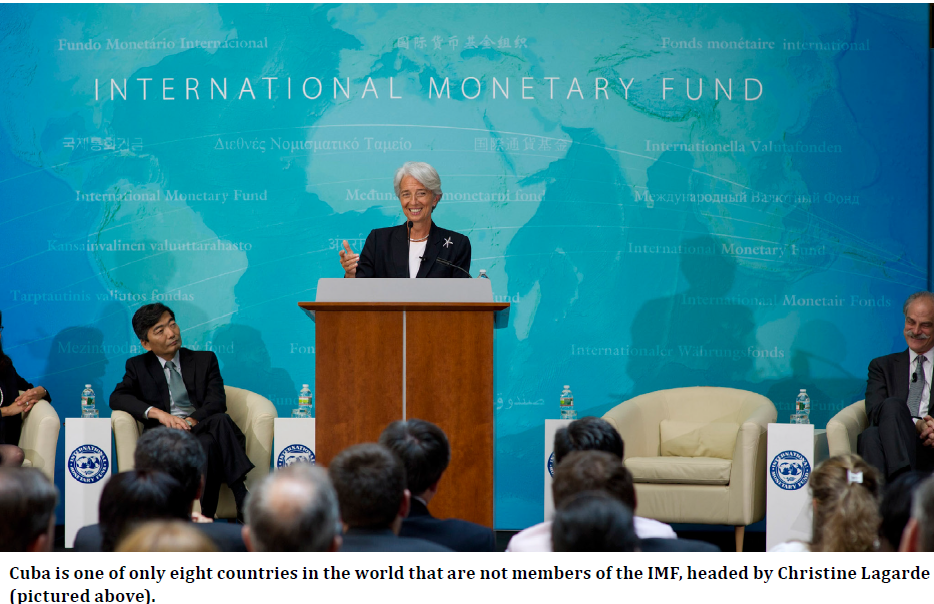
The guidelines involve only microeconomic reforms. Raúl’s macroeconomic recipe has so far been limited to austerity: he has managed to trim the fiscal and current-account deficits. The trickiest reform of all will be unifying the two currencies, by devaluing the CUC and revaluing the peso. It would help if Cuba were a member of the IMF and the World Bank and had access to international credit, but so far the government has shown no interest in joining. Mr Vidal of CEEC points out that for devaluation to provide a stimulus, rather than just generating inflation, the economy would have to be far more flexible. That will require a political battle.
 

Posted in Blog | Tagged , , , , , , , , , , , , | Leave a comment

New Publication, CUBA: PEOPLE, CULTURE, HISTORY

A near-encyclopedic volume on Cuba was recently published by Charles Scribner’s Sons but has received surprisingly limited publicity- at least from my perspective up here in winter-time in the True North. I have not yet seen the volume myself nor have I even seen the Table of Contents. However, the description of the substance of the volume below looks interesting.

If my finances were infinite, I would certainly buy a copy, even though the price ranges from $284.44 to $454.95, depending on the seller.

I contributed two essays on the Cuban economy. These are available here:

Archibald Ritter  “The Cuban Economy, Revolution, 1959-1990″

Archibald Ritter, “Cuba’s Economy During the Special Period, 1990-2010″

Here is a brief description of the volume:

Editor in Chief: Alan West-Durán, Northeastern University

 Associate Editors: Victor Fowler Calzada, Unión de Escritores y Artistas de Cuba (UNEAC); Gladys E. García Pérez, Unión de Escritores y Artistas de Cuba (UNEAC); Louis A Pérez, Jr., University of North Carolina; César Salgado, University of Texas; Maria de los Angeles Torres, University of Illinois, Chicago

Charles Scribner’s Sons,  An Imprint of Gale, Cengage Learning 2011

 INTRODUCTION

In an exceedingly complex and changing global situation,  understanding Cuba is an important and challenging task. The Scribner CUBA: People, Culture, History is a reference work that goes beyond a mere presentation of facts, biographies, and “ready reference” information, which is widely available on the Internet, to offer deep interpretation. The book will offer on the one hand, twenty-one interpretative essays on major topics in Cuban history, culture and society, as well as over one hundred twenty-five shorter essays on artistic, literary, and nonfiction works; major events and places of cultural significance.

The major essays will not only cover Economics, Sugar, Tobacco, Religion, and Food, but also Cuba and its Diasporas, Ecology and Environment, Sexuality, Gender, Race and Ethnicity, the Arts, Language, Sports and Cuban Ways of Knowing and Being, among others.

The short essays will focus on specific literary works, photographs, paintings, political documents, speeches, testimonies, historical dates, key places and cities on the island and abroad. For example:  literary works include “Los Versos sencillos”; “Paradiso”; and “The Mambo Kings Play Songs of Love”; works of nonfiction include: “Cuba: Azúcar y Población”; “Indagación del choteo”; and La historia me absolverá”; works of visual art: “La Jungla”; and “Los Hijos del agua conversando con un pez”; works of music: “Guantanamera”; “Misa cubana”; and “Mambo #5”; cinema: “Lucía”; and “Fresa y chocolate”; events: “Violence and Insurrection in 1912: A Racial Conflict”; and “January 1, 1959”; and places of cultural significance: “Baracoa”; “Holguín”; “Isla de Pinos”; “Spain”; and “New York,” to name a few examples.

By combining longer overview pieces with short and focused descriptive and analytical ones, CUBA  aims to give the curious and interested reader a way to comprehend the country by presenting the major forces that have shaped the island historically and culturally. Rather than overwhelm the reader with thousands of entries and biographies, CUBA offers a close look at major themes that are emblematic to the country’s unique history. CUBA is a reference guide for readers undertaking a journey of comprehension; it is not a work that presumes to have all of the answers.

Posted in Blog | Tagged , , , , , , , , | Leave a comment

Melissa Lockhart, “After dramatic 2011 in Cuba, will US-Cuban policy shift in 2012?”

Melissa Lockhart reviews a year of what she calls big change in Cuba, little change in US policy. From the Christian Science Monitor. http://www.csmonitor.com/World/Americas/ December 29, 2011

This year in Cuban history will be viewed as a significant one, having seen more economic change and reform on the island than some entire decades. Yet Washington’s response has been minimal.

Let’s start with a brief summary of the past year. In January 2011, the executive branch of the US government announced and published new travel and remittance rules with respect to Cuba, which increased possibilities for people-to-people travel. The effect has been gradual (OFAC in the Treasury is under-staffed and really quite slow), but greater numbers of cultural travel groups have received the necessary licenses and are leading trips to the island because of the new rules.

February and March saw the trial of the infamous violent Cuban exile Luis Posada Carriles, and a historic step in the US to prosecute him for terrorist acts in Cuba (he was later acquitted, to the chagrin of many Cuba-watchers). Alan Gross, the USAID contractor who remains in jail in Cuba, was ultimately sentenced in March to 15 years in prison — a relationship-damaging development that has continued to be a point of great contention between Washington and Havana.

In April, the Cuban Communist Party held their Sixth Party Congress and reviewed the terms of a great number of economic reforms whose implementation has proceeded during the course of the year. Yet in the fall, the US stood nearly solo at the United Nations as the world voted against the US embargo on Cuba. Washington put Cuba again on its list of “State Sponsors of Terrorism,” though the evidence to support the designation has withered.

This week, President Castro pardoned 2,900 prisoners in advance of the Pope’s visit to the island in 2012, noting that many of the pardoned were first-time offenders, youths, or inmates over 60 or suffering from illness. Yet here we are at the close of the year, and the Obama administration is still apparently convinced that the release of political prisoners in Cuba and the drastic economic changes underway are not enough to qualify as the “change” that would merit a significant bilateral discussion.

Asi es la vida for Cuba-watchers. The most unexpected event of this year was not a “happening” at all: it is the lack of movement forward in Washington on Cuba issues, and the continuing age-old tendency to cater to the conservative Miami Cuban-American base — a demographic that is changing and adapting its views to new developments in Cuba more so than Congress and the current administration, it seems. We expected more this year, despite the myriad of other global challenges faced by the US. Washington has found time recently to take a fresh look at Myanmar, but still not at our close neighbor Cuba.

With all of the events of the last year, here in the US the individual whose name has received the most airtime – and who therefore receives our designation of person of the year – is Alan Gross. Mr. Gross has been held in Cuba since December 2009 for distributing communications equipment illegally on the island. His sentence of 15 years in prison for crimes against the Cuban state was upheld by the Cuban Supreme Court in August. US officials have tried unsuccessfully to argue for his unilateral release; many experts have unsuccessfully argued for a prisoner swap (modeled off of the Israel-Hamas prisoner exchange of Gilad Shalit for hundreds of Palestinians — but in this case just one for five). Mr. Gross remains imprisoned, and as he was not one of the recently pardoned 2,900, Washington has continued to ignore other signs of significant change within the Cuban state. As long as Gross remains imprisoned, it appears there can be no progress.

Are you up on Latin American news? Try our quiz. Christmas In Havana: President Obama prevails on Cuban family travel rules For Cubans, new property rights – and the return of an old anxiety Topics

The forecast for 2012 is unfortunately only a tick higher than bleak in terms of the US-Cuba relationship. 2012 is a US election year, and Cuba policy remains a contentious political issue. Even just in the last few weeks, Cuba-watchers cringed (and spoke out) as a small faction of House representatives sought to fold an amendment into the 2012 spending bill that would change US regulations on Cuban-American family visits to Cuba, rolling this policy back to the Bush era. Fortunately, the White House took a stand and threatened a veto if the amendment was not removed. But many had feared that the administration would not spend the political capital to step in, and this was on an issue that simply maintained the status quo. There is very little reason for an administration seeking re-election to take the kind of political risk that more significant (necessary) Cuba policy changes entail.

However, the island’s future looks positive, at least for the moment. The population is testing out new economic reforms, the reforms are pressing ahead to the long-run benefit of a troubled economy, and foreign businesses and investors remain interested in Cuba (despite recent crackdowns on corruption that have affected foreigners as well as Cubans). Pope Benedict XVI will visit Cuba in March, and the state appears to be taking a look at its prison system in advance of that visit and making the largest number of pardons and releases of prisoners in recent history. These are positive developments that likely will not receive much acknowledgement from Washington, but for now, Havana does not appear to need our stamp of approval.

Melissa Lockhart Fortner is Senior Programs Officer at the Pacific Council on International Policy and Cuba blogger at the Foreign Policy Association. You can read her blog here.


Posted in Blog | Tagged , , , | Leave a comment

Updating re Economics Essays from TEMAS

Below are a series of hyperlinks to articles on economic reform in Cuba. Unfortunately the essays are available only in Spanish.

Economía y política

Richard Levins y Aurora Levins Morales, Respondiendo a Ricardo Torres

Omar Álvarez Dueñas, A propósito de la controversia sobre la «inviabilidad del socialismo»

Carmelo Mesa-Lago, Sobre la «inviabilidad del socialismo», pero ¿qué tipo de socialismo? (Observaciones a los comentarios de José Luis Rodríguez en Temas)

José Luis Rodríguez, A propósito del socialismo, ¿de qué inviabilidad se habla?

Luis Marcelo Vera ¿Cuál es el problema estratégico principal de la economía cubana?

LArmando Nova González, La propiedad en la economía cubana

Ricardo Torres Pérez, La actualización del modelo económico cubano: continuidad y ruptura

Julio Díaz Vázquez, Es aplicable el modelo chino o vietnamita en Cuba?

Rafael Betancourt, Observaciones en torno al Proyecto de Lineamientos

Fernando Barral, Aproximación sociológica al problema de la corrupción en Cuba

Armando Nova González, El papel estratégico de la agricultura: problemas y medidas

Omar Everleny Perez, Cuba: ¿por dónde va la economía?

Pavel Vidal Alejandro, La estabilidad monetaria en Cuba: una síntesis

Ramón de la Cruz Ochoa, Acotaciones al texto del Dr. Fernando Barral sobre la corrupción en Cuba


Posted in Blog | Tagged , , , , | Leave a comment

Centro de Estudios de la Economía Cubana (CEEC)

By Arch Ritter

Centro de Estudios de la Economía Cubana (CEEC)

The University of Havana’s Centro de Estudios de la Economia Cubana has made itself the foremost research institution on the Cuban economy since its establishment in 1989.  Its faculty includes many of the best-known analysts on the Cuban economy, including both senior and newer faculty members. The work of the Cuban Economy Team is especially impressive and is certainly worth careful study by anyone interested in Cuba. I have often thought that Cuba would benefit immensely if some of the members of CEEC were in key Cabinet positions in the Government of Cuba responsible for the management of the economy.  I expect that this in fact will happen before too long!

Cuban Economy Team: Dr. Juan Triana Cordoví, Dr. Omar Everleny Pérez (Director), Dr. Armando Nova González, Dr. Hiram Marquetti Nodarse, Dr. Jorge Mario Sánchez Egozcue, Dr. Pavel Vidal Alejandro, Ms. Betsy Anaya, Ms. CamilaPiñeiro Harnecker, Ms. Ricardo Torres Pérez and Lic. Saira Pons Pérez

Enterprise Management Team: Dr. Orlando W. Gutierréz Castillo, Dr. Humberto Blanco Rosales, Dr. Rosendo Morales González, Dr. Jorge Ricardo Ramírez, Dra. Aleida Gonzalez-Cueto, Dra. Dayma Echevarría León, Dra. Ileana Díaz Fernández, Ms. Mercedes González Sánchez, Ms. Maria Isabel Suárez González,  Lic. Dayrelis Ojeda Suris and Lic. Mariuska Cancio  Fonseca

The CEEC publishes a number of “Boletínes” each year that usually include valuable analyses of various aspects of Cuba’s economy and economic policy. Here are the Tables of Contents of the last three issues. The “Boletínes” are hyper-linked to the CEEC Web Site and some of the essays are linked to the PDF files for rapid access.

Boletín Agosto 2011

El sistema de gestion y direccion de la economia hoy. Ileana Diaz,  Dra.Ileana Diaz

Experiencias noruegas relevantes para la agricultura cubana, Dr. Anicia Garcia

La propiedad en la economia cubana. Armando Nova,  Dr.Armando Nova

Los sistemas de direccion  de la economia  1961- 1975,  Dra.Ileana Diaz

Turismo de salud en Cuba. David Pajon Dr. David Pajon

Boletín Abril-Agosto 2010

Competitividad e innovacion, donde esta Cuba. Ileana Diaz, Dr. Ileana Díaz

El impacto del postgrado en la educacion superior Cuba- Venezuela. Rosendo Morales Dr. Rosendo Morales

El mercado y el estado, dos partes que forman un todo. Armando Nova, Dr. Armando Nova González

Entre el ajuste fiscal y los cambios estructurales, se extiende el cuentapropismo, Dr. Pavel Vidal y Dr. Omar Everleny Pérez

Fuerzas favorables y restrictivas a la dirección estratégica de la empresa. Dayrelis Ojeda y Humberto Blanco Lic. Dayrelis Ojeda y Dr. Humber

Boletin Enero-Mayo 2010

El mercado libre agropecuario en 2009. Armando Nova, Dr. Armando Nova González

El sector energetico cubano entre 2005 y 2009. Ricardo Torres_0 Ms. Ricardo Torres Pérez

La política fiscal actual. Pavel Vidal_0 Dr. Pavel Vidal Alejandro

Estrategia. Mito o realidad. Ileana Diaz y Roberto Cartaya_0 Dr. Ileana Díaz y Dr. Roberto Cartaya

La producción agricola y ganadera en 2009. Armando Nova_0 Dr. Armando Nova González

La universidad, la economía y el desarrollo. Juan Triana_0 Dr. Juan Triana Cordoví

Los cambios estructurales e institucionales. Pavel Vidal_0,  Dr. Pavel Vidal Alejandro

Universidad de la Habana, “Alma Mater”

Posted in Blog | Tagged , , , , , , , , , , , , , , , | 1 Comment

Crecimiento económico y sector externo en Cuba

A descriptive analysis of Cuba’s external sector and economic growth has been published by Jorge Mario Sanchez, of the Centro de Estudios sobre la Economia Cubana. Here is the hyperlink:

Jorge Mario Sanchez, Crecimiento económico y sector externo en Cuba

Jorge Mario Sánchez

Posted in Blog | Tagged , , , , , , , , , | Leave a comment

NUEVA EDICIÓN DE LA REVISTA ESPACIO LAICAL

The July-September 2011 edition of La Revista Espacio Laical has just been published.  Its primary focus is on an evaluation of the results of the VI Congress of the Communist party of Cuba.Included also is an interview with Phil Peters, author of the Blog The Cuban Triangle and Carlos Saladrigas.Unfortunately it is available only in Spanish.

Here is a full Table of Contents together with Abstracts of some of the Economics Essays with hyper-links.

Table of Contents:

Índice General
Secciones y artículos:

EDITORIAL : El reto de ser audaces  – Del Magisterio.

RELIGIÓN
- Contemplarán al que traspasaron.  Por Sandro Magister

- La contemplación de la belleza.  Por Joseph Ratzinger

PÁGINAS RESCATADASA cargo de Jorge Domingo Cuadriello
- El patriotismo cubano. Por Eliseo Giberga

EL DOSSIER: Post VI Congreso PCC
- El VI Congreso del Partido y los Lineamientos: ¿un punto de vi raje para Cuba?  Por Archibald Ritter
- El VI Congreso: una evaluación preliminar.  Por Armando Chaguaceda.
- Cuba: ¿qué cambia tras el VI Congreso del Partido Comunista?  Por Carmelo Mesa-Lago.
- Cambios en marcha y consensos por lograr.  Por José Ramón Vidal
- Tratando de reinventar el socialismo. (Entrevista a Ricardo Alarcón). Por Manuel Alberto Ramy
- Reformas económic as y desarrollo en el Este de Asia: ¿una experiencia para Cuba? Por Arturo López-Levy

INTERNACIONALES

- La apuesta egipcia. Entrevista a Antonios Naguip. Por Gianni Valente
- Mi vida para la libertad de Chile. Entrevista a Sergio Bitar. Por Roberto Veiga González

BÚSQUEDA:

- Cuba y su diáspora: el desafío de facilitar un reencuentro.  Por Carlos Saladrigas

- Poder  e ineptitud en el exilio de Miami. Por Alejandro Armengol

CUBA
- Vivir como vecinos. Entrevista a Philip Peters. Por Roberto Veiga González

- Aportando para el diálogo y el consenso.  Entrevista a Roberto Veiga González.  Por Armando Chaguaceda

TEMA POLÉMICO

- Saladrigas, Arboleya y el debate sobre el futuro de Cuba.  Por Lenier González Mederos

CULTURA

- Re-señas de libros. Por Jorge Domingo Cuadriello

- Elogio y digresión.  Por David Mateo

- Aspera ad Astra o el itinerario espiritual de un líder político. Por Habey Hechavarría Prado

- José María Chacón y Calvo. Por Malena Balboa Pereira

- Cambiar o no cambiar: ¿es ese el dilema? Por Francisco Almagro Domínguez

- Harold Bloom y yo. Por Roberto González Echeverría

ESPIRITUALIDAD

- En busca de una transformación relevante. Por Raúl Fornet-Betancourt

DE LAS ENTRAÑAS DE LA ISLA

- Cuba en su diversidad cultural. Por Jesús Guanche

EN DIÁLOGO

- El lugar de la ciudadanía. Participación política  y República en Cuba.  Por Julio César Guanche

LA POLÉMICA

- Las propuestas de Carlos Saladrigas para Cuba. Por Jesús Arboleya Cervera

- Comentarios sobre la entrevista a Saladrigas y las opiniones de Arboleya. Por Ramón de la Cruz Ochoa

- Saladrigas y el debate con Ramón de la Cruz. Por Jesús Arboleya Cervera

- Soberanía nacional, emigrados e inversionistas Por Arturo López-Levy

Abstracts

El VI Congreso del Partido y los Lineamientos: ¿un punto de viraje para Cuba? Por Archibald Ritter

El VI Congreso del Partido Comunista de Cuba (PCC) probablemente será de gran importancia para el futuro de Cuba. La revisión que el Congreso hizo de los Lineamientos de la Política Económica y Social del Partido y la Revolución significa que ahora es políticamente correcto apoyar, promover e implementar esta ambiciosa agenda de reformas. Por deducción, es también políticamente correcto llegar a la conclusión de que medio siglo de experimentación económica estuvo en su mayor parte equivocada, y fue contraproducente e insostenible. A pesar de los intentos de crear una impresión de continuidad histórica con la referencia a una “actualización” del modelo económico, los viejos enfoques de gestión económica han quedado profundamente desacreditados. El Congreso ha certificado el clima creado por los cambios de opinión acerca de cómo puede funcionar mejor la economía cubana. Ahora parece que es altamente improbable un regreso a los viejos modos de operar.
(leer más…)


El VI Congreso: una evaluación preliminar. Por Armando Chaguaceda
Pocos eventos han generado tantas esperanzas, frustraciones y debates como el pasado VI Congreso del Partido Comunista de Cuba. La postergación del mismo por 14 años y el trasfondo político del país (continuación de la crisis estructural del modelo socialista de Estado, inicio de reformas económicas e institucionales, relevo de liderazgo) fueron caldo de cultivo para las más variadas especulaciones. Por ello, al cierre inmediato de sus cortinas, diferentes analistas compartieron sus plurales evaluaciones del foro, tributando al necesario balance de sus resultados en cuyo seno se inserta el presente texto. (leer más…)


Cuba: ¿qué cambia tras el VI Congreso del Partido Comunista? Por Carmelo Mesa-Lago
En abril de 2011 se realizó el VI Congreso del Partido Comunista de Cuba (pcc), después de 14 años sin celebrar ese tipo de reuniones. El Congreso estuvo marcado por las ambiciosas reformas que Raúl Castro se propuso como meta tras reemplazar a su hermano Fidel Castro en 2006. No obstante, las contradicciones, las indecisiones, las inercias y las resistencias del aparato burocrático siembran dudas acerca de la eficacia de los cambios aprobados por el Congreso para sacar al país de la profunda crisis económica que enfrenta y recuperar unas fuerzas agotadas. (leer más…)


- Cambios en marcha y consensos por lograr. Por José Ramón Vidal
Las sesiones del VI Congreso del Partido Comunista de Cuba, celebradas en abril último, cerraron una etapa de formulación y consulta de propuestas dirigidas a producir transformaciones en el modelo económico y social, que como es lógico suponer tienen y tendrán en lo adelante inevitables repercusiones en la esfera política. (leer más…)


- Tratando de reinventar el socialismo. (Entrevista a Ricardo Alarcón). Por Manuel Alberto Ramy
Hace apenas 48 horas concluyó el VI Congreso del Partido Comunista de Cuba, un congreso que, según lo que he leído y escuchado, prefigura un país cualitativamente distinto y una sociedad diferente. El presidente de la Asamblea Nacional y miembro del Buró Político del Partido Comunista, Ricardo Alarcón, me ha concedido esta entrevista. Sé que dispone de poco tiempo así que me gustaría hacerle tres preguntas muy concretas. La primera está referida al ámbito del Poder Popular.(leer más…)


- Reformas económicas y desarrollo en el Este de Asia: ¿una experiencia para Cuba? Por Arturo López-Levy
Al discutir los cambios planteados en los Lineamientos económicos y sociales del VI Congreso del Partido Comunista de Cuba, muchos observadores han evocado las reformas en el Este de Asia, particularmente los procesos ocurridos en China y Vietnam. El contexto cultural, económico y social cubano es diferente al de estas naciones; sin embargo, conviene plantearse si hay lecciones de aquellas experiencias que Cuba pueden adaptar. (leer más…)


Posted in Blog | Tagged , , , , , | Leave a comment

Centro de Estudios sobre la Economía Cubana, “Seminario Anual sobre la Economía Cubana” 21-24 de junio de 2011

 The Centro de Estudios sobre la Economia Cubana has just completed and publicized its 2011 Annual Report on the Cuban economy. Here are hyperlinks to the main economics articles. A number of essays focussing on enterprise management have not been included here.

Juan Triana Cordoví, “Cuba 2010-2011, del crecimiento posible al desarrollo necessario

Jorge Mario Sánchez Egozcue, “La Relación Crecimiento Económico y Sector Externo, una evaluación de la dinámica

Pavel Vidal Alejandro y Omar Everleny Pérez Villanueva, “Relanzamiento del cuentapropismo en medio del ajuste estructural1
 
Ileana Díaz Fernández y Ricardo Torres Pérez, “Los encadenamientos productivos, un análisis para Cuba


Posted in Blog | Tagged , , , , , , , | Leave a comment

Espacio Laical, “The Sixth Party Congress and “Lineamientos”: A Turning Point for Cuba?”

Just Published on Espacio Laical, Suplemento Digital No.132 / 16 de Junio 2011
Tomado de la sección Búsqueda (revista 3-2011) Hyperlink here:

The Sixth Congress of the Cuba’s Communist Party will likely be of immense importance for Cuba’s future. The ratification of the revised Lineamientos de la Política Económica y Social del Partido y la Revolución “by the National Assembly means that it is now politically correct to support, advocate and implement an ambitious reform agenda.  By implication, it also is politically correct to draw the conclusion that a half century of economic experimentation with the lives of Cuban citizens was for the most part misguided, counterproductive, and unsustainable.  Despite attempts to create an impression of historical continuity by referring to the “updating” of the economic model, the old approaches to economic management have been deeply discredited. The shifting climate of opinion regarding how the Cuban economy can best function has been certified as reasonable by the National Assembly.  It now appears that a regression to old modes of economic operation is now highly improbable..

The economic future for Cuba clearly lies in a newly-rebalanced albeit vaguely-envisaged mixed market economy that will be the outcome of the various reforms that are slated to be implemented.  This is a surprising reversal of fortunes. It also constitutes a vindication of the some of the views of the critics of past economic policies.

The “Lineamientos” represent an attempt by President Raul Castro to forge his own “legacy” and to emerge from the long shadow of his brother, as well as to set the Cuban economy on a new course. The ratification of the reform agenda represents a successful launch of the “legacy” project.  President Raul Castro would indeed make a unique and valuable contribution to Cuba and its citizens were he to move Cuba definitively through dialogue and agreement among all Cubans towards a model that guarantees both economic and social rights as well as civil liberties and authentic democracy.

Are moves in these directions likely to happen? Not under current political circumstances. However, there are bottom-up pressures building and some official suggestions that movement towards political liberalization is not impossible. In the meantime, Raul’s de-centralizing, de-bureaucratizing and “market-liberalizing” reforms been launched. This is a good start for the construction of a positive independent “legacy.”

I. Cuba’s Economic Situation

In various speeches since 2006, Raul Castro has indicated that he recognizes the problems that Cuba confronts in terms of the production of agricultural and industrial goods and improvement of Cuba’s infrastructure (despite the ostensibly solid GDP performance from 2005 to 2009 before Cuba was hit by the international recession.) He is well aware of the central causal forces underlying weak Cuba’s economic vulnerabilities and weaknesses such as the unbalanced structure of the economy, the overburden of deadening rules and regulations and a sclerotic bureaucracy and the monetary and exchange rate pathologies and dysfunctional incentive environment that deform the energies and lives of Cuban citizens.

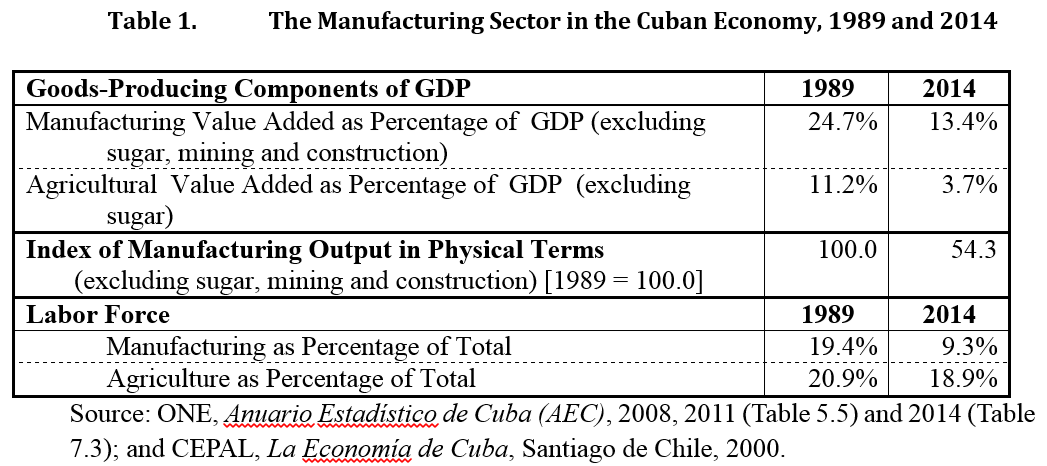
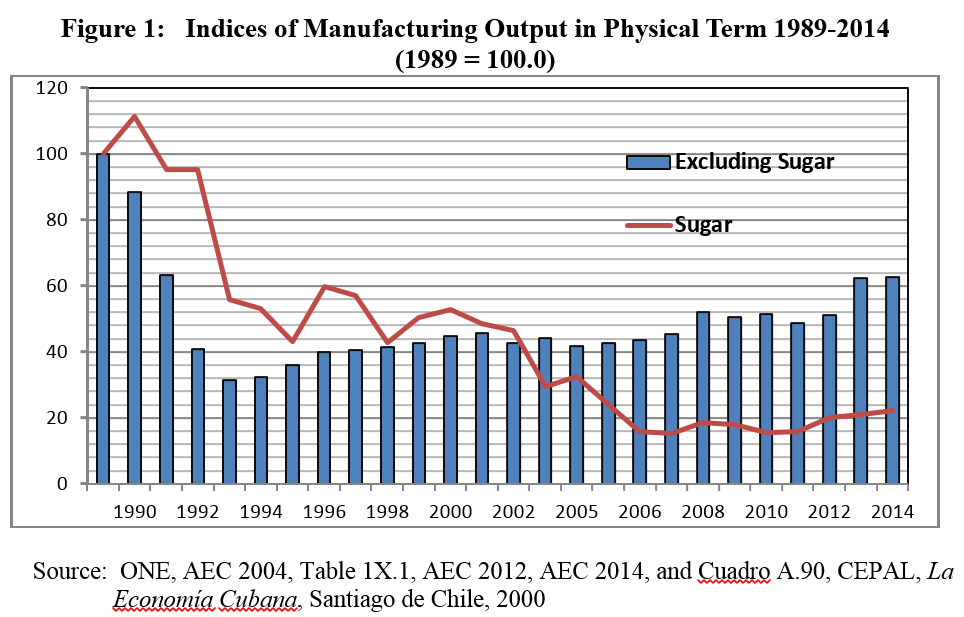
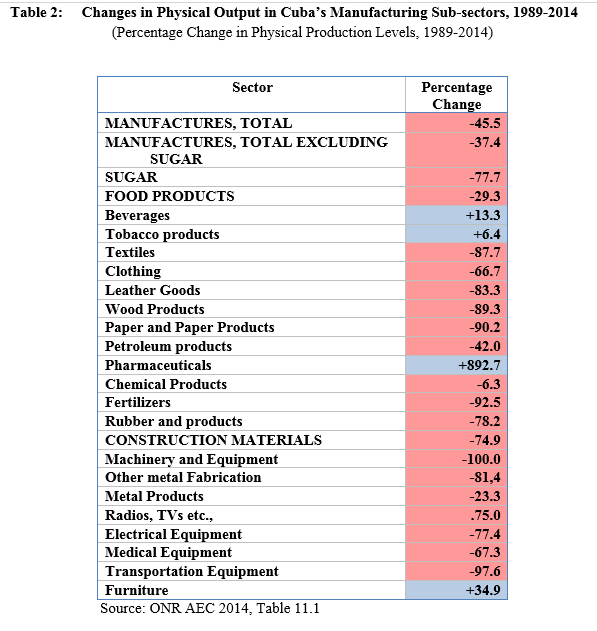
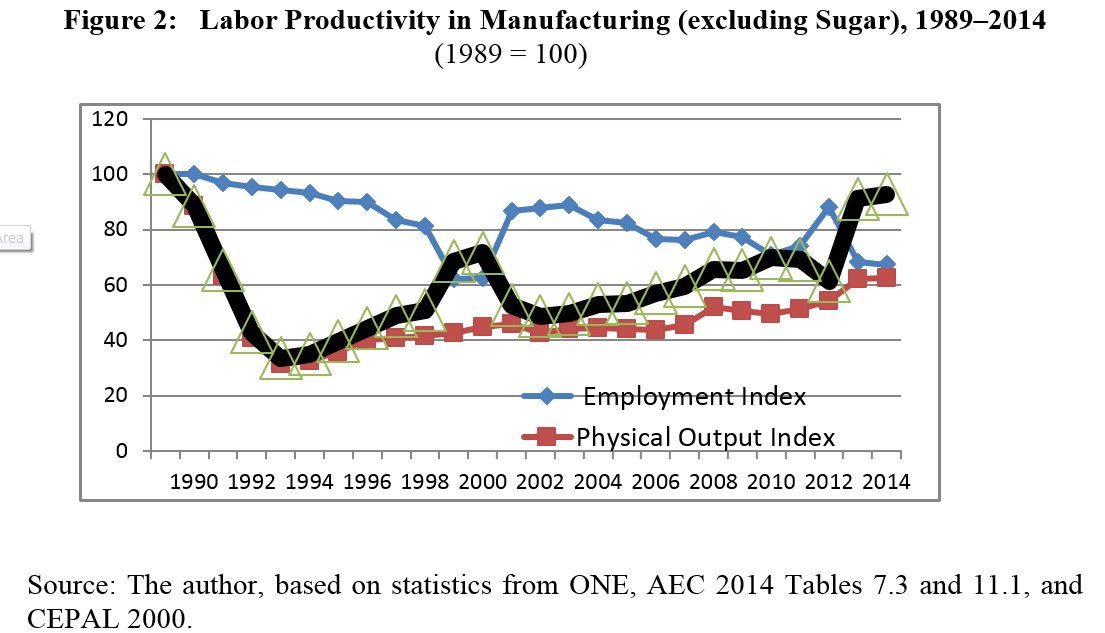
Cuba’s economic plight can be summarized quickly with a couple of illustrations. First, Cuba’s underwent  serious de-industrialization after 1989 from which it has not recovered, reaching only about 51% of the 1989 level by 2009 (Chart 1)

Source: ONE AEC, 2004, Table 11.1 and 2IX.1

Note: Data for 1990-1997 are not available

There are a variety of reasons for the collapse of the industrial sctor:

(a)    The antiquated technological inheritance from the Soviet era as of 1989;

(b)   Insufficient maintenance over a number of decades before and after 1989;

(c)    The 1989-1993economic melt-down;

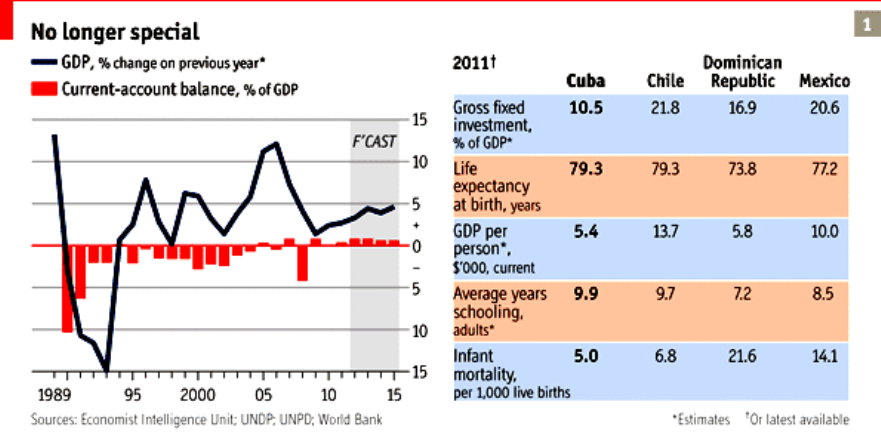
(d)   Insufficient levels of investment; (The overall level of investment in Cuba in 2008 was 10.5% of GDP compared to 20.6% for all of Latin America  according to UN ECLA, 2011, Table A-4.)

(e)    The dual monetary and exchange rate system that penalizes potential exporters that would receive one old (Moneda Nacional) peso for each US dollar earned from exports;

(f)    Competition in Cuba’s domestic market with China which has had a grossly undervalued exchange rate, coexisting with Cuba’s grossly overvalued exchange rate.

Second, the collapse of the sugar agro-industrial complex is well known and is illustrated in Chart 2. The sugar sector essentially was a “cash cow” milked to death for its foreign exchange earnings, by insufficient maintenance, by insufficient re-investment preventing productivity improvement, and by the exchange rate regime under which it labored.
Source: NU CEPAL, 2000 Cuadro A.86; ONE, 2010 Table 11.4

The consequences of the collapse of the sugar sector include the loss of about US$ 3.5 billion in foreign exchange earnings foregone (generated largely with domestic value added); reductions in co-produced electricity; a large increase in idled farm land; a destruction of the capacity to produce ethanol; damaging regional and local development impacts, and a destruction of much of the “cluster” of input-providing, output-processing and marketing activities related to sugar.

Third, the production of food for domestic consumption has been weak since 1989, despite some successes in urban agriculture.  Food imports have increased steadily and in recent years account for an estimated 75 to 80% of domestic food consumption despite large amounts of unused farm land. Meanwhile agricultural exports have languished,


Chart 3  Cuban Exports and Imports of Foodstuffs, 1989-2009
(excluding Tobacco and Alcoholic Beverages) (Millions CUP)

Source: NU CEPAL, 2000 Tables A.36 and A.37, and ONE, AEC, Various Years.

Fourthly, “inflation-adjusted “ or “real” wages in the official economy collapsed and have not recovered significantly according to estimates from the Centro de Estudios sobre la Economia Cubana (Chart 4.)  This is indeed a major calamity for the official state economy. But though the official 2008 wage rate remained around 25% of its level of 1989, most people had other sources of income, such as remittances, legal self-employment, home produced goods and services, economic activities in the underground economy, income supplements in joint ventures, goods in kind from the state and widespread pilferage.  Those without other sources of income are in poverty.

Chart 4   Cuba: Real Inflation-Adjusted Wages, 1989-2009
(
Pesos, Moneda Nacional)

Vidal  Alejandro, Pavel, “Politica Monetaria y Doble Moneda”, in Omar Everleny Perez et. al., Miradas a la Economia Cubana, La Habana: Editorial Caminos, 2009

Furthermore, despite the exceedingly low official rates of unemployment – around 1.6 to 1.7%, (far below the “natural rate” of unemployment which represents normal new entrants, job-changers and structural changes in any economy) – underemployment is obviously very high. Presumably the 1.8 million workers considered by the Government to be redundant and subject to probable lay-off and transfer to small enterprise, are “underemployed”, accounting for around 35 per cent of the labor force.

A further dimension of the fragility of Cuba’s economic situation is the dependence on the special relationship with Venezuela that relies upon high oil prices and the presence and munificence of President Chavez.

It is to the credit of President Raul Castro that he has faced these problems directly, diagnosed their sources, and produced the “Lineamientos” to deal with them. The central sources of the difficulties are the general structure of incentives that orients the economic activities of Cuban citizens, this including the dual monetary and exchange rate system, the tight containment of individual economic initiatives, the detailed rules and regulations of the omnipresent bureaucracy. Paradoxically, in attempting to control everything in the past, the government has ended up controlling very little. The effectiveness of stricter state controls actually leads to weaker genuine control due to their promotion of illegalities, corruption and the ubiquitous violation of unrealistic regulations.

II. The Lineamientos

The objective of the “Lineamientos” is “to guarantee the continuity and irreversibility of Socialism” as well as economic development (p.10). This is to be achieved through an “up-dating” of the economic model that should result in utilization of idle lands, reversal of decapitalization of infrastructure and industry, a restructuring of employment, increased labor productivity, increased and diversified exports, decentralized decision-making and elimination of monetary and exchange rate dualism (p. 8.)

But the term “Socialism” remains somewhat ambiguous in the document.  Reference is made to “socialist property” and “preserving the conquests of the Revolution.”  Especially interesting is the statement that

“…socialism signifies equality of rights and equality of opportunities for all the citizens, not egalitarianism” (p.9)

This assertion could be of game-changing significance, as it articulates a fundamental principle of “Social Democracy” more so that a traditional principle of  “Socialism.”  This leaves questions unanswered and doors unclosed.

The “Lineamientos” are in effect an ambitions and comprehensive “wish-list” or statement of aspirations. Many of the 313 recommendations are fairly obvious, trite and general statements of reasonable economic management. Some statements have been made repeatedly over a number of decades, including those relating to the expansion and diversification of exports, science and technology policy, the sugar agro-industrial complex, or the development of by-products and derivatives from the sugar industry (an objective at least since 1950.) Restating many of these as guidelines can’t do much harm, but certainly does not guarantee their implementation.

There are also opaque elements among the guidelines and seeming contradictions as some of them stress continuity of state planning and control while others emphasize greater autonomy for enterprises.  For example, Guideline 7 emphasizes how “planning” will include non-state forms of enterprise and “new methods…. of state control of the economy” while No. 62 states “The centralized character …of the degree of planning of the prices of products and services, which the state has an interest in regulating will be maintained.” But numerous other guidelines spell out the greater powers that state and non-state enterprises will have over a wide range of their activities including pricing (Guidelines 8 to 22 and 63.)

While there are a few gaps and shortcomings in the “Lineamientos” as well as the references to planning and state control, they include some deep-cutting proposals on various aspects of economic organization and policy that represent the inauguration of a movement towards a “market-friendly” economic policy environment. Among these are:

  • Greater autonomy of the enterprise in numerous dimensions, hiring and firing, wage structures, financing, price setting, investing, and also in facing bankruptcy;
  • A phase-out of rationing and the ration book and the more careful targeting of social assistance to those who need it, thereby also strengthening incentives to work (No. 162);
  • The establishment of wholesale markets for inputs for all types of enterprise. (No. 9);
  • Continuing distribution of unused state lands to small farmers (No. 187);
  • Reduction of state controls regarding small farmers and cooperatives regarding producer decision-making, marketing of crops, provision of inputs, and (No. 178-184)

A central policy thrust is the expansion of the self-employment and cooperative sector in order to absorb ultimately some 1,800.000 state workers considered redundant. The legislation already implemented in October 2010 liberalized policy somewhat so as to encourage the establishment of additional microenterprises – especially by the liberalization of licensing, the establishment of wholesale markets for inputs and the recent relaxation of hiring restrictions. However, the limitations of the policy changes are highlighted by the modest increase in the number of “Paladar” chairs – from 12 to 20.

Unfortunately current restrictions will prevent the expected expansion of the sector. These include the heavy taxation that can exceed 100% of net earnings (after costs are deducted from revenues)  for enterprises with high costs of production; the prohibition of the use of intermediaries and advertising, and continued petty restrictions. Perhaps most serious restriction is that all types of enterprises that are not specifically permitted are prohibited including virtually all professional activities.  The 176 permitted activities, some defined very narrowly, contrast with the  “Yellow Pages” of the telephone directory for Ottawa (half the size of Havana) that includes 883 varieties of activities, with 192 varieties for “Business Services”, 176 for “Home and Garden, 64 for “Automotive”  and 29 for “Computer and Internet Services.” Presumably policies towards micro-and small enterprise will be further liberalized in the months ahead if laid-off workers are to be absorbed productively.

One short-coming of the “Lineamientos” is the lack a time dimension and a depiction of how the various changes will be implemented. There are no clear priorities among the innumerable guidelines, no sequences of actions, and no apparent coordination of the guidelines from the standpoint of their implementation. It remains a “check-list” of good intentions, though none-the-less valuable.

The absence of a vision of how change was to occur and the slow pace of the adoption of the reforms so far is also worrisome. However, the Administration of Raul Castro has been deliberative and systematic though also cautious. It is probable that somewhere in the government of Raul Castro there is a continually evolving time-line and master-plan for the implementation of the reform measures.

A careful and well-researched approach to economic reform is obviously desirable. The difficulties encountered in laying off 500,000 state sector workers and re-absorbing them in the small-enterprise sector by March 31, 2011 has probably encouraged an even more cautious  “go-slow” approach.  Perhaps “slow and steady wins the race!”

A process of economic —but not political— reform seems to have already begun following the Congress. Where it will lead is hard to predict. Presumably Raúl Castro’s regime would like the process to end with the political status quo plus a healthy economy. The latter would require a new balance between public and private sectors, with a controlled movement toward the market mechanism in price determination and the shaping of economic structures, and with the construction of a rational configuration of incentives shaping citizens’ daily economic actions so that their private endeavors become compatible with Cuba’s broader economic well-being.

In such a reform process many things would be changing simultaneously with symbiotic impacts and consequences that will likely be painful and are difficult to foresee. Will President Raul Castro have the courage to take the risks inherent in an ambitious process of economic change? This remains to be seen. But the economic and political consequences of inaction are so bleak and the attractiveness of a positive historical “legacy” are so enticing that President Raul Castro will continue.

The economic reform process has been launched. It is in its early stages. It will likely continue under the leadership of Raul Castro. It will proceed far beyond the “Lineamientos” under new generations of Cuban citizens in economic as well as political spheres.

Bibliography

Naciones Unidas, CEPAL, La Economia Cubana: Reformas estructurales y desempeňo en los noventa, Santiago, Chile, 2000, Second Edition.

Oficina Nacional de Estadisticas (ONE), Anuario Estadistico de Cuba (AEC), various years. Website: http://www.one.cu/

Partido Comunista de Cuba,  Lineamientos de la Política Económica y Social del Partido y la Revolución, Aprobado el 18 de abril de 2011, VI Congreso del PCC

United nations, Economic Commission for Latin America and the Caribbean, Preliminary Overview of the Economies of Latin America and the Caribbean, 2010, Santiago, Chile January, 2011

Vidal Alejandro, Pavel, “Politica Monetaria y Doble Moneda”, in Omar Everleny Perez et. al., Miradas a la Economia Cubana, La Habana: Editorial Caminos, 2009

Posted in Blog | Tagged , , , , , , , , , | 2 Comments