Tag Archives: Human Rights

Cuban Public Opinion Survey, 2011, International Republican Institute

The International Republican Institute has just published the results of a public opinion survey taken in Cuba, the fifth such survey since 2007. A series of questions were asked concerning general perspectives on Cuba, attitudes towards political and economic change, and access to information technology. Some of the same questions have been asked since 2007 providing some interesting comparisons over time.

The complete survey is located here: Cuban Public Opinion Survey, 2011, Int’n’l Republican Institute

The survey methodology was as follows

  • Dates of Interviewing: The fieldwork was conducted Jan, 28 – Feb. 10, 2011.
  • Data Collection Method: Stratified-intercept methodology based on personal, face-to-face interviews in Cuba.
  • Sample Size: 463 Cuban adults (age 18 and older).
  • Sample: Interviews were conducted in twelve (12) Cuban provinces
  • The sample was stratified by province, then by sub-units within each province. Interviewees were allocated by gender and age quotas. The final selection of each interviewee was random.
  • Respondents: The sample selection for province, gender and age are based on the last available Cuban census data, released in 2002.
  • Maximum Sample Margin of Error: Margin of error of ± five percent for a 95 percent level of confidence.

There are a number of interesting results of the survey. Here are a couple.

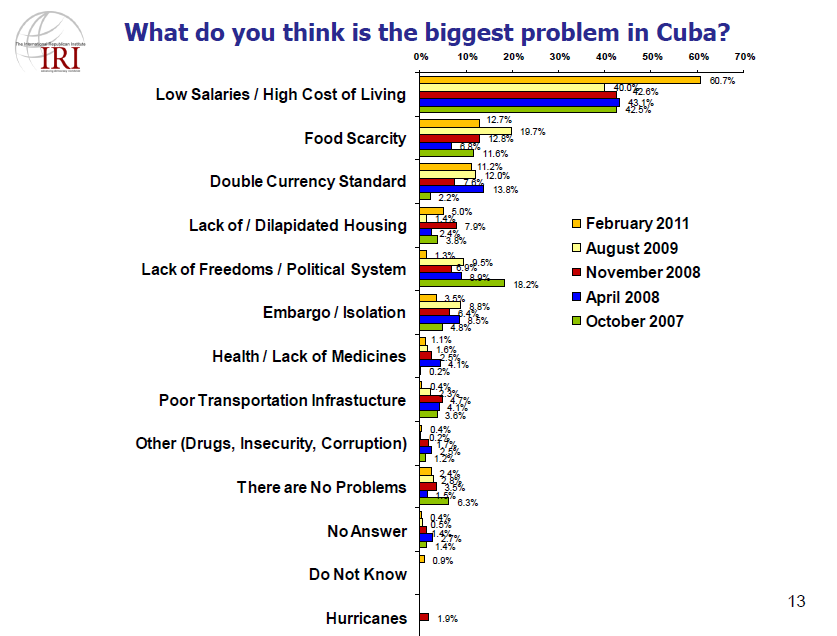
1. What do you think is the biggest problem in Cuba?   60.7% said that Low Salaries / High Cost of Living were the most serious, up from 40% in 2009,  while 12.7% said that food scarcity was the most serious. 1% of the respondents stated that the Lack of Freedoms / Political System was the most serious. This suggests that Raul Castro’s priority on the economy is not misplaced.

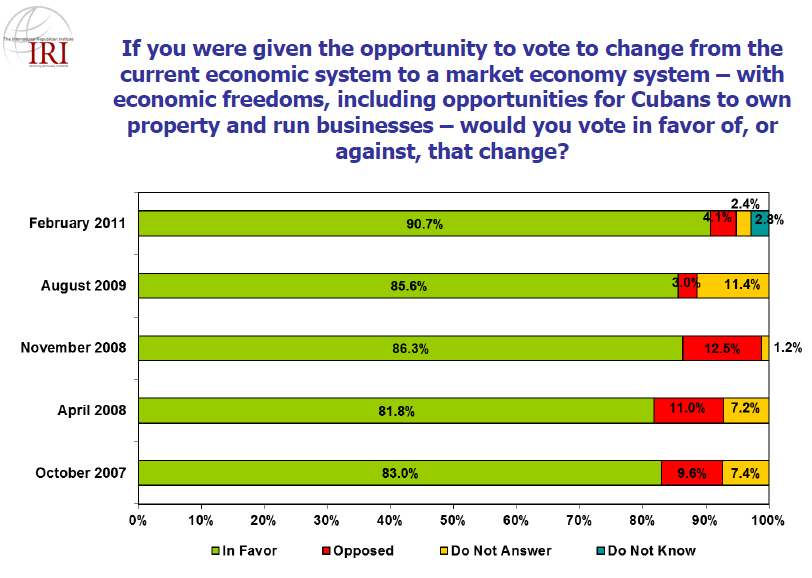
2.      If you were given the opportunity to vote to change from the current economic system to a market economy system – with economic freedoms, including opportunities for Cubans to own property and run businesses – would you vote in favor of, or against, that change?  90.7 of the respondents were in favor. The prospective pro-market reforms of the Sixth Congress would appear to be in line with public opinion.

3.      Do you believe the current government will succeed in solving Cuba’s biggest problem in the next few years?     77% say no, a higher proportion than in any IRI survey since 2007.

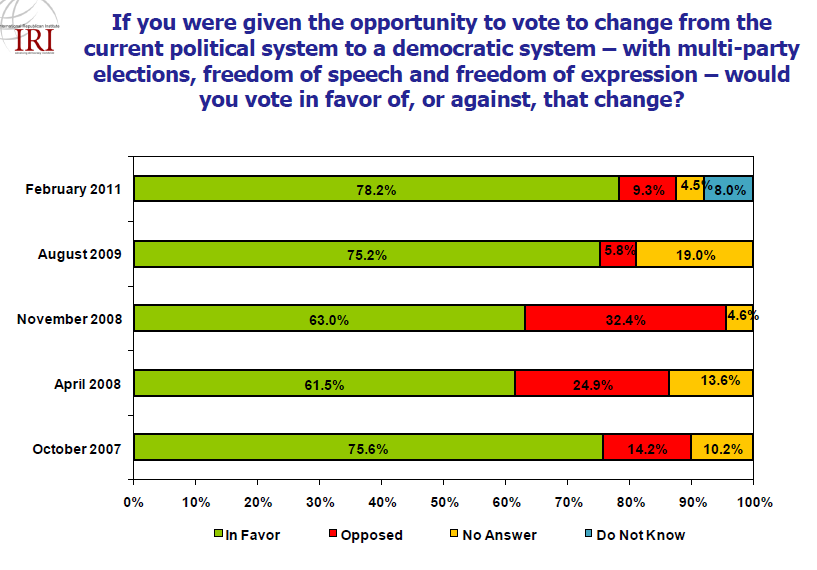
4.      If you were given the opportunity to vote to change from the current political system to a democratic system – with multi-party elections, freedom of speech and freedom of expression – would you vote in favor of, or against, that change? 78.2% were in favor.

5.      Do you regularly use a cellular phone?  25.3% said yes, up from 10% in 2007.

Presumably the Government of Cuba conducts similar studies but with differently worded questions that produce results somewhat more congenial to the status quo.

But the results of the IRI surveys certainly must be of deep concern to the Government and the Party.

Posted in Blog | Tagged , , , , , , | Leave a comment

Cuba’s Standings in Social, Political, Economic and Environmental Indices in Comparative International Perspective

By Arch Ritter

In the last week of January 2011, the Heritage Foundation (HF), a conservative US “Think Tank”. published its 2011 Report on Economic Freedom. No surprise: Cuba ranks #175 of the 177 countries included in that report, ahead only of North Korea and Zimbabwe.

The concept or definition used for “Economic Freedom” is:

“Economic freedom is the fundamental right of every human to control his or her own labor and property. In an economically free society, individuals are free to work, produce, consume, and invest in any way they please, with that freedom both protected by the state and unconstrained by the state. In economically free societies, governments allow labor, capital and goods to move freely, and refrain from coercion or constraint of liberty beyond the extent necessary to protect and maintain liberty itself.”

The components of economic freedom in the Heritage Foundation’s definition include business freedom, trade freedom; fiscal freedom, government spending, monetary freedom, investment freedom, financial freedom, property rights, freedom from corruption, and labor freedom.

What the HF definition misses is the capability to utilize one’s freedom, such as good health, a useful education, and a reasonable income. Presumably the HF types of freedom are more effective when people live longer, have good health so that they can work and appreciate life, and are not mired in poverty. Cuba would score better if life expectancy, health, education and income distributional measures were included in the concept and the index.

Other Measures of Human Achievement or Performance

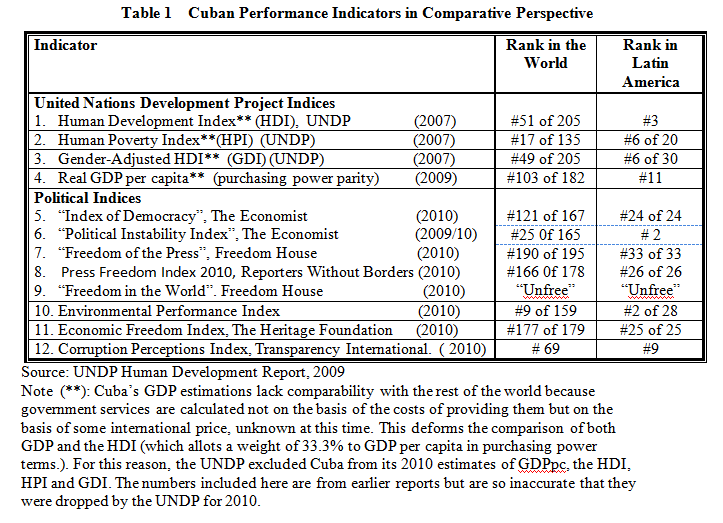
The HF’s Economic Freedom Index brought to mind some other measures of social, economic, environmental and political performance. A listing of these and Cuba’s place therein is presented in Table 1 and hyperlinks to some basic definitions and methodological sources are summarized in the next section.

Again, it is no surprise that Cuba fares badly on the political and economic freedom rankings, coming at the very bottom in Latin America on the “democracy” and “freedom of the press” rankings.

Cuba’s high ranking for the EIU Political Instability Index – second only to Costa Rica- is unexpected. Cuba would have scored well on “ethnic fragmentation”, labor unrest (no strikes, collective bargaining or independent unions), economic growth in 2009, income inequality (as officially measured), unemployment (at least the official rate) and “status of minorities”.

Cuba’s standing in the “corruption perceptions” listing does not seem unreasonable.

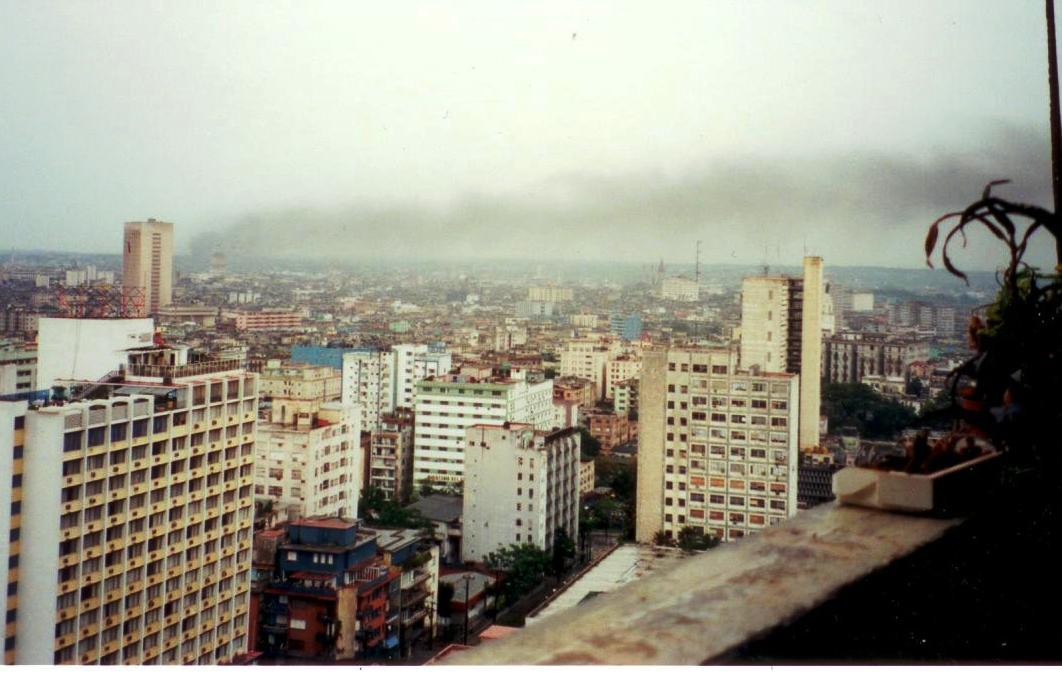
Cuba’s high standing in the Environmental Performance rankings – again second only to Costa Rica-  will be a surprise to those who have spent time inhaling the exhaust of urban traffic in Havana or observing the fumes of the Havana’s thermal electric plant, pictured below.  Indeed, a close study of the Yale-Columbia-World Economic Forum calculations for Cuba would be worthwhile. One suspects some statistical creativity such as has been employed in the area of basic economic measures such as GDP, unemployment and the Consumer price Index.

Data Sources and Methodology

The full sources of the information are hyperlinked below. The methodologies can also be found at these web sites.

UNDP Measures

1, 2, 3, and 4: Human Development Index 2009, HDR 2009 Statistical Tables

Democracy Measures

5.      The Economist Intelligence Unit’s Index of Democracy 2010,  This index is based on electoral process and pluralism; civil liberties; the functioning of government; political participation; and political culture.

6.      The Economist Intelligence Unit’s “Political Instability Index”. This measure is based on   I. Underlying vulnerability: 1.Inequality Measured by Gini coefficient; 2.State history; 3.Corruption; 4.Ethnic fragmentation; 5.Trust in institutions; 6. Status of minorities; 7.History of political instability; 8.Proclivity to labor unrest; 9.Level of social provision; 10.A country’s neighborhood; 11.Regime type; 12.Regime type and factionalism and II. Economic distress: 1.Growth in incomes Growth in real GDP per head in 2009; 2.Unemployment; 3.Level of income per head

7.      Freedom House, Freedom of the Press index an annual survey of media independence in 195 countries and territories. “The index asesses the degree of print, broadcast, and internet freedom in every country in the world, provides numerical rankings and rates each country’s media as “Free,” “Partly Free,” or “Not Free.””  Freedom House, Freedom of the Press, 2010

8. Press Freedom Index 2010, Reporters Without Borders

9. Freedom House, Freedom in the World, 2010, Tables and Graphs measures freedom according to political rights and civil liberties.

(See also Wikipedia’s list of freedom indices.)

10. The 2010 ENVIRONMENTAL PERFORMANCE INDEX, of the Yale Center for Environmental Law & Policy, Yale University and Center for International Earth Science Information Network, Columbia University and the World Economic Forum. This measure includes some 25 indicators in 10 categories including Environmental Health. Air Pollution (effects on humans), Water (effects on humans), Air Pollution (effects on ecosystems), Water (effects on ecosystems), Biodiversity and Habitat, Forestry, Fisheries, Agriculture and Climate Change

11. “Index of Economic Freedom” The Heritage Foundation. (See discussion above.)

12. Transparency International. Corruption Perceptions Index Report, 2010

Havana Thermal-Electric Plant, from Edificio Fochsa, Hotel Capri on the left, 1997, Photo by Arch Ritter

Posted in Blog, Featured | Tagged , , , , , , | Leave a comment

Ana Julia Faya: Nosotros tampoco viajamos libremente a Cuba

Los permisos de entrada y salida del país son una violación de los derechos de los cubanos.

Published originally on January 26, 2011 in  Diario de Cuba

Jose marti International Airport, Photo by A. Ritter, 1966

Primero fue en la Declaración del Ministerio de Relaciones Exteriores en respuesta a las medidas de Obama sobre los viajes a Cuba. Después fue la subdirectora de América del Norte de la cancillería cubana, Johana Tablada, en entrevista publicada en Cubadebate. Y más recientemente Fidel Castro en una de sus Reflexiones, o quizás Castro primero y Johana después. Para el caso, no importa. Repiten el mismo desaguisado: que los estadounidenses son los únicos ciudadanos de este mundo que no pueden viajar libremente a Cuba. Craso error.

Los ciudadanos cubanos que vivimos fuera del territorio nacional tampoco viajamos libremente a nuestro propio país, no solo desde Estados Unidos, sino desde Canadá, España, o cualquier otro de los cientos que ocupan el globo terráqueo. Y no es por voluntad del “imperio”, sino por las restricciones impuestas en Cuba por cubanos sobre viajes de cubanos, medidas que ya suman tantas décadas que si no somos especialistas en la materia no sabemos cuándo fue que empezaron, en qué período de la historia antigua de los Castro se decidió cerrarnos las puertas para salir y para entrar.

En la cancillería cubana se sabe muy bien que los cubanos que residimos en segundos países y no le pagamos al MINREX por un Permiso de Residencia en el Exterior, si queremos visitar a nuestra familia en Cuba debemos solicitar antes a las autoridades de la embajada cubana correspondiente que se nos “habilite” el pasaporte cubano. Porque para viajar a Cuba no se nos admite el del país donde tenemos segunda ciudadanía. Y en ese pasaporte se nos estampará un cuño que nos abrirá las puertas del Aeropuerto Internacional José Martí, si los funcionarios encargados de esa gestión no se oponen y no nos incluyen en un largo listado que el defenestrado ministro de Exteriores Felipe Pérez Roque denominara de “personas repugnantes”, y que hasta el momento no tenemos noticia de que Bruno Parrilla haya desechado.

Que Fidel Castro asegure que solo los estadounidenses no viajan libremente a Cuba, bueno, él predijo una guerra nuclear por los días del campeonato mundial de fútbol, el año pasado, y ahora, en medio de su senilidad, se regocija con la bondad de los delfines mientras sobre el modelo cubano dice lo mismo y lo contrario. Pero que el tema de los viajes se especifique en una Nota Oficial del MINREX y que una inteligente funcionaria lo asegure también, da que pensar. Porque si seguimos al pie de la letra lo declarado últimamente por el régimen, en esta nueva era inaugurada por el general Castro con Lineamientos, Congreso y sesiones en la Asamblea Nacional, rigen los llamados a que los funcionarios cambien la “mentalidad”, se enfatiza en la necesidad de eliminar “prohibiciones obsoletas justificadas en el pasado”, y sobre todo se exige actuar con disciplina. Quizás los funcionarios del MINREX se han salido del modelo de conducta exigido por el liderato del régimen y no han cambiado su mentalidad, quizás se debe a que en Cuba hay tantas cosas obsoletas que se confunden al dirigir los tiros, o quizás es ahora el general Castro el que dice lo mismo y lo contrario.

La abolición de los permisos de entrada y salida fue pedida en muchas de las asambleas celebradas en el país convocadas por Raúl Castro de 2007 a 2008, dizque para conocer qué pensaban los cubanos de la isla. “El permiso de salida y de entrada, eso debería abolirse completamente (…) se hizo con otro destino, por otras razones, y ha sobrevivido durante demasiados años en Cuba, y yo no creo que tenga razón de ser”, dijo Silvio Rodríguez entonces. Fueron tantas las declaraciones públicas en ese sentido de conocidos seguidores del régimen, y tantos los rumores de que “ahora sí”, que incluso el corresponsal de El País en La Habana aseguró haber visto el documento donde se levantaban las prohibiciones sobre viajes y que su presentación era cuestión de días. Pero, seguimos esperando.

Ahora pudiera ser un buen reclamo de los delegados al VI Congreso del Partido Comunista, aunque tengan que ser indisciplinados y salirse de la agenda prevista solo para los Lineamientos económicos. En definitivas, ¿no es el Congreso “el órgano supremo del partido y decide sobre todas las cuestiones más importante de la política”? Si es así, la discusión en abril no debiera circunscribirse a las reformas sobre los cuentapropistas, o la compra y venta de casas, sino ampliarse hacia otras cuestiones importantes reclamadas por la población desde hace rato, como los permisos de entrada y salida.

Soy de las que piensa que Obama debiera levantar todas las restricciones de viaje en su país, para que no sean violados los derechos de sus ciudadanos. Los permisos de entrada y salida en Cuba debieran levantarse por lo mismo. No en reciprocidad por las decisiones de Obama, sino por elemental respeto, para que no se sigan violando los derechos de los cubanos.

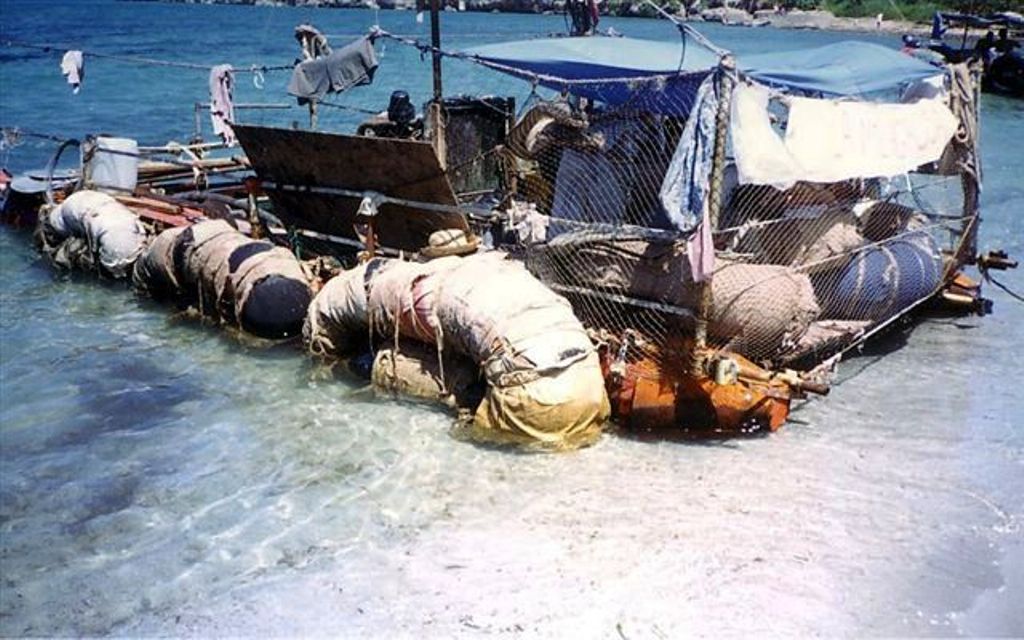
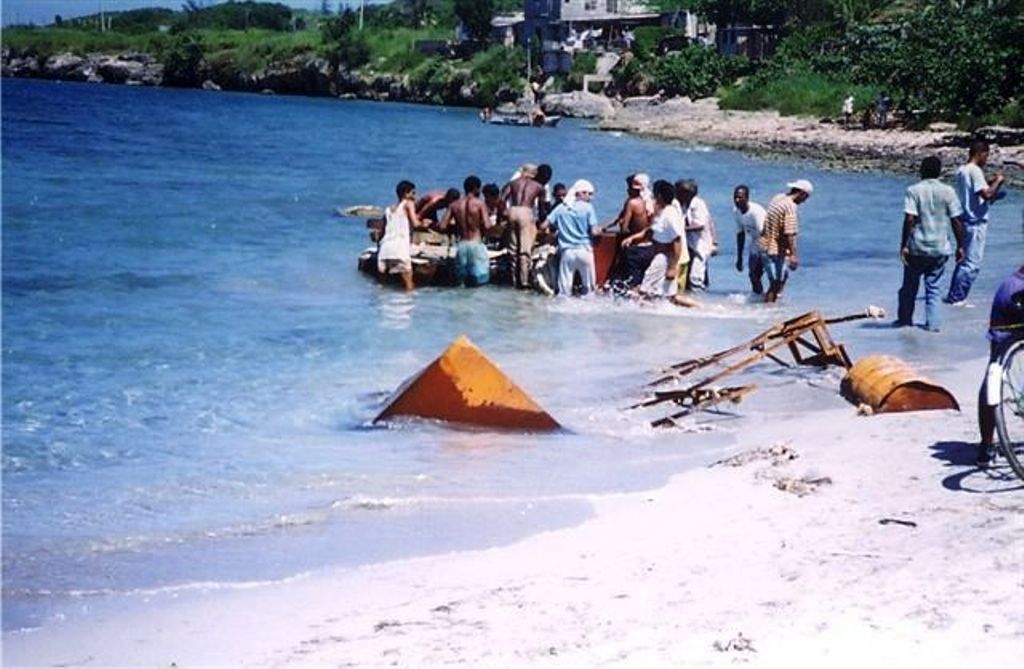
Playas del Este, Summer 1994 Preparing to Leave

Posted in Blog | Tagged , , , , , | Leave a comment

Fidel’s Phenomenal Economic Fiascoes: the Top Ten

Fidel Castro recently clarified an allegedly erroneous quotation and stated something to the effect that “Yes the Cuban Model does indeed work”. It would have been difficult for Fidel to do a “Mea Culpa” and agree that half a century of his own management of the Cuban economy had been erroneous and counter-productive.

However, as the grand economic “strategizer” as well as the micro-manager of many issues that captured his attention President Fidel Castro was responsible for a long list of economic blunders. Here is my listing of Fidel’s most serious fiascoes.

Next week I will try and produce a listing of Cuba’s Greatest Achievements under President Castro. Unfortunately I find this more difficult than to identify the failures.

Top Ten Economic Fiascoes

Fiasco # 10     The Instant Industrialization Strategy, 1961-1963:

Fiasco #9        The 10 Million Ton Sugar Harvest Strategy, 1964-1970

Fiasco #8        The “New Man”

Fiasco #7        The “Budgetary System of Finance”

Fiasco #6        The “Revolutionary Offensive” and the Nationalization of Almost Everything

Fiasco #5        Revolucion Energetica

Fiasco #4 Shutting Down Half the Sugar Sector

Fiasvco #3 A Half Century of Monetary Controls and Non-Convertibility

Fiasco #2        Suppression of Workers’ Rights

Fiasco #1        Abolition of Freedom of Expression


Fiasco # 10     The Instant Industrialization Strategy, 1961-1963:

Cuba’s first development strategy, installed by the Castro Government in 1961, called for “Instant Industrialization”, the rapid installation of a wide range of import-substituting industries, such as metallurgy, heavy engineering and machinery, chemical products, transport equipment and even automobile assembly.

The program proved unviable as it was import-intensive, requiring imported machinery and equipment, raw materials, intermediate goods, managerial personnel, and repair and maintenance equipment. Because the sugar sector was ignored, the harvest fell from 6.7 million tons in 1961 to 3.8 in 1963 generating a balance of payments crisis. The end result was that Cuba became more dependent than ever on sugar exports, on imported inputs of many kinds and on a new hegemonic partner, the Soviet Union.

The strategy was aborted in 1964.

Fiasco #9        The 10 Million Ton Sugar Harvest Strategy

The failure of the “Instant Industrialization” strategy led to an emphasis on sugar production for export with a guaranteed Socialist Bloc market for 5 million tons per year at a price well above the world price – from 1965 to 1970. The over-riding preoccupation became the 10 million ton goal, which according to President Castro was necessary for “defending the honor, the prestige, the safety and self-confidence of the country” (February 9, 1970.)
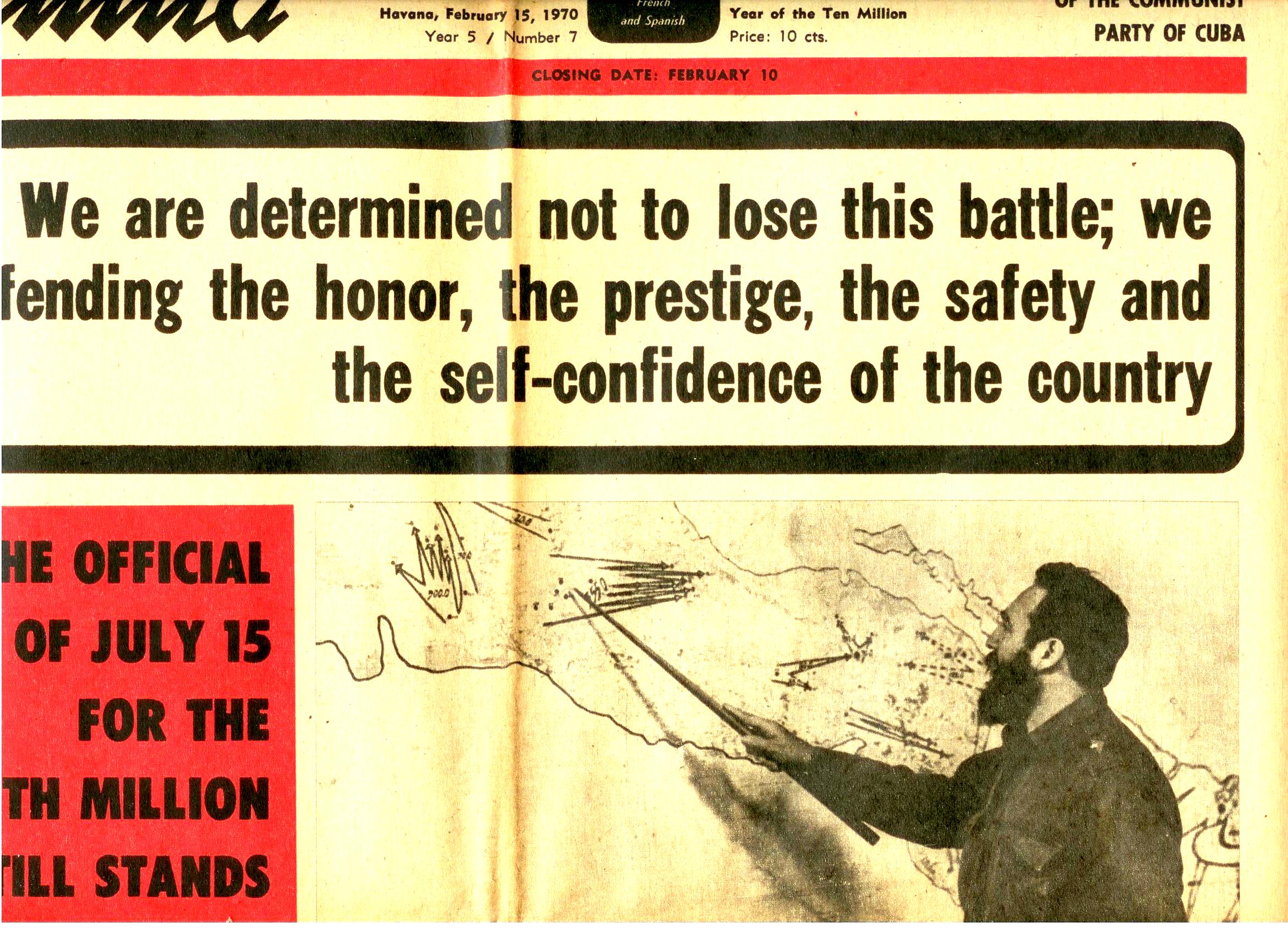
Fidel seemed happiest when conducting a campaign military style as he did during the effort to produce 10 million tons of sugar.

If it had been implemented in a measured way, a strategy to increase export earnings from sugar would have been reasonable. However, as 1970 approached, the implementation of the 10 million ton target became increasingly forced. Other sectors of the economy were sacrificed as labor, transport capacity, industrial inputs, energy, raw materials and national attention all focused on sugar.

This strategy was aborted in 1970.

Fiasco #8        The “New Man”

In order to mobilize human energies for the 10 million ton harvest a radical “Guevaraist” approach was adopted involving the construction of the so- called  “New Man.” The idea behind this was a vision of the Cuban Nation as a guerrilla column marching behind Fidel – somewhat like his marches down the Malecon in 2000-2006 – single-mindedly pursuing a common objective, willingly sacrificing individual interests for the common good and with the esprit de corps, discipline and dedication of an idealized guerrilla band. To promote this revolutionary altruism, the government used public exhortation and political education, “moral incentives” instead of material incentives and proselytizing and enforcement by the Party and other “mass organs” of society.

By 1970, it was apparent that people could not be expected to sacrifice their own and their family’s material well-being and survival for some objective decreed and enforced by the Party. The approach was dropped in 1970.

Fiasco #7        The “Budgetary System of Finance”

In a simultaneous experiment, a so-called “budgetary system of finance” was installed under which enterprises were to operate without financial autonomy and without accounting, neither receiving the revenues from sales of their output nor paying for their inputs with such revenues – somewhat like University Departments.

Without a rational structure of prices, and without knowledge of their true costs or the value of their output, neither enterprises nor the planning authorities could have an idea of the genuine efficiencies of enterprises, of sectors of the economy, or of resource-use anywhere. The result of this was disastrous inefficiency.  In President Castro’s words:

“..What is this bottomless pit that swallows up this country’s human resources, the country’s wealth, the material goods that we need so badly? It’s nothing but inefficiency, non-productivity and low productivity.” (Castro, December 7, 1970)

This system was also terminated in 1970.

Fiasco #6        The “Revolutionary Offensive” and the Nationalization of Almost Everything

In the “Revolutionary Offensive” of 1968, Fidel Castro’s government expropriated most of the remaining small enterprise sector on the grounds that it was capitalistic, exploitative, and deformed people’s characters, making them individualistic instead of altruistic “New Men”. The result was true living standards were impaired, product quality, quantity and diversity deteriorated, enterprises were pushed into the underground economy,  theft from state sector and illegalities become the norm and citizen’s entrepreneurship was suppressed. This policy was changed in 1993, then contained by tight regulation, licensing and taxation after 1985,.

Again in September 2010, the government of Raul Castro appears ready to expand the small enterprise sector in hopes that it will absorb most of the 500,000 workers to be laid off from the state sector.

Fiasco #5        “Revolucion Energetica”

President Castro’s “Revolucion Energetica” included some valuable elements such as conservation measures, re-investment in the power grid and the installation of back-up generators for important facilities such as health centres. A questionable feature of the plan is the replacement of large-scale thermal-electric plants with numerous small generators dispersed around the island. But the use of the small-scale generators likely constitutes a major error for the following reasons:

  • The economies of large scale electricity generation are lost;
  • Synchronizing the supply of electricity generated from numerous locations to meet the minute-by-minute changes in electricity demand is complicated and costly;
  • Problems and costs of maintaining the numerous dispersed generators are  high;
  • Logistical control and management costs escalate as the national grid is replaced with regional systems.
  • Expensive diesel fuel is used rather than lower cost heavy oil:
  • Diesel fuel has to be transported by truck to the generators around the island;
  • Investments for the storage of diesel fuel in numerous supply depots are necessary;
  • Problems of pilferage of diesel fuel may be significant, and costs of security and protection may be high.

No other country in the world has adopted this method of generating electricity, suggesting that it does not make sense economically.

The energy master-plan also ignores a possible role of the sugar sector in producing ethanol and contributing to energy supplies. The experience of Brazil indicates that at higher petroleum prices, ethanol from sugar cane becomes economically viable. The shut-down of some 70 out of Cuba’s 156 sugar mills in 2003, the moth-balling of another 40 and the contraction of the whole sugar agro-industrial service cluster is also a major loss for electricity generation.

Fiasco #4        Shutting Down Half of the Sugar Sector

In 2002, Castro decided that there was no future in sugar production, a decision prompted by low sugar prices at the time and undoubtedly the continuing difficulties in the sector. He decreed the shut-down of 71 of 156 sugar mills, taking some 33% of areas under sugar cane out of production and displacing about 100,000 workers. It was hoped that land-use would shift to non-sugar crops, that remaining mills would become more productive, and that displaced labour would be reabsorbed elsewhere.

In any case, sugar production has continued to decline which is unfortunate given high prices in recent years. There has not been a shift into ethanol production. The physical plant has continued to deteriorate. The cluster of activities surrounding sugar must be near collapse.  The sugar communities are left without an economic base and some face the prospect of becoming ghost towns.

Fiasco #3        A Half Century of Monetary Controls and Non-Convertibility

Responsibility for Fiasco #3 is shared in part with Che Guevara, who as President of the Banco Nacianal de Cuba, presided over imposition of monetary controls and implementation of the policies that made Cuba’s peso non-convertible for half a century.
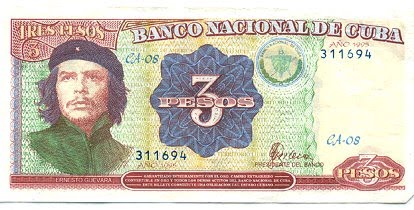
Cuba’s monetary system has been and is a serious obstacle to the freedom of Cuban citizens. Citizens’ incomes have had purchasing power outside the country only when permitted to be exchanged for a foreign convertible currency and then only at a discount for some decades. As is well known, the official exchange rate for Cuban citizens has been in the area of  22 pesos (Moneda Nacional) to US $1.00, so that the purchasing power of the average monthly salary – 415 pesos in 2008 (Oficina Nacional de Estadisticas, 2009, Table 7.4) is about US$20.00.

Fiasco #2        Suppression of Workers’ Rights

Thanks to the regime implanted by President Castro, Cuban workers do not have the right to undertake independent collective bargaining or to strike. Unions are not independent organizations representing worker interests but are official government unions. Independent unions and any attempts to establish them are illegal.

Cuba has signed the Universal Declaration of Human Rights and is a member of the International Labor Organization.  The basic United Nations Declarations support freedom of association for labor. The International Labor Organization’s Declaration on Fundamental Principles and Rights at Work includes, as the first fundamental right of labor, “freedom of association and the effective recognition of the right to collective bargaining”

The central function of independent labor unions is to provide countervailing power to oligopolistic or monopolistic employers in wage determination and in the setting of the terms and conditions of work. Unions have been successful in western countries in raising wages, improving the equity of income distribution and improving work conditions.

In the Cuban case, workers have confronted a monopolistic employer – the state – that also controls their unions which are in effect “company unions.” By controlling the unions and containing their wage demands, wages have been held down. The absence of independent unions has permitted the government to implement counterproductive economic policies year after year and has muted the urgency of undertaking economic reforms.

Fiasco #1        Abolition of Freedom of Expression

An important requirement for the sustained effectiveness of an economic system is the ability to freely, openly and continuously analyze and criticize its functioning.  Open analysis and criticism in a context of free generation and diffusion of information provide a necessary spur for self-correction, exposing illegalities, flawed policies and errors.  Free analysis and criticism is vital in order to bring illicit actions to light, to correct errors on the part of all institutions and enterprises as well as policy makers and to help generate improved policy design and implementation. This in turn requires freedom of expression and freedom of association, embedded in an independent press, publications systems and media, independent universities and research institutes, and freely-functioning opposition political parties.

Unfortunately this has been lacking, thanks to the Castro regime.  The media and the politicians have largely performed a cheerleader role, unless issues have been opened up for discussion by the President and the Party.

The near-absence of checks and balances on the policy-making machinery of the state also contributes to obscuring over-riding real priorities and to prolonging and amplifying error.  The National Assembly is dominated by the Communist Party, meets for very short periods of time – four to six days a year – and has a large work load, so that it is unable to serve as a mechanism for undertaking serious analysis and debate of economic or other matters. The cost for Cuba of this situation over the years has been enormous.  It is unfortunate that Cuba lacks the concept and reality of a “Loyal Opposition” within –the electoral system and in civil society.  These are vital for economic efficiency, not to mention, of course, for authentic participatory democracy.

NOTE: For additional articles on various aspects of Fidel Castro’s presidency, see:

Fidel Castro: The Cowardice of Autocracy

Cuba’s Achievements under the Presidency of Fidel Castro: The Top Ten

Fidel’s No-Good Very Bad Day

The “FIDEL” Models Never Worked; Soviet and Venezuelan Subsidization Did
Posted in Blog, Featured | Tagged , , , , , , , , , , , , | 1 Comment

An Analysis of Cuban Democracy and the Potential Roles of Diplomats in its Promotion, from the “DIPLOMAT’S HANDBOOK” for Democracy Development Support


The “Diplomat’s Handbook for Democracy Development Support” project of the “Community of Democracies” has just released a study of democracy and democratization in China. It also includes an older Case Study on Cuba that I had never seen and that may be of broad interest.

The Web site of the Diplomat’s Handbook is  http://www.diplomatshandbook.org/

The complete case study on Cuba can be seen on an Adobe file accessed at the above web site.

Below is the Introduction to the study.

Cuban Exceptionalism

INTRODUCTION

This Handbook presents individual country case studies in order to record the practical activity that diplomats from democratic countries have performed there in support of civil society, democracy development, and human rights. Situations can and often do resemble each other in some recognizable respects, and our aim is to enable diplomats and civil society partners in the field to obtain insights and guidance from actions taken elsewhere, without, however, suggesting that the experiences in one country can simply be transposed directly to another, since the trajectory of each country’s development is singular.
The case of Cuba is extreme, and in many ways unique. Cuban history since the late 19th Century is intertwined in a relationship with one country, the United States. The mutual enmity between the two governments for much of the last 50 years has had a direct impact on conditions inside Cuba. Anything that diplomats of democratic countries can do in support of Cuban democracy development pales in significance to the potential effect of placing US-Cuba relations on a normal basis, possibly for the first time.
The only country in the western hemisphere that does not practice some form of electoral democracy, Cuba’s government remains in principle a Marxist-Leninist throwback and a resolute holdout more than two decades after the abandonment of communism in Europe and adoption of the market economy in China. Expectations that Cuban communism would be merely the last domino to fall failed to recognize a signal difference with Eastern Europe where the regimes were judged to be collaborating with an outside oppressor, the USSR. The Cuban government presents itself as the patriotic defender against an outside threat.
The regime has from the outset been symbiotically identified with its Comandante en jefe who led the revolution that propelled it into power on January 1, 1959. Descriptive labels scholars employ to capture its essence range from “extreme paternalism” (Prof. Carollee Berghdorf, Hampshire College, UK) to “charismatic post-totalitarianism” (Prof. Eusebio Mujal-León, Georgetown University, Washington, DC). Exile adversary US Congressman Lincoln Díaz-Balart, has called it “the Fidel Castro regime,” pure and simple. Although an orderly succession has obviously occurred as Fidel Castro retired from public office in July, 2006 and ostensibly turned power over to Raúl Castro, the question arises whether anything significant has changed. Fidel Castro’s moral influence over the country remains, though he is without direct control of all details as before. Having described himself in 1961 as a “Marxist-Leninist until I die,” he recast himself in post-retirement writings as a “utopian socialist,” adding that “one must be consistent to the end.”
The regime he built over the decades, “is not the German Democratic Republic,” as one diplomat in Havana phrased it, but it is an authoritarian one-party state that has used an Orwellian security apparatus to rein in and quash democratic impulses over five decades, often citing the threat from the US as the rationale. Much of the world acknowledges the ability of Castro’s Cuba to have stared down and survived determined efforts by successive US governments to end the regime, by invasion, attempted assassination, a CIA program of subversion, and a punitive economic embargo.
But increasingly, democrats rebuke the regime for its invocation of these real threats to Cuba’s sovereignty to justify the continued and even tighter suffocation of human and civil rights of Cuban citizens.
60
The case study that follows attempts to identify activities by diplomats and democracies in support of Cubans’ efforts to secure rights at home, including discussion of a more open and democratic system. But the study reports the view that these efforts tend to bounce off a tightly controlled and controlling regime that veers between self-confidence and paranoia, and discounts the pertinence of mutual leverage.
Diplomatic efforts meant to support democracy development are in consequence especially challenged in today’s Cuba. Diplomats have to manage seemingly competing professional obligations of non-interference, official engagement, a long-term developmental perspective, and immediate democratic solidarity.
This challenge, familiar to diplomats and international NGOs working in other authoritarian and repressive states, is made especially vexing in Cuba by an authoritarian government that is fearful of change. But some signs of change are present in Cuba. Coming years will engage democrats in support of efforts by the Cuban people to pursue aspirations for more significant change that is theirs alone to accomplish

Posted in Blog | Tagged , , , , , , , , | 1 Comment

A Citizen’s Perspective: Jorge Gonzalez on the Cuban Economy

From Oliver Blatch,  Guardian Weekly, Series: First person Thursday 31 January 2008
http://www.guardian.co.uk/world/2008/jan/31/cuba

Oliver Blatch published this statement from Jorge Gonzalez describing his and his family’s existence in Cuba and the general attitudes towards low wages, food shortages, the dual economy, and the political paralysis that prevents meaningful change.

Gonzalez is an ex-member of the Foreign Ministry.

I feel like a real revolutionary – someone who desires to see things change for the better. Here in Cuba, nothing ever improves. It only stays the same or gets worse.

Imagine, my daughter is 23 years old and she’s never ever stayed in a hotel. Not one night in her whole life. If she did go, the police would probably think she was a prostitute anyway.

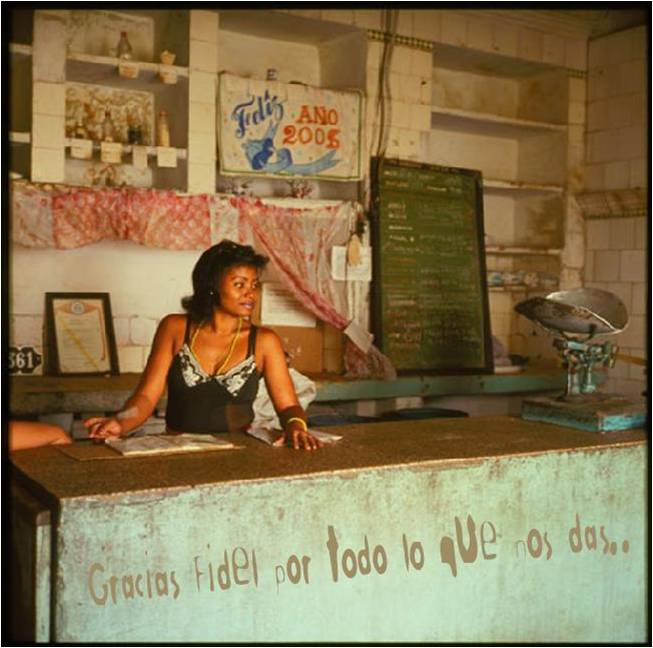
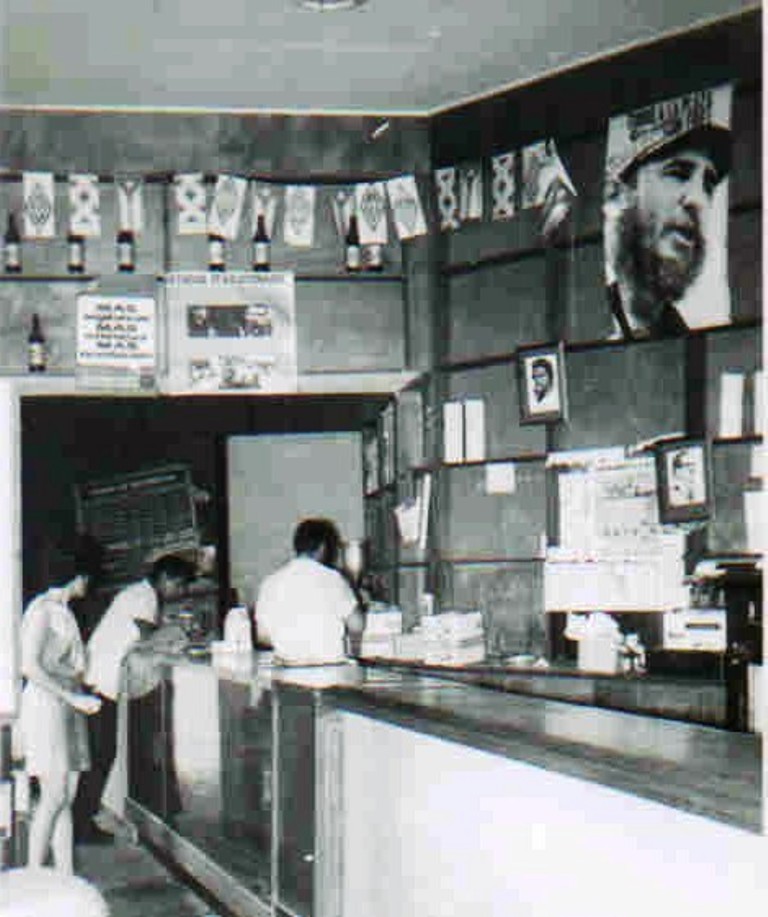
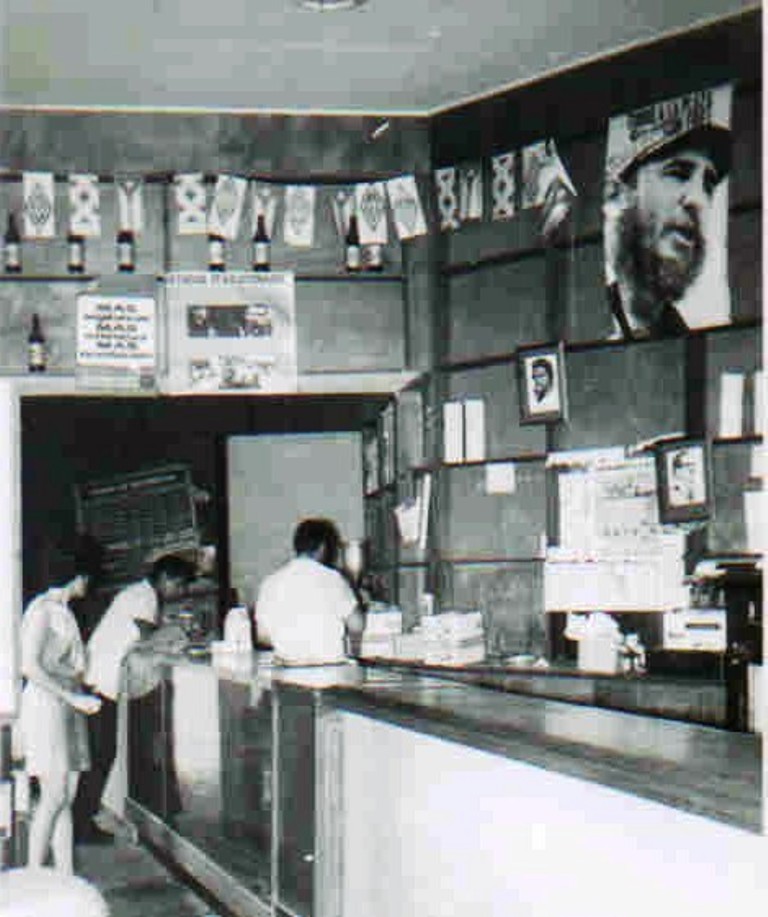
Tienda, La Habana circa 1969, Photo by Arch Ritter

My wife works as a doctor. She was one of the first doctors to go to Venezuela to help Hugo Chávez with his socialist revolution. She earns 400 Cuban national pesos (£7.60) a month. That’s all we receive. She works six days a week, with one night shift included.

A pair of shoes is worth around 30 Cuban convertible pesos (£7.66). So if we need some shoes, how are we supposed to wash or eat or pay for electricity? Sure, we get basic rations every month, but they only last about 10 days.

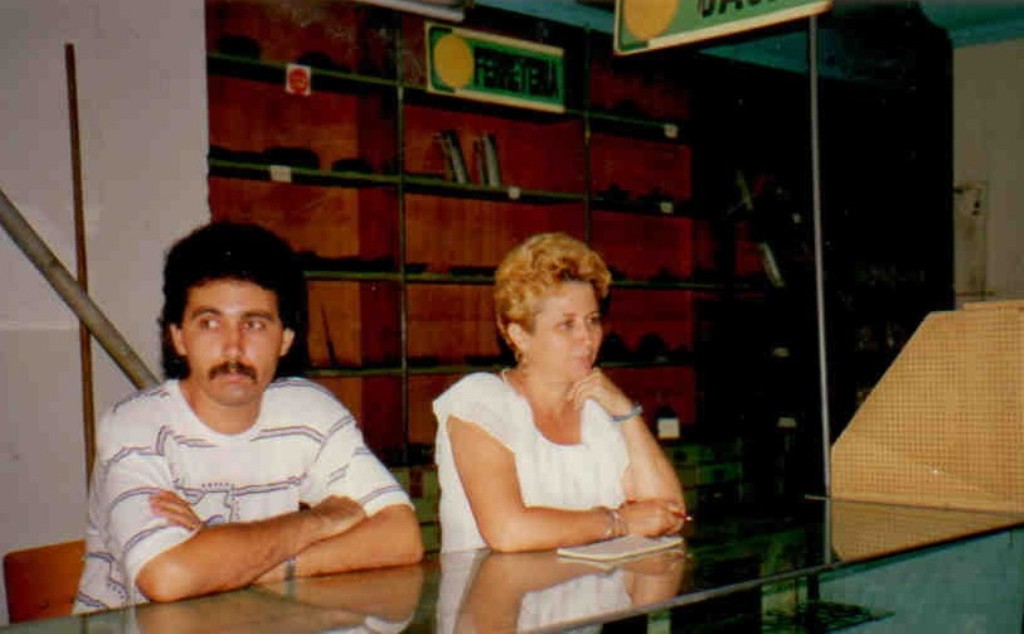
Tienda, circa 2007, Photo by Arch Ritter

At the moment my son is in the United States. He’s a ballet dancer. He escaped there illegally after a tour in Mexico; on the last day, he just disappeared. Now he has a car, laptop, mobile phone and an apartment that he rents.

And here I am, 46 years old, never having owned my own car. Just think about it. I have a beautiful beach less than half an hour away from my house and I haven’t visited it for three years because I can’t afford the transport.

That is why there’s a clandestine economy going on in every household. Everyone is on the make, selling things on the side. I graduated as a lawyer and worked in a variety of government positions, but now I earn my living as an odd-job mechanic. If the inspectors found out, I’d get severely fined.

Read More, directly from  from the Guardian:
http://www.guardian.co.uk/world/2008/jan/31/cuba


“Thank you Fidel for all you have given us”

Posted in Blog | Tagged , , , , , | Leave a comment

Politics and Human Rights

Politics

Raúl Castro, Closing speech at the 1st Cuba-Venezuela Presidential Summit,  Granma International, July 27 2010http://www.granma.cu/ingles/cuba-i/27-julio-we.html

Dalia Acosta entrevista a MARIELA CASTRO ESPÍN, “CUBA: Otro socialismo posible”, Agencia de Noticias, Inter Press Service, 3 de Julio, 2009

Dalia Acosta, “POLÍTICA-CUBA: Video muestra perfil estricto de Raúl Castro”, Agencia de Noticias, Inter Press Service, 29 de Junio, 2009

OFFICIAL NOTE FROM THE COUNCIL OF STATE, Agrees on movement of cadres and reorganization of agencies, Granma Digital, March 2, 2009

Editorial, “El desafío del momento presente”, Revista Espacio Laical N°1-2009, (Febrero 2009. No. 58)

Orlando MÁRQUEZ, “¿La hora del cambio?” Palabra Nueva, No. 182, Febrero de 2009

Freedom House, Special Report, nother “Special Period” in Cuba? How Citizens View Their Country’s Future, March 25, 2009

International Republican Institute, Survey of Cuban Public Opinion March 14 to April 12, 2008, June 5, 2008

Haroldo Dilla, “La elite política y los cambios: La intuición del límite”, Kaos en la Red, Agosto 11 de 2008

Leonel González y Carlos Díaz, “La necesaria contraofensiva de los trabajadores”, Kaos en la Red, Junio 18 de 2008

Manuel Cuesta Morúa, “Cuba: Democracy for a Possible Nation“, WP 30/2008, (Translated from Spanish) Real Instituto Elcano, Madrid,16/9/2008

Pedro Campos y varios compañeros, “Presentación para su discusión pública al pueblo, a los trabajadores y a los revolucionarios cubanos, con miras al VI Congreso del Partido Comunista de Cuba”, Kaos en la Red, 17-8-2008

Eusebio Mujal-León and Lorena Buzón, “EXCEPTIONALISM AND BEYOND: CIVIL-MILITARY RELATIONS IN CUBA, 1986–2008”, Cuba in Transition, ASCE 2009

Jorge Dominguez, “Cuba’s Civil-Military Relations in Comparative Perspective: Looking Ahead to a Democratic Regime,” in Looking Forward: Comparative Perspectives on Cuba’s Transition, ed. Marifeli Pérez-Stable (Notre Dame: University of Notre Press, 2007): 47-71

James Petras and Robin Eastman-Abaya, “Cuba: Continuing Revolution and Contemporary Contradictions, Dissident Voices”, August 13th, 2007

Government of Cuba, Ministry of Foreign Relations, The Cuban political and electoral system, Havana, undated

William M. LeoGrande, “THE CUBAN COMMUNIST PARTY AND ELECTORAL POLITICS: ADAPTATION, SUCCESSION, AND TRANSITION”, Cuban Transition project, INSTITUTE FOR CUBAN AND CUBAN-AMERICAN STUDIES, University of Miami, 2002

Human Rights

Open Letter Condemning Recent Obstructions and Prohibitions of Social and Cultural Initiatives – Observatorio Crítico

Human Rights Watch, New Castro, Same Cuba, Political Prisoners in the Post-Fidel Era, November 18, 2009

Human Rights Watch, World Report 2009, Country Summary: Cuba, January 2009

Reporters Without Borders, 2008 Annual Report, (pp. 45-46. for report on Cuba)

Freedom House, Freedom in the World, 2009, Special Report Section, Freedom on the Net: A Global Assessment of Internet and Digital Media: Cuba, April, 2009

Laura García Freyre, “DE LA IGLESIA A LA PLAZA: LAS DAMAS DE BLANCO Y LA LUCHA POR EL ESPACIO PÚBLICO EN LA HABANA” Cuba in Transition, ASCE 2008

Freedom House, Freedom in the World, Country Report, Cuba, 2008

Tomas Pstross, The Ministry of Foreign Affairs of the Czech Republic, The Concept of Human Rights in Foreign Policy. An analytical and methodological study (with special reference to Cuba, Date: 2004/04

Human Rights Watch, CUBA’S REPRESSIVE MACHINERY: Human Rights Forty Years After the Revolution, June 1999

Posted in Archive of Analyses | Tagged , | Leave a comment

Employment, Labour, Distributional and Equity Issues

James K. Galbraith, Laura Spagnolo and Daniel Munevar, “Pay Inequality in Cuba: the Special Period and After,” ECINEQ WP 2006 – 52, The University of Texas Inequality Project, August 2006

Posted in Archive of Analyses | Tagged , , , | Leave a comment

Freedom of Expression, Economic Self-Correction and Self-Renewal

An important requirement for the sustained effectiveness of an economic system and society is the ability to analyze and criticize – freely, openly and continuously – its functioning.  Open analysis and criticism in a context of free generation and diffusion of information provide a necessary spur for self-correction, exposing illegalities, flawed policies and errors.  Free analysis and criticism are vital in order to bring illicit actions to light, to correct errors on the part of all institutions and enterprises as well as policy makers and to help generate improved policy design and implementation. This in turn requires freedom of expression and freedom of association, embedded in an independent press, publications systems and media, independent universities and research institutes, and freely-functioning opposition political parties.

The absence of free economic criticisms means that major policy errors or indeed fiascos are not “nipped in the bud” and terminated quickly but steam ahead to disaster. Some major examples of this in Cuba have been

  • The 1961-1963 instant industrialization strategy, aborted in 1963
  • The 10 Million Ton Sugar Harvest effort, from 1964 to 1970;
  • The attempt to use the “New Man” ideology as a labour mobilization device, 1966-1970
  • The shut-down of half of Cuba’s sugar agro-industrial complex (2002)
  • The billion dollar mini-generator component of the “Revolucin Energtica (2006)

Pluralistic democratic countries have free presses and open debate on the issues of the day.  Opposition political parties, academics, interest groups and NGOs, and journalists continuously analyze and critique public policy issues and proposals and the functioning of private and public enterprises and institutions.  Indeed, there is major competition among economic and business journalists as well as academics to be the most perspicacious analysts and critics of public policy.

Unfortunately much of this has been lacking in Cuba.  The media largely performs a cheerleader role, unless issues have been opened up for discussion by the President and the Party.  For example, there was virtually no public discussion or debate concerning the shut-down of half of the sugar sector in 2002, the attacks on self-employment, the dysfunctional parts of the “Revolución Energética” or of the imprisoning of the critics  – or so-called “dissidents” –in  2003.This means that public policies get announced and implemented full-blown without critical input into their formulation, and without subsequent criticism and early correction.

Are the restrictions on freedom of expression becoming more or less severe in recent years? Some indications suggest that there is some relaxation of such restrictions, notably:

  • On June 16 to 20, the Catholic church was able to organize the Semana Social Católica including a Panel on “Economy and Society” with Pavel Vidal Alejandro, Omar Everleny Perez, Carmelo Mesa-Lago y Cristina Calvo.
  • The presentation of information on the economy has improved over the last 10 years. The web site of the Oficina Nacional de Estadisticas is now surprisingly good and the Anuario Estadistico Economico is quite comprehensive and appears in a timely way. (However, the methodologies for the measurement of some fundamental economic data such as labor force, employment and unemployment, consumer price index, and national accounts are opaque and ambiguous so that the analyses based on them are not as strong as they could be.)

But on the other hand, there are also some indications of a hardening of the restrictions on freedom of expression.

  • The containment and harassment of the bloggers continues. They have been denied access to the web. They have been harassed and intimidated – unsuccessfully – by actions of state security. They have been vilified as “mercenaries” in the service of foreign powers. They have been denied the right to travel abroad. They are often denied the right to participate in relevant domestic events such as a conference on civil society and the new media! Their web sites and therefore their commentaries are available within Cuba only with difficulty. But they have not been shut down as of mid-2010, though this could change.
  • The expulsion of Esteban Morales, Professor of Economics and Political Science, University of Havana, from the Communist Party also represents a hardening of restrictions on freedom of expression. Morales comments on the character of racism in Cuba, Challenges of the racial problem in Cuba seemed reasonably innocuous. His April 22 essay entitled “Corruption: The True Counter Revolution” was more hard hitting. But being expelled from the Party looks to me like a reward, not a punishment. Of course, this is not correct, because expulsion from the Party usually means exclusion from foreign travel which is vital for academics as a means of buttressing their inadequate Moneda Nacional incomes.

  • Certain areas of the economy appear to continue to be off limits to analysis and scrutiny, notably the bio-technological industry and the conglomerate enterprises that straddle the peso and the convertible peso economies.
  • The political decision-making process on economic and other matters within the highest levels of the Government continues to be a “black box,” the workings of which we can only speculate about.  Cuban Universities need some real Departments of Political Science!

The near-absence of checks and balances on the policy-making machinery of the state also contributes to obscuring over-riding real priorities and to prolonging and amplifying error.  The National Assembly, dominated by the Communist Party, meets for very short periods of time – four to six days a year – and has a large work load, so that it is unable to serve as a mechanism for undertaking serious analysis and debate of economic or other matters. The cost for Cuba of this situation over the years has been enormous.  It is unfortunate that Cuba lacks the concept and reality of a “Loyal Opposition” within the electoral system and in civil society.  These are vital for economic efficiency, not to mention, of course, for authentic participatory democracy.

Posted in Blog, Featured | Tagged , , , , | 1 Comment