Tag Archives: Self-Employment

John P. Rathbone “Lessons for Cuban business”: A Note on Problems of Micro-Ensterprises

“Lessons for Cuban Business” fromBeyondbrics” (Financial Times); January 30, 2012 8:19 am

John Paul Rathbone
President Raúl Castro wants the recent liberalisation of small businesses to bolster Cuba’s sagging economy and absorb the 1m state workers he says will eventually be laid off.

But Cuba’s budding micro-entrepreneurs – over 350,000 had registered as of November 2011 – lack almost everything that start-ups need, from premises and relevant skills to capital. Will they ever really get off the ground?

A bustling restaurant in Havana’s colonial centre – which opened in January 2011, is appropriately called “La Moneda Cubana”, the Cuban coin, and is run by Miguel Ángel, a 37-year old entrepreneur – suggests some answers.

First, the premises. The three-storey restaurant, which once belonged to Ángel’s grandfather, was nationalised in the 1960s. But the family has lived continuously at the premises since then – indeed, ever since 1924. As a result, Ángel was able to set up operations immediately.

And what a location it enjoys: La Moneda Cubana lies just a few steps from the cathedral, has a sweeping view of the Havana bay from its roof terrace, and enjoys a regular stream of tourists. Few are so fortunate. Indeed, the process of leasing state properties remains incipient.

Second, necessary skills. Ángel worked for several years in the state tourist sector, first at the Floridita, where Ernest Hemmingway once drank daiquiris; then in the kitchens of the nearby Hotel Sevilla. “I learnt there everything I needed to run my kitchen,” Ángel told beyondbrics.

However, similar backward linkages are rarer elsewhere. “A good restaurant also needs a manager and an accountant,” he adds. Such skills are hard to come by in Cuba’s Soviet-style economy – hence the business skills training program the Catholic church set up last year.

Third, funds. The usual supposition is that Cubans turn to their émigré relatives for start-up capital. This is entirely legal under Castro’s new rules – indeed, it is tacitly encouraged.

Be that as it may, the cagey habits of under-the-table informality that Cubans developed over decades socialism remain deeply engrained.

Ángel, for example, insists he restored the three-story building “all with my own resources”.

Be that as it may, Ángel says his operation is now self-financing. La Moneda Cubana’s intense footfall suggests this may indeed be so. That is just as well, as the notion of Cuba’s creaking banking system offering credit is entirely novel – although there is government talk it will do so.

Fourth, inputs. Cubans can now buy construction materials directly from the state. As for food, Ángel still buys from the state rather than private farmers. “They can’t ensure a steady and reliable supply,” he says.

That is changing fast, however. According to state media, 71 contracts have been executed between private farmers and state-run hotels – a huge change that will strip out the inefficient state-distribution system.

Cuba’s small business sector is still fragile and Ángel’s success will not be replicated everywhere. Business generally remains very small scale. Most entrepreneurs sell out of their homes, or from makeshift street stalls. Havana is far from becoming a neon-wrapped landscape.

But the popularity of the reforms and Castro’s mantra that they will be implemented “slowly, but without pause” also means they are irreversible. Ahead of the Communist Party’s conference over the weekend, even state newspaper Granma talked of the need “to leave behind prejudices against the non-state sector” and to overcome the “psychological barrier” of “obsolete dogmas”.

One of these is work habits. Ángel, for one, has already turned on its head the old socialist rubric of “everyone pretends to work and the state pretends to pay.” Compared to state wages worth around $20 a month but paid in Cuban pesos, his staff get a percentage of profits in hard currency. “They like that, very much,” he says.

As for his own workday: “I get here early in the morning and usually leave around 3am.” Does he mind? “One has to do what one has to or wants to do – and I do. This is as much an emotional adventure as a financial one,” he says, with a smile.

John Paul Rzthbone

Posted in Blog | Tagged , , | Leave a comment

Liberating Cuba’s Long-Suppressed Resource: Entrepreneurship

By Arch Ritter

In early 1996, I visited the home of a high Cuban official with whom I had become acquainted.  While there, a “colero or  “queuer” arrived after having waited in the queue to purchase the family’s rations of cigars and cigarettes among other things. (A source of income for many people in Cuba was to stand in line and purchase short-supply rationed products for other families.)  Although no members of the family smoked, they happily collected their rationed tobacco products for resale on the black market in order to acquire other necessities. My friend the official was as “revolutionary” as anyone that I have known in Cuba, going so far in the early years of the Revolution as to return the “per diems” that he saved from foreign travel to the government rather than buying such things as shoes for his children. However, by 1996, buying and selling on the black market was natural and comprehensible for him and most other people.

I. From “School for Socialism” to “Nation of Entrepreneurs”

During the thirty years or so in which the exercise of entrepreneurship in a market-oriented setting was largely prohibited, Cuba in fact created a nation of entrepreneurs.  Although the intention was to convert Cuba into a “school for socialism,” the reality is that Cuba has also been a school for market-oriented entrepreneurship.  This is one of the more significant paradoxes of the Cuban Revolution.

The nature of Cuba’s planned economy itself inadvertently promoted widespread entrepreneurial values, attitudes, behavior, and savoir-faire as citizens of necessity have had to buy and sell, hustle and “network” in order to improvise solutions to their personal economic problems.  The most important phenomenon in this process was the rationing system, implemented in 1961. This system was designed to provide everyone with a basic supply of foodstuffs, clothing, and household consumables, in order to achieve a minimum level of equality of consumption and real income.  It provided every individual (or household for some products) with fixed monthly quotas of foodstuffs, cigarettes, or household consumables and with annual quotas for clothing and footwear.  Everyone received the same allocations of products at controlled and generally low prices (in relation to average monthly incomes).  (Children and those with special health problems such as diabetics were treated differently and provided with special food rations.)  Because everyone received essentially the same rations, many people would receive some items that they did not want or which were of lower priority than other items.  In the context of generalized shortage and excess demand which existed with varying intensities since 1962, especially after 1989, everyone had an incentive to sell the rationed items they did not want or to trade them for other products they did want.  For example, non-smokers would purchase their cigarettes and cigars through the rationing system and would then give them to other family members or friends, resell them on unofficial markets, or trade them for other products. Thus, the rationing system converted many people into “mini-capitalists.”

The situation of excess demand and generalized shortage, especially after about 1989 when the subsidization from the Soviet Union ceased, also meant that anyone with privileged access to a product at an official price could resell it at a higher free-market price or in the dollar economy.  There was therefore a strong incentive making a profit from exchanging many types of product between the fixed-price official sources and the unofficial or “black market” determined price.  Related to the above phenomenon was “amiguismo” or “sociolismo” or “partner-ism”, that is, the reciprocal exchange of favors.  While such reciprocity probably occurs in all countries and in many different contexts, it took on some important additional forms in Cuba.  Basically, any person with control over resources could exchange access to those resources for some current or future personal material benefit.   Cultivating friends or associates in this way was vital for assuring oneself and one’s family access to the goods and services necessary for basic material well-being.  Complex networks of reciprocal obligations thus became an important part of the functioning of the economy.  Daily life involved continuing endeavors in maintaining the personal relationships necessary to ensure access to necessary goods and services through the unofficial channels or through the official channels unofficially.

In short, citizens in their everyday material lives had to behave in an entrepreneurial manner.  People had to explore and evaluate new economic opportunities, to acquire the consumer goods they and their families needed, to sell some consumer goods (or in some cases outputs of goods and services), to bear uncertainty, face risk and take ultimate responsibility, and to invest in the maintenance of their supply and market networks, all under hard and unforgiving budget constraints.

A second area where entrepreneurial action was necessary was the central planning system itself. In a perfectly functioning planning system, enterprise managers would have little to do besides obeying and implementing orders.  But because the planning system could not and cannot work perfectly especially in the face of continuing disruptions and uncertainty, enterprise managers had to take initiatives in resolving unforeseen problems. Frequently, solutions to such problems were to be found outside the normal channels of the planning system and required improvised responses by the enterprise managers. This often involved enterprise managers obtaining the required inputs through negotiations with other enterprises, with superior officials, or with superiors or inferiors in other sectors or Ministries.  In these negotiation processes, political argumentation, political or Party “amiguismo” or “sociolismo” (i.e. the exchange of favors within the Party for political and material benefit) as well as economic criteria were central, and economic management was therefore highly political. Managers throughout the Cuban economy had to invest large amounts of time and energy in resolving such input-supply problems. Indeed, their performance depended upon their entrepreneurial success in operating “outside the plan.”

While entrepreneurial talents have been developed broadly among the population, their exercise until 1993 was for the most part restricted to the important but low-level everyday tasks of sustenance and survival, often carried out in the underground economy or in “black markets.”  But when the space available for entrepreneurial activity was increased with the liberalization of microenterprise beginning in September 1993, the expansion and diversification of micro-entrepreneurial activity was impressive.

II. Liberating Cuban Entrepreneurship

The advantageous consequences of further policy liberalization towards micro-enterprise have been illustrated dramatically by the arts and crafts market and by the Barrio Chino. The production of arts and crafts, largely for the tourist market, expanded immensely and the quality and diversity of the products has improved greatly after 1993. It is now a major source of foreign exchange for Cuba, though statistics on this do not seem to exist. Similarly, the quasi-private restaurants in the Barrio Chino that enjoyed a cultural exemption from the 12 chair size-limitation emerged some time ago as dynamic, large, diverse and efficient restaurants – perhaps the best in Havana. They are a living example of what many sectors of the Cuban economy could become with further relaxation of restrictions and a reasonable  tax regime were implemented.

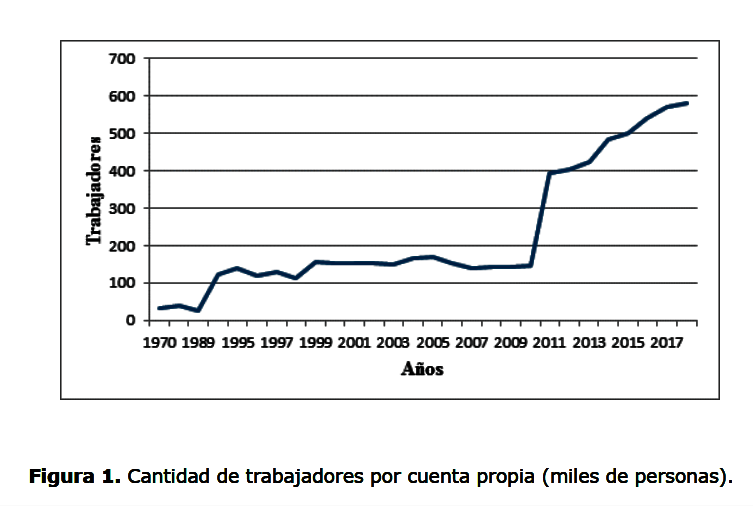
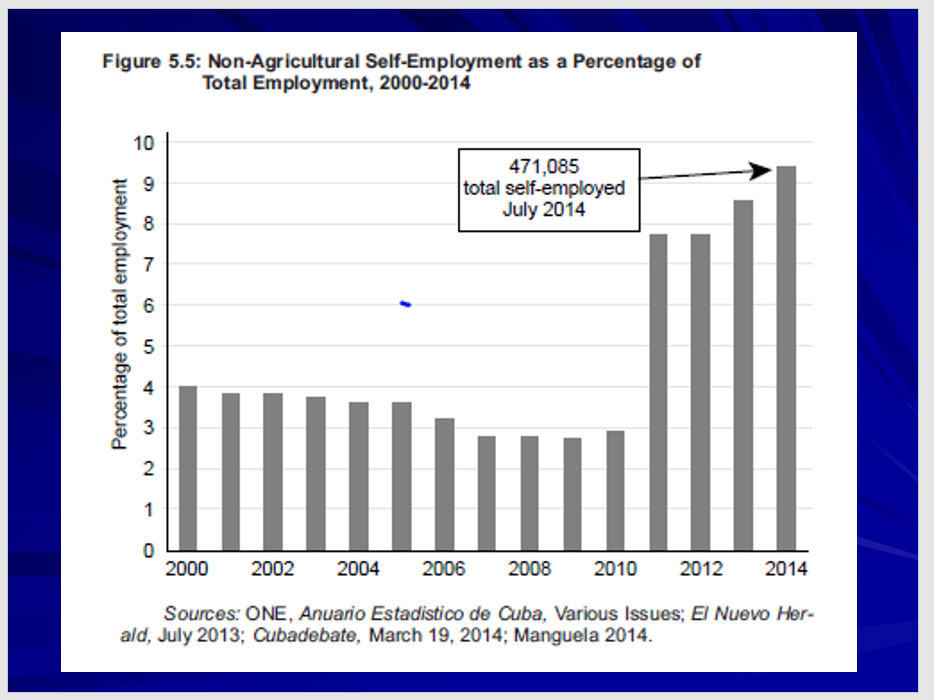
The liberalization of licensing and the other policy changes that were introduced in 2010 and 2011 have already born fruit. (The policy reforms are outlined here Raul Castro and Policy towards Self-Employment and here: State Sector Lay-offs then Private Sector Job Creation.) The numbers of micro-enterprises have increased significantly even if the initial objective of 500,000 new jobs in the sector by March 31 2011was not achieved. This is illustrated in the accompanying chart.

Source: Republica de Cuba, Oficina Nacional de Estadisticas (ONE), Anuario Estadistico de Cuba, various issues

While the task of modifying the policy framework for the micro-enterprise sector is incomplete, major improvements have been instituted so far and more are in the process of implementation. In the summary presented in Table 1, it can be seen that advances have been made in a number of areas, notably licensing and “de-stigmatizing”. Progress has been made or promised in other areas. In still other areas, some reforms have been introduced but further action is desirable. And in a few areas there has been no action yet.

It is worth noting again the benefits that a deeper liberalization of policy towards small enterprise would generate. These would include:

  • More productive employment would be created, a vital objective if redundant state workers are to be reabsorbed into the economy.
  • An increase in small enterprise would increase competition, lower prices, improve quality and broaden diversity of the goods and services produced.
  • Incomes would be generated.
  • The average levels of incomes in the small enterprise sector would tend to be driven to the average national level if it were opened up with free entry for anyone wanting to establish a micro-enterprise.
  • Citizens would gain when reduced effort and time was necessary to obtain the goods and services necessary for survival.
  • Improved productivity of small enterprises would permit higher material well-being throughout Cuban society.
  • The massive underground economy would shrink.
  • Tax revenues from the sector would increase as it expanded.
  • Foreign exchange earnings and savings would occur as domestic products replaced imported products and as markets for tourists and for export expanded.
  • Innovation and improvement would be promoted.
  • Urban and rural commercial revival would occur.
  • The general quality of life would be improved.
  • The culture of compliance and respect for public policy rather than regulation avoidance and illegality would in time take effect.

Most important, further liberalization of the small enterprise sector would harness the ingenuity, creativity, industriousness and enthusiasm of a substantial proportion of the Cuban people to more productive economic activities.

Would such an apertura worsen income distribution? In the early stages, as some small enterprises increased in size, this would perhaps occur. But Cuba already has an income tax and an effective administrative system for taxing small enterprise so that this effect could be managed. Opening self-employment and small enterprise to all possible entrants would also increase competition in the sector and push prices and thence incomes towards average levels.

Barrio Chino, November 2008, Photo by Arch Ritter


Posted in Blog, Featured | Tagged , , , , , | 1 Comment

Toronto Globeand Mail, “Small acts of free enterprise attest to reform looming large in Cuba”

Small acts of free enterprise attest to reform looming large in Cuba

By SONIA VERMA
Globe and Mail, Toronto, October 18, 2011

Regime can no longer afford to finance socialist ideals upon which it was founded

Original Article Here: Small acts of free enterprise….

Just off the Malecon, Havana’s famous seaside corniche, Omar Gatierrez strikes a deal to sell his ’56 Oldsmobile for the rough equivalent of $14,500. It’s the most money he’s ever made.

At a burger joint not far from there, Alfredo Garcia, an economist, shells out twice as much as he normally would for a strawberry milkshake just because it tastes good. Around the corner, Lazaro Rafael, a mechanic, haggles over the price of repairing an infirm Peugeot on the street near the sea where he lives.

Nerci, Cuenta Propista and Artisan, Habana Vieja, Photo by Arch Ritter, November 2008

These small acts of free enterprise would have been inconceivable in Fidel Castro’s Cuba. Under his younger brother, Raul, however, they add up to dramatic economic reform that is quietly reconfiguring the country into something altogether different. Cuban authorities are careful to depict this restructuring as upgrading the revolution rather than forsaking it, yet underpinning it all is an overriding sense of urgency to change.

Floated by fickle Chinese credit and Venezuelan oil, the regime can no longer afford to finance the socialist ideals upon which it was founded. With Cuba at a crossroads, the future remains unclear. One path appears to lead to nowhere, should the regime prove too brittle to allow private enterprise to truly flourish. The alternative route, others worry, would morph the island into something resembling a Floridian mega-mall.

Both outcomes would be disastrous. Most analysts believe the country’s true destiny lies in becoming a mixed economy where the state loosens its grip over some sectors but maintains leverage over others. The aim, Cuban sources said, is to have 35 per cent of the economy privatized by 2015. Achieving this elusive balance, however, will prove exceedingly difficult. The reforms that have been rolled out so far – such as allowing cars to be sold and licensing small businesses – have been relatively painless, eclipsing more agonizing ones that lie ahead.

For Cubans, many of whom have virtually no memory of life before the revolution, the reforms are confusing and their consequences unknown. The regime has vowed to implement a progressive tax structure to avoid a Russian-like result where vast amounts of wealth is concentrated in the hands of the few. But a schism of class – however minor – would symbolically violate Mr. Castro’s symbolic contract with his people.

Over the next five years, for instance, the regime intends to lay off up to a million public-sector workers, equalling 10 per cent of its work force. Food rations, for which many Cubans rely on for their daily sustenance, are also due to be phased out. Betting on an increase in productivity, the government has promised to boost wages, but economists doubt it will be enough to keep pace with a rising cost of living, as goods are removed from the ration card.

“These larger state-led reforms are going to be wrenching,” said Christopher Sabatini, editor-in-chief of Americas Quarterly. One of the biggest obstacles to real change in Cuba, he argues, is the awkward paradox the regime finds itself in: Downgrading its leverage in order to save itself from ruin.

“There’s an inherent tension in any economic reform that involves the Cuban state reducing its own authority over the economy, which is [Fidel] Castro’s real legacy,” Mr. Sabatini explained.

Another problem is that while Cuban authorities seem to have a clear idea of the main focus of the restructuring – reducing the state payroll, nourishing the private sector, boosting food production – the government is vague on its timeline for implementing the changes and even more so on how it plans to deal with any fallout. The haphazard transition means that whenever one of the 311 new decrees issued by the Communist Party at its April Congress becomes law, few people on the street in Havana seem to notice or understand why they should care.

Josefina Vidal, director of the North America Department for Cuba’s Ministry of Foreign Affairs, said the protracted rollout is deliberate: “It’s a slow process because we are very much interested in avoiding any kind of social impact. We don’t want anybody to be abandoned or left behind,” she said in a recent interview with The Globe And Mail. Some measures, she acknowledged, were easier to implement than others.

When it comes to defining Cuba’s end goal, officials are equally open-ended, maintaining the state is not trying to emulate other countries – such as China or Vietnam – but rather aiming to pursue an entirely unique set of reforms. Observers, however, disagree.

“They want this to be a made-in-Cuba type of economic system. But if it is made in Cuba it certainly resembles the Chinese approach, and it’s moving more and more in that direction,” said Arch Ritter, an economist at Carleton University who specializes in Cuba.

As he points out, Cuba’s economy is nowhere near China’s in terms of scale or scope. Also, China’s ruling Communist Party is less ossified than Cuba’s, which is still dominated by octogenarians. The recent death Cuba’s minister of defence, Julio Casas Regueiro, at the age of 75, highlighted the frailty of the state’s older generation of leaders who are still firmly in charge.

Without political renewal, analysts say Cuba’s economic reforms are doomed. “They are trying to let the economic genie out of the bottle while keeping the political genie in. That’s not going to work,” predicted Arturo Lopez-Levy, a former political analyst in the Cuban Interior Ministry and a lecturer at the University of Denver.

Meanwhile it remains unclear how Cuban society, much less the regime, will deal with social changes that will inevitably follow the economic ones. How will the state prevent Cuba’s new generation of entrepreneurs from accumulating the kind of wealth that could give rise to a new upper class? How will it ensure all Cubans have access to capital, not just the ones with relatives in Europe or Miami? How will it provide incentives for productivity and initiative if it plans to heavily tax the rewards of that?

“Don’t be fooled,” Mr. Sabatini says. “They want to preserve the system in many ways … at least the perks of the system.”

As sweeping as Cuba’s current economic reforms are, key enterprises such as mining, oil and sugar production will remain in the hands of the state. Cuba’s health system and its lucrative tourist industry will also remain unchanged, at least for now. The rebranding of the revolution, Mr. Sabatini argues, is still very much a work in progress.

“What was Castroism anyways? It was really about survival. Cuba’s future will boil down to whatever it needs for political and economic survival, rather than any principled commitment to the revolution,” he said.

Posted in Blog | Tagged , , , | Leave a comment

“The Economist” on Taxes in Cuba: Get used to it

The Castros’ subjects get acquainted with that other sure thing

Sep 17th 2011 | HAVANA | from the print edition

Half your monies are belong to us

WHEN Raúl Castro, Cuba’s president, announced last year that the government would cut its payroll by up to 20% and promote self-employment, state media hailed the birth of a “tax culture”. As most Cubans had never paid income tax, the Communist newspaper published a guide to the concept. Government economists predicted a 400% increase in tax revenue from individuals.

The experiment has been bumpy. Last October Cuba published a tax code for workers in its 181 newly authorised occupations, ranging from furniture repairer to professional clown. As in the early 1990s, the last time Cuba tried economic liberalisation and taxation, the rates were punitive: 10% on turnover, 25% for social security and up to 50% on income. Such levies discouraged some people from risking self-employment. By May applications for job licences were tailing off.

Moreover, Mr Castro failed to beef up the National Tax Administration Office (ONAT), which was soon overwhelmed by filings. That has delayed revenue collection, and allowed both intentional and inadvertent tax cheats to go unpunished. “They seem even more confused about this than we are,” says Ernesto, an engineer who obtained a licence to set up a plumbing business in March. He admits that he simply guesses how much he has earned each month and declares a tenth as much.

But Mr Castro seems more flexible than his brother and predecessor Fidel, who blamed the self-employed for sowing inequality and happily taxed private firms out of existence. Eager to find jobs for up to 1m public workers he plans to fire, he has carved out exemptions from the social-security tax and twice increased the scope for deductions. He has also ordered ONAT to retrain its staff and hire new inspectors. “There certainly is an element of making up the rules as they go along,” says one European diplomat based in Havana. “But Raúl seems totally determined to make this work.”

Further reforms are on the way. By the end of 2011, Cubans will be allowed to buy and sell homes and cars. It remains to be seen how long they will accept taxation without representation. “They happily take our taxes,” says Michel, a barber who recently founded a business. “But they still keep their secrets.”

Posted in Blog | Tagged , , , , | Leave a comment

Centro de Estudios sobre la Economía Cubana, “Seminario Anual sobre la Economía Cubana” 21-24 de junio de 2011

 The Centro de Estudios sobre la Economia Cubana has just completed and publicized its 2011 Annual Report on the Cuban economy. Here are hyperlinks to the main economics articles. A number of essays focussing on enterprise management have not been included here.

Juan Triana Cordoví, “Cuba 2010-2011, del crecimiento posible al desarrollo necessario

Jorge Mario Sánchez Egozcue, “La Relación Crecimiento Económico y Sector Externo, una evaluación de la dinámica

Pavel Vidal Alejandro y Omar Everleny Pérez Villanueva, “Relanzamiento del cuentapropismo en medio del ajuste estructural1
 
Ileana Díaz Fernández y Ricardo Torres Pérez, “Los encadenamientos productivos, un análisis para Cuba


Posted in Blog | Tagged , , , , , , , | Leave a comment

Cheney Wells: “The Role of Remittances in Cuba’s Non-State Sector Expansion”

How recent changes in remittance policy by the US and Cuba may facilitate small-scale investment to support Cuba’s growing non-state sector

Attached is an interesting MA Thesis by Chaney Wells on remittances and their posible use for microenterprise in Cuba:
Abstract:
This study adds to the existing literature on the potential use of remittances for credit in a financially underdeveloped economy, focusing on Cuba, a country for which little is known about the relationship between remittances and investment. In the past, economic and legal conditions in Cuba, in addition to US and Cuban policies on financial transfers have resulted in a large majority of remittances to Cuba being used for basic consumption. The Cuban government’s changing stance on the non-state sector, as well as recent shifts in both US and Cuban policies on remittances have important  implications for remittance use in Cuba. This paper assesses the factors affecting remittance use, and makes the case that as a result of the concurrent shifts in US and Cuban remittance policy along with Cuba’s non-state sector expansion initiative, a more significant portion of remittances will be used for productive investment purposes, filling the void left by the underdeveloped financial sector.
Posted in Blog | Tagged , , , | Leave a comment

Espacio Laical, “The Sixth Party Congress and “Lineamientos”: A Turning Point for Cuba?”

Just Published on Espacio Laical, Suplemento Digital No.132 / 16 de Junio 2011
Tomado de la sección Búsqueda (revista 3-2011) Hyperlink here:

The Sixth Congress of the Cuba’s Communist Party will likely be of immense importance for Cuba’s future. The ratification of the revised Lineamientos de la Política Económica y Social del Partido y la Revolución “by the National Assembly means that it is now politically correct to support, advocate and implement an ambitious reform agenda.  By implication, it also is politically correct to draw the conclusion that a half century of economic experimentation with the lives of Cuban citizens was for the most part misguided, counterproductive, and unsustainable.  Despite attempts to create an impression of historical continuity by referring to the “updating” of the economic model, the old approaches to economic management have been deeply discredited. The shifting climate of opinion regarding how the Cuban economy can best function has been certified as reasonable by the National Assembly.  It now appears that a regression to old modes of economic operation is now highly improbable..

The economic future for Cuba clearly lies in a newly-rebalanced albeit vaguely-envisaged mixed market economy that will be the outcome of the various reforms that are slated to be implemented.  This is a surprising reversal of fortunes. It also constitutes a vindication of the some of the views of the critics of past economic policies.

The “Lineamientos” represent an attempt by President Raul Castro to forge his own “legacy” and to emerge from the long shadow of his brother, as well as to set the Cuban economy on a new course. The ratification of the reform agenda represents a successful launch of the “legacy” project.  President Raul Castro would indeed make a unique and valuable contribution to Cuba and its citizens were he to move Cuba definitively through dialogue and agreement among all Cubans towards a model that guarantees both economic and social rights as well as civil liberties and authentic democracy.

Are moves in these directions likely to happen? Not under current political circumstances. However, there are bottom-up pressures building and some official suggestions that movement towards political liberalization is not impossible. In the meantime, Raul’s de-centralizing, de-bureaucratizing and “market-liberalizing” reforms been launched. This is a good start for the construction of a positive independent “legacy.”

I. Cuba’s Economic Situation

In various speeches since 2006, Raul Castro has indicated that he recognizes the problems that Cuba confronts in terms of the production of agricultural and industrial goods and improvement of Cuba’s infrastructure (despite the ostensibly solid GDP performance from 2005 to 2009 before Cuba was hit by the international recession.) He is well aware of the central causal forces underlying weak Cuba’s economic vulnerabilities and weaknesses such as the unbalanced structure of the economy, the overburden of deadening rules and regulations and a sclerotic bureaucracy and the monetary and exchange rate pathologies and dysfunctional incentive environment that deform the energies and lives of Cuban citizens.

Cuba’s economic plight can be summarized quickly with a couple of illustrations. First, Cuba’s underwent  serious de-industrialization after 1989 from which it has not recovered, reaching only about 51% of the 1989 level by 2009 (Chart 1)

Source: ONE AEC, 2004, Table 11.1 and 2IX.1

Note: Data for 1990-1997 are not available

There are a variety of reasons for the collapse of the industrial sctor:

(a)    The antiquated technological inheritance from the Soviet era as of 1989;

(b)   Insufficient maintenance over a number of decades before and after 1989;

(c)    The 1989-1993economic melt-down;

(d)   Insufficient levels of investment; (The overall level of investment in Cuba in 2008 was 10.5% of GDP compared to 20.6% for all of Latin America  according to UN ECLA, 2011, Table A-4.)

(e)    The dual monetary and exchange rate system that penalizes potential exporters that would receive one old (Moneda Nacional) peso for each US dollar earned from exports;

(f)    Competition in Cuba’s domestic market with China which has had a grossly undervalued exchange rate, coexisting with Cuba’s grossly overvalued exchange rate.

Second, the collapse of the sugar agro-industrial complex is well known and is illustrated in Chart 2. The sugar sector essentially was a “cash cow” milked to death for its foreign exchange earnings, by insufficient maintenance, by insufficient re-investment preventing productivity improvement, and by the exchange rate regime under which it labored.
Source: NU CEPAL, 2000 Cuadro A.86; ONE, 2010 Table 11.4

The consequences of the collapse of the sugar sector include the loss of about US$ 3.5 billion in foreign exchange earnings foregone (generated largely with domestic value added); reductions in co-produced electricity; a large increase in idled farm land; a destruction of the capacity to produce ethanol; damaging regional and local development impacts, and a destruction of much of the “cluster” of input-providing, output-processing and marketing activities related to sugar.

Third, the production of food for domestic consumption has been weak since 1989, despite some successes in urban agriculture.  Food imports have increased steadily and in recent years account for an estimated 75 to 80% of domestic food consumption despite large amounts of unused farm land. Meanwhile agricultural exports have languished,


Chart 3  Cuban Exports and Imports of Foodstuffs, 1989-2009
(excluding Tobacco and Alcoholic Beverages) (Millions CUP)

Source: NU CEPAL, 2000 Tables A.36 and A.37, and ONE, AEC, Various Years.

Fourthly, “inflation-adjusted “ or “real” wages in the official economy collapsed and have not recovered significantly according to estimates from the Centro de Estudios sobre la Economia Cubana (Chart 4.)  This is indeed a major calamity for the official state economy. But though the official 2008 wage rate remained around 25% of its level of 1989, most people had other sources of income, such as remittances, legal self-employment, home produced goods and services, economic activities in the underground economy, income supplements in joint ventures, goods in kind from the state and widespread pilferage.  Those without other sources of income are in poverty.

Chart 4   Cuba: Real Inflation-Adjusted Wages, 1989-2009
(
Pesos, Moneda Nacional)

Vidal  Alejandro, Pavel, “Politica Monetaria y Doble Moneda”, in Omar Everleny Perez et. al., Miradas a la Economia Cubana, La Habana: Editorial Caminos, 2009

Furthermore, despite the exceedingly low official rates of unemployment – around 1.6 to 1.7%, (far below the “natural rate” of unemployment which represents normal new entrants, job-changers and structural changes in any economy) – underemployment is obviously very high. Presumably the 1.8 million workers considered by the Government to be redundant and subject to probable lay-off and transfer to small enterprise, are “underemployed”, accounting for around 35 per cent of the labor force.

A further dimension of the fragility of Cuba’s economic situation is the dependence on the special relationship with Venezuela that relies upon high oil prices and the presence and munificence of President Chavez.

It is to the credit of President Raul Castro that he has faced these problems directly, diagnosed their sources, and produced the “Lineamientos” to deal with them. The central sources of the difficulties are the general structure of incentives that orients the economic activities of Cuban citizens, this including the dual monetary and exchange rate system, the tight containment of individual economic initiatives, the detailed rules and regulations of the omnipresent bureaucracy. Paradoxically, in attempting to control everything in the past, the government has ended up controlling very little. The effectiveness of stricter state controls actually leads to weaker genuine control due to their promotion of illegalities, corruption and the ubiquitous violation of unrealistic regulations.

II. The Lineamientos

The objective of the “Lineamientos” is “to guarantee the continuity and irreversibility of Socialism” as well as economic development (p.10). This is to be achieved through an “up-dating” of the economic model that should result in utilization of idle lands, reversal of decapitalization of infrastructure and industry, a restructuring of employment, increased labor productivity, increased and diversified exports, decentralized decision-making and elimination of monetary and exchange rate dualism (p. 8.)

But the term “Socialism” remains somewhat ambiguous in the document.  Reference is made to “socialist property” and “preserving the conquests of the Revolution.”  Especially interesting is the statement that

“…socialism signifies equality of rights and equality of opportunities for all the citizens, not egalitarianism” (p.9)

This assertion could be of game-changing significance, as it articulates a fundamental principle of “Social Democracy” more so that a traditional principle of  “Socialism.”  This leaves questions unanswered and doors unclosed.

The “Lineamientos” are in effect an ambitions and comprehensive “wish-list” or statement of aspirations. Many of the 313 recommendations are fairly obvious, trite and general statements of reasonable economic management. Some statements have been made repeatedly over a number of decades, including those relating to the expansion and diversification of exports, science and technology policy, the sugar agro-industrial complex, or the development of by-products and derivatives from the sugar industry (an objective at least since 1950.) Restating many of these as guidelines can’t do much harm, but certainly does not guarantee their implementation.

There are also opaque elements among the guidelines and seeming contradictions as some of them stress continuity of state planning and control while others emphasize greater autonomy for enterprises.  For example, Guideline 7 emphasizes how “planning” will include non-state forms of enterprise and “new methods…. of state control of the economy” while No. 62 states “The centralized character …of the degree of planning of the prices of products and services, which the state has an interest in regulating will be maintained.” But numerous other guidelines spell out the greater powers that state and non-state enterprises will have over a wide range of their activities including pricing (Guidelines 8 to 22 and 63.)

While there are a few gaps and shortcomings in the “Lineamientos” as well as the references to planning and state control, they include some deep-cutting proposals on various aspects of economic organization and policy that represent the inauguration of a movement towards a “market-friendly” economic policy environment. Among these are:

  • Greater autonomy of the enterprise in numerous dimensions, hiring and firing, wage structures, financing, price setting, investing, and also in facing bankruptcy;
  • A phase-out of rationing and the ration book and the more careful targeting of social assistance to those who need it, thereby also strengthening incentives to work (No. 162);
  • The establishment of wholesale markets for inputs for all types of enterprise. (No. 9);
  • Continuing distribution of unused state lands to small farmers (No. 187);
  • Reduction of state controls regarding small farmers and cooperatives regarding producer decision-making, marketing of crops, provision of inputs, and (No. 178-184)

A central policy thrust is the expansion of the self-employment and cooperative sector in order to absorb ultimately some 1,800.000 state workers considered redundant. The legislation already implemented in October 2010 liberalized policy somewhat so as to encourage the establishment of additional microenterprises – especially by the liberalization of licensing, the establishment of wholesale markets for inputs and the recent relaxation of hiring restrictions. However, the limitations of the policy changes are highlighted by the modest increase in the number of “Paladar” chairs – from 12 to 20.

Unfortunately current restrictions will prevent the expected expansion of the sector. These include the heavy taxation that can exceed 100% of net earnings (after costs are deducted from revenues)  for enterprises with high costs of production; the prohibition of the use of intermediaries and advertising, and continued petty restrictions. Perhaps most serious restriction is that all types of enterprises that are not specifically permitted are prohibited including virtually all professional activities.  The 176 permitted activities, some defined very narrowly, contrast with the  “Yellow Pages” of the telephone directory for Ottawa (half the size of Havana) that includes 883 varieties of activities, with 192 varieties for “Business Services”, 176 for “Home and Garden, 64 for “Automotive”  and 29 for “Computer and Internet Services.” Presumably policies towards micro-and small enterprise will be further liberalized in the months ahead if laid-off workers are to be absorbed productively.

One short-coming of the “Lineamientos” is the lack a time dimension and a depiction of how the various changes will be implemented. There are no clear priorities among the innumerable guidelines, no sequences of actions, and no apparent coordination of the guidelines from the standpoint of their implementation. It remains a “check-list” of good intentions, though none-the-less valuable.

The absence of a vision of how change was to occur and the slow pace of the adoption of the reforms so far is also worrisome. However, the Administration of Raul Castro has been deliberative and systematic though also cautious. It is probable that somewhere in the government of Raul Castro there is a continually evolving time-line and master-plan for the implementation of the reform measures.

A careful and well-researched approach to economic reform is obviously desirable. The difficulties encountered in laying off 500,000 state sector workers and re-absorbing them in the small-enterprise sector by March 31, 2011 has probably encouraged an even more cautious  “go-slow” approach.  Perhaps “slow and steady wins the race!”

A process of economic —but not political— reform seems to have already begun following the Congress. Where it will lead is hard to predict. Presumably Raúl Castro’s regime would like the process to end with the political status quo plus a healthy economy. The latter would require a new balance between public and private sectors, with a controlled movement toward the market mechanism in price determination and the shaping of economic structures, and with the construction of a rational configuration of incentives shaping citizens’ daily economic actions so that their private endeavors become compatible with Cuba’s broader economic well-being.

In such a reform process many things would be changing simultaneously with symbiotic impacts and consequences that will likely be painful and are difficult to foresee. Will President Raul Castro have the courage to take the risks inherent in an ambitious process of economic change? This remains to be seen. But the economic and political consequences of inaction are so bleak and the attractiveness of a positive historical “legacy” are so enticing that President Raul Castro will continue.

The economic reform process has been launched. It is in its early stages. It will likely continue under the leadership of Raul Castro. It will proceed far beyond the “Lineamientos” under new generations of Cuban citizens in economic as well as political spheres.

Bibliography

Naciones Unidas, CEPAL, La Economia Cubana: Reformas estructurales y desempeňo en los noventa, Santiago, Chile, 2000, Second Edition.

Oficina Nacional de Estadisticas (ONE), Anuario Estadistico de Cuba (AEC), various years. Website: http://www.one.cu/

Partido Comunista de Cuba,  Lineamientos de la Política Económica y Social del Partido y la Revolución, Aprobado el 18 de abril de 2011, VI Congreso del PCC

United nations, Economic Commission for Latin America and the Caribbean, Preliminary Overview of the Economies of Latin America and the Caribbean, 2010, Santiago, Chile January, 2011

Vidal Alejandro, Pavel, “Politica Monetaria y Doble Moneda”, in Omar Everleny Perez et. al., Miradas a la Economia Cubana, La Habana: Editorial Caminos, 2009

Posted in Blog | Tagged , , , , , , , , , | 2 Comments

A Further Step in the Liberalization of the Regulatory and Tax Environment for Small Enterprise Has Raul Now Got the “Horse before the Cart”?

By Arch Ritter

On Friday May 27, 2011, Granma, the official Cuban Newspaper announced a number of additional measures that would reduce the restrictions on micro and small enterprise, notably the “paladars” or small restaurants. (Continuar facilitando el trabajo por cuenta propia http://www.granma.cu/espanol/cuba/27mayo-continua.html)

The objective of the policy changes is to facilitate the expansion of employment in the small enterprise, creating new jobs to absorb workers to be declared redundant in the state sector.

The Government seems to now have the “horse before the cart: rather than the “cart befor the horse” in that job creation is being promoted first, with presumably the lay-offs coming afterwards, or perhaps through a normal process of letting those state sector work centers in personal service areas shut down, if they continuously make losses and have to be subsidized by the state.

There are a number of interesting measures:

1.      The most conspicuous measure is to permit the paladares or small restaurants to expand their capacity from 20 to 50 chairs – up from 12 before October.

2.      Loss-making state enterprises, notably state restaurants, may be offered for rental to self-employed individuals and operated as “cuenta-propistas”

3.      The hiring of up to 5 workers has been extended to all self-employment activities.

4.      The “minimum employment requirement” whereby for purposes of paying a tax on each employee a minimum number of employees were required, has been dropped.

5.      An exemption on paying the tax on each employee has been granted for the rest of 2011.

6.      Some additional new activities have been designated for self-employment;

7.      The payment of monthly taxes has been waived for taxi and bed and breakfast operators for up to three months while they repair their vehicles or rental facilities.

8.      The monthly up-front payment for bed-and breakfast operators has been reduced for the rest of 2011 from 200 to 150 pesos or convertible pesos (depending on whether they rented to Cubans in Moneda Nacional or foreigners in Convertible Pesos.

A Great New Paladar, with a Lucky Location on the Callejon del Chorro, Plaza de la Catedral

These changes are all reasonable. The government states that it is “learning from experience” (“rectificar en el camino”.) Pragmatism seems to be the growing vogue in economic management and that can only be positive.

Anothe Great Paladar, 23 y Calle G (Avenida de los Presidentes)

Cuenta Propista

Posted in Blog, Featured | Tagged , , , | Leave a comment

Cuba Study Group: “Supporting Small Business in Cuba: Recommendations for Private and Public Sector Leaders”

The Cuba Study Group today released a “white paper” in collaboration with Americas Society/Council of the Americas and the Center for Financial Inclusion at ACCION International entitled: Cuba Study Group, Supporting Small Business in Cuba. Here is the Executive Summary:

EXECUTIVE SUMMARY

In January 2011, the Cuba Study Group and the Center for Financial Inclusion at ACCION International sponsored a Cuba Small Business Summit in collaboration with Americas Society and Council of the Americas in New York. The summit brought together experts in the fields of microfinance, business education and economic development to identify ways to support entrepreneurship and self-employment in Cuba.

The goal of the summit, and this paper, is to identify specific steps that private-sector leaders, foundations, nongovernmental organizations (NGOs) and the governments of Cuba and the United States can take to improve conditions for micro and small businesses. One product of the summit was a set of recommendations for public- and private-sector leaders and foundations. This white paper, which will be updated to reflect developments at the Cuban Communist Party’s Sixth Party Congress in April 2011, covers the following topics:

• The future role that small businesses and those who are self-employed can play in Cuba’s economy.
• Lessons from other countries that have undertaken reforms to promote small business.
• Short- and medium-term initiatives for individuals and NGOs to support and nurture entrepreneurship and selfemployment.
• Steps the U.S. government can take to ensure its own policies
do not hinder small business development in Cuba.

The Cuban government has begun implementing reforms to allow greater private economic activity to reduce government expenditures, increase productivity and raise wages. If fully enacted, these reforms will constitute the most far-reaching economic remodeling in Cuba in half a century. Despite these steps, numerous obstacles could inhibit the creation of a friendly
environment for small businesses: lack of access to capital, dysfunctional wholesale markets, regulatory issues, insufficient business training, anemic domestic demand and U.S. sanctions against Cuba.

China, Vietnam, Bolivia, and Singapore’s past experiences offer important lessons to the Cuban government. For small businesses to flourish, the Cuban government will likely need o simplify the business creation process, reduce tax burdens on entrepreneurs, revamp its regulatory frameworks and liberalize prices, similar to what occurred in China and Vietnam. The Cuban government should also adopt consistent pro-entrepreneur policies; take steps
to guard against unexpected inflation; and promote access to foreign capital and technical know-how through multinational financial institutions, NGOs, development banks and other international partners. An orderly, market oriented economic
reform process is decidedly in the best interests of Cuba, the United States and the region.

Short- and medium-term initiatives for individuals and NGOs could include business training and market research programs to provide experience-based learning and business mentorships, partnerships with Cuban universities to facilitate training workshops, and the development of online entrepreneur communities and other  Web-based resources. In the medium to long term, remittances can be leveraged to support entrepreneurs through online giving  portals modeled after well-known examples like www.Kiva.org. Family lending programs could also boost remittances and enable Cubans living abroad to sign promissory notes for loans and then
remit the money to their relatives in Cuba. The establishment of micro-lending funds for Cuba could also help emerging entrepreneurs get access to capital and dramatically assist in the
development of small and microenterprises.

As the Cuban government begins to reform its economy to allow greater private economic activity and self-employment, the U.S. government must evaluate the impact of its economic sanctions on small business development in Cuba. The United States should seize the opportunity to support micro and small enterprises on the island and should take additional measures to loosen rules in this area. The Obama Administration has recently taken positive steps by creating new licenses for remittances and travel. Nevertheless, the U.S. government can do more. An orderly, market-oriented economic reform process is decidedly in the best interests of Cuba, the United States and the region.

Posted in Blog | Tagged , , , | 2 Comments

Cuba’s Economic Reform Process under President Raul Castro: Challenges, Strategic Actions and Prospective Performance

The Bildner Center at City University of New York Graduate Center organized a conference entitled “Cuba Futures: Past and Present” from March 31 to April 2. The very rich and interdisciplinary program can be found here: Cuba Futures Conference, Program.

I had the honor of making a presentation in the Opening Plenary Panel.  The Power Point presentation is available at “Cuba’s Economic Reform Process under President Raul Castro.”

Posted in Blog, Featured | Tagged , , , , , , , , , , , , , , , , , | 1 Comment